Wu Sheng-Han, Chan Hsin-Hua, Hsiao Hseuh-Chien, Jou Ruwen
Taiwan Centers for Disease Control, Taipei, Taiwan.
Front Microbiol. 2021 Oct 22;12:754249. doi: 10.3389/fmicb.2021.754249. eCollection 2021.
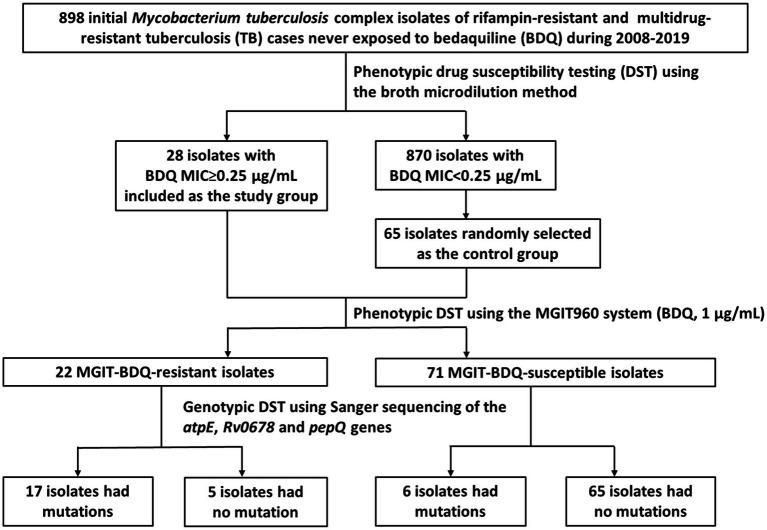
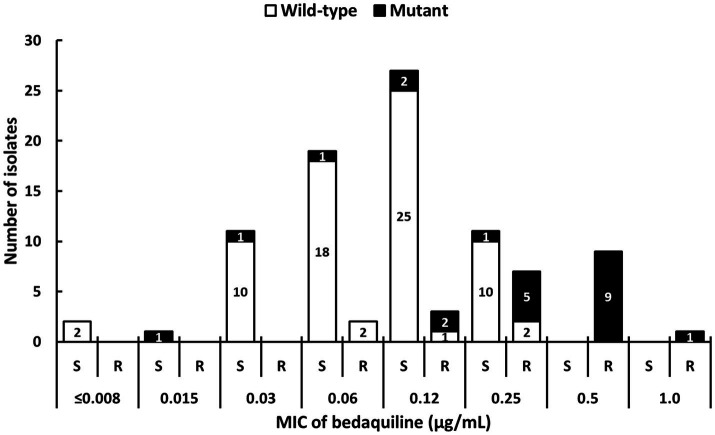
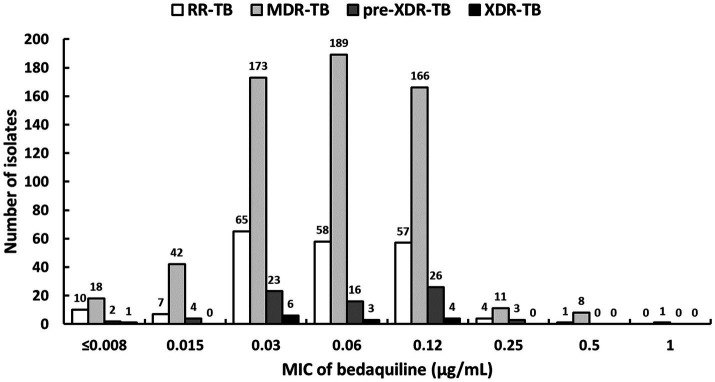
Bedaquiline (BDQ), which is recommended for the treatment of drug-resistant tuberculosis (DR-TB), was introduced in Taiwan in 2014. Due to the alarming emergence of BDQ resistance, we conducted BDQ resistance analyses to strengthen our DR-TB management program. This retrospective population-based study included initial isolates from 898 rifampicin-resistant (RR) or multidrug-resistant (MDR) TB cases never exposed to BDQ during 2008-2019. We randomly selected 65 isolates and identified 28 isolates with BDQ MIC<0.25μg/ml and MIC≥0.25μg/ml as the control and study groups, respectively. BDQ drug susceptibility testing (DST) using the MGIT960 system and Sanger sequencing of the , , and genes was conducted. Notably, 18 isolates with BDQ MIC=0.25μg/ml, 38.9% (7/18), and 61.1% (11/18) isolates were MGIT-BDQ resistant and susceptible, respectively. Consequently, we recommended redefining MIC=0.25μg/ml as an intermediate-susceptible category to resolve discordance between different DST methods. Of the 93 isolates, 22 isolates were MGIT-BDQ-resistant and 77.3% (17/22) of MGIT-BDQ-resistant isolates harbored mutations. After excluding 2 MGIT-BDQ-resistant isolates with borderline resistance (GUgrowth control-GUBDQ≤1day), 100% (15/15) harbored gene mutations, including seven novel mutations [g-14a, Ile80Ser (=2), Phe100Tyr, Ala102Val, Ins g 181-182 frameshift mutation (=2), Del 11-63 frameshift mutation, and whole gene deletion (=2)]. Since the other 22.7% (5/22) MGIT-BDQ-resistant isolates with borderline resistance (GUgrowth control-GUBDQ≤1day) had no mutation in three analyzed genes. For isolates with phenotypic MGIT-BDQ borderline resistance, checking for GU differences or conducting genotypic analyses are suggested for ruling out BDQ resistance. In addition, we observed favorable outcomes among patients with BDQ-resistant isolates who received BDQ-containing regimens regardless of mutations. We concluded that based on MIC≥0.25μg/ml, 3.1% (28/898) of drug-resistant TB cases without BDQ exposure showed BDQ resistance, was not a robust marker of BDQ resistance, and its mutations were not associated with treatment outcomes.
贝达喹啉(BDQ)于2014年在台湾被引入,推荐用于治疗耐多药结核病(DR-TB)。由于BDQ耐药性令人担忧地出现,我们进行了BDQ耐药性分析,以加强我们的耐多药结核病管理计划。这项基于人群的回顾性研究纳入了2008年至2019年期间898例从未接触过BDQ的利福平耐药(RR)或耐多药(MDR)结核病患者的初始分离株。我们随机选择了65株分离株,并分别将28株BDQ MIC<0.25μg/ml和MIC≥0.25μg/ml的分离株确定为对照组和研究组。使用MGIT960系统进行BDQ药物敏感性试验(DST),并对 、 和 基因进行桑格测序。值得注意的是,18株BDQ MIC=0.25μg/ml的分离株中,分别有38.9%(7/18)和61.1%(11/18)的分离株对MGIT-BDQ耐药和敏感。因此,我们建议将MIC=0.25μg/ml重新定义为中介敏感类别,以解决不同DST方法之间的不一致性。在93株分离株中,22株对MGIT-BDQ耐药,77.3%(17/22)的MGIT-BDQ耐药分离株存在 基因突变。在排除2株具有临界耐药性(GU生长对照-GUBDQ≤1天)的MGIT-BDQ耐药分离株后,100%(15/15)存在 基因突变,包括7种新突变[g-14a、Ile80Ser(=2)、Phe100Tyr、Ala102Val、Ins g 181-182移码突变(=2)、Del 11-63移码突变和全基因缺失(=2)]。由于另外22.7%(5/22)具有临界耐药性(GU生长对照-GUBDQ≤1天)的MGIT-BDQ耐药分离株在三个分析基因中没有突变。对于具有表型MGIT-BDQ临界耐药性的分离株,建议检查GU差异或进行基因分型分析以排除BDQ耐药性。此外,我们观察到接受含BDQ方案治疗的BDQ耐药分离株患者有良好的治疗结果,无论是否存在 基因突变。我们得出结论,基于MIC≥0.25μg/ml,3.1%(28/898)未接触过BDQ的耐多药结核病患者表现出BDQ耐药性, 不是BDQ耐药性的可靠标志物,其突变与治疗结果无关。