Bai Shijie, Zhang Peijun, Zhang Changhao, Du Jiang, Du Xinyi, Zhu Chengwei, Liu Jun, Xie Peiyu, Li Songhai
Institute of Deep-sea Science and Engineering, Chinese Academy of Sciences, Sanya, China.
Marine Mammal and Marine Bioacoustics Laboratory, Institute of Deep-sea Science and Engineering, Chinese Academy of Sciences, Sanya, China.
Front Microbiol. 2021 Oct 21;12:769012. doi: 10.3389/fmicb.2021.769012. eCollection 2021.
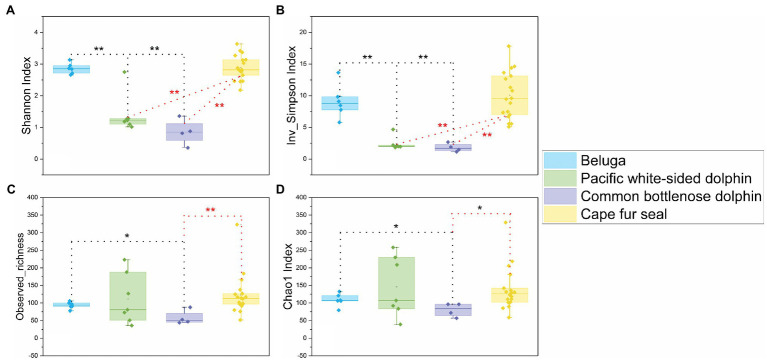
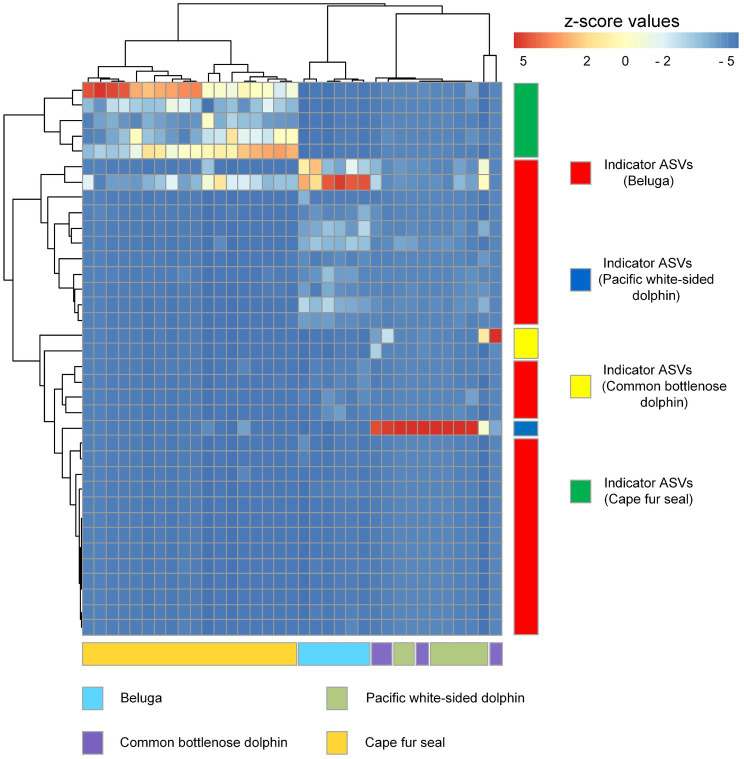
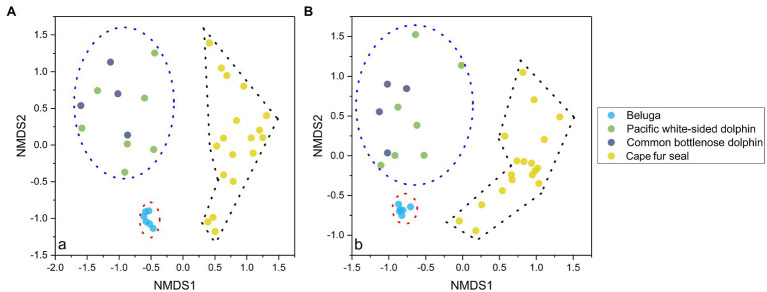
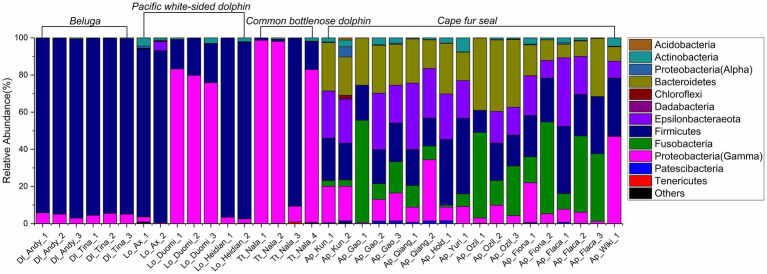
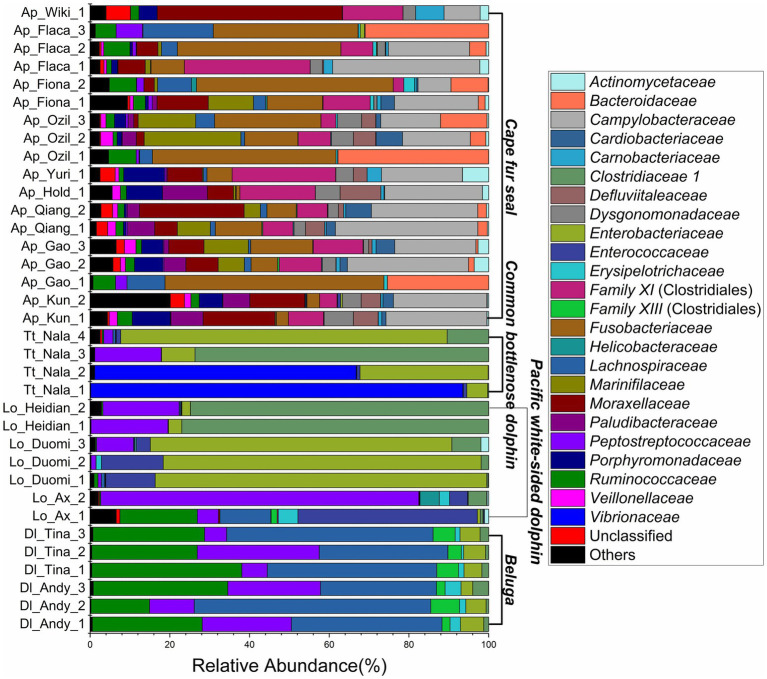
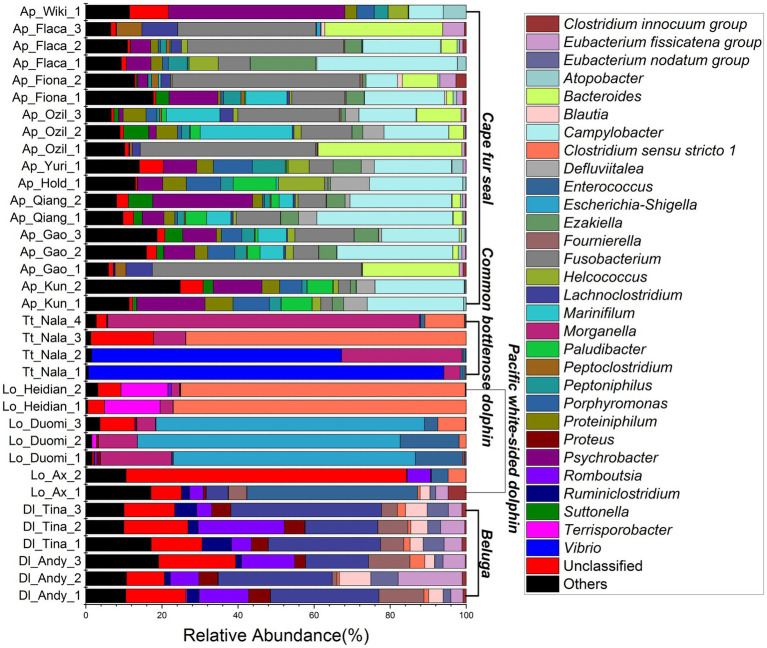
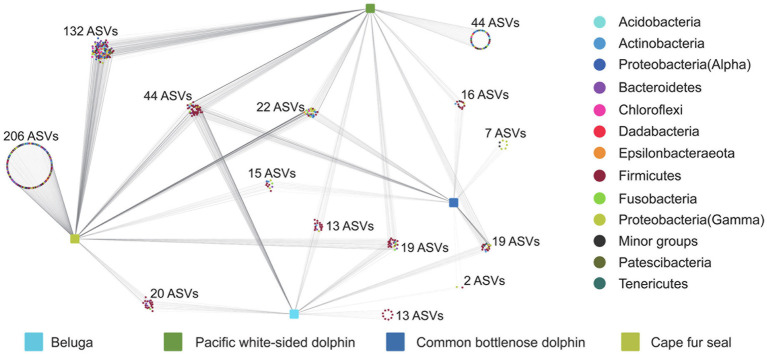
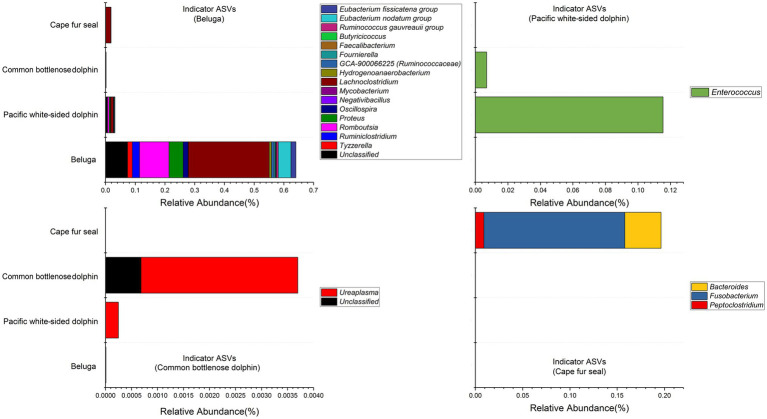
Despite an increasing appreciation in the importance of host-microbe interactions in ecological and evolutionary processes, information on the gut microbial communities of some marine mammals is still lacking. Moreover, whether diet, environment, or host phylogeny has the greatest impact on microbial community structure is still unknown. To fill part of this knowledge gap, we exploited a natural experiment provided by an aquarium with belugas () affiliated with family Monodontidae, Pacific white-sided dolphins () and common bottlenose dolphin () affiliated with family Delphinidae, and Cape fur seals () affiliated with family Otariidae. Results show significant differences in microbial community composition of whales, dolphins, and fur seals and indicate that host phylogeny (family level) plays the most important role in shaping the microbial communities, rather than food and environment. In general, the gut microbial communities of dolphins had significantly lower diversity compared to that of whales and fur seals. Overall, the gut microbial communities were mainly composed of Firmicutes and Gammaproteobacteria, together with some from Bacteroidetes, Fusobacteria, and Epsilonbacteraeota. However, specific bacterial lineages were differentially distributed among the marine mammal groups. For instance, , , and were the dominant bacterial lineages in the gut of belugas, while for Cape fur seals, and were the main bacterial lineages. Moreover, gut microbial communities in both Pacific white-sided dolphins and common bottlenose dolphins were dominated by a number of pathogenic bacteria, including , , and , reflecting the poor health condition of these animals. Although there is a growing recognition of the role microorganisms play in the gut of marine mammals, current knowledge about these microbial communities is still severely lacking. Large-scale research studies should be undertaken to reveal the roles played by the gut microbiota of different marine mammal species.
尽管人们越来越认识到宿主 - 微生物相互作用在生态和进化过程中的重要性,但关于一些海洋哺乳动物肠道微生物群落的信息仍然匮乏。此外,饮食、环境或宿主系统发育对微生物群落结构的影响最大,这一点仍然未知。为了填补这一知识空白的一部分,我们利用了一个水族馆提供的自然实验,该水族馆中有隶属于独角鲸科的白鲸()、隶属于海豚科的太平洋白侧海豚()和普通宽吻海豚()以及隶属于海狮科的南非海狗()。结果表明,鲸鱼、海豚和海狗的微生物群落组成存在显著差异,并表明宿主系统发育(科级水平)在塑造微生物群落方面发挥着最重要的作用,而不是食物和环境。一般来说,与鲸鱼和海狗相比,海豚的肠道微生物群落多样性显著较低。总体而言,肠道微生物群落主要由厚壁菌门和γ - 变形菌纲组成,还有一些来自拟杆菌门、梭杆菌门和ε - 变形菌纲。然而,特定的细菌谱系在海洋哺乳动物群体中分布不同。例如, 、 和 是白鲸肠道中的优势细菌谱系,而对于南非海狗来说, 和 是主要细菌谱系。此外,太平洋白侧海豚和普通宽吻海豚的肠道微生物群落都由多种病原菌主导,包括 、 和 ,这反映了这些动物的健康状况不佳。尽管人们越来越认识到微生物在海洋哺乳动物肠道中所起的作用,但目前关于这些微生物群落的知识仍然严重不足。应该开展大规模的研究,以揭示不同海洋哺乳动物物种肠道微生物群所起的作用。