Fan Jie, Kang Hui, Lv Meiqi, Zhai Yuhuan, Jia Yangyang, Yang Zixin, Shi Chengcheng, Zhou Changhao, Diao Lin, Li Jingsuo, Jin Xiaowei, Liu Shanshan, Kristiansen Karsten, Zhang Peijun, Chen Jianwei, Li Songhai
College of Life Sciences, University of Chinese Academy of Sciences, Beijing, China.
BGI Research, Qingdao, China.
Front Microbiol. 2024 Aug 29;15:1394745. doi: 10.3389/fmicb.2024.1394745. eCollection 2024.
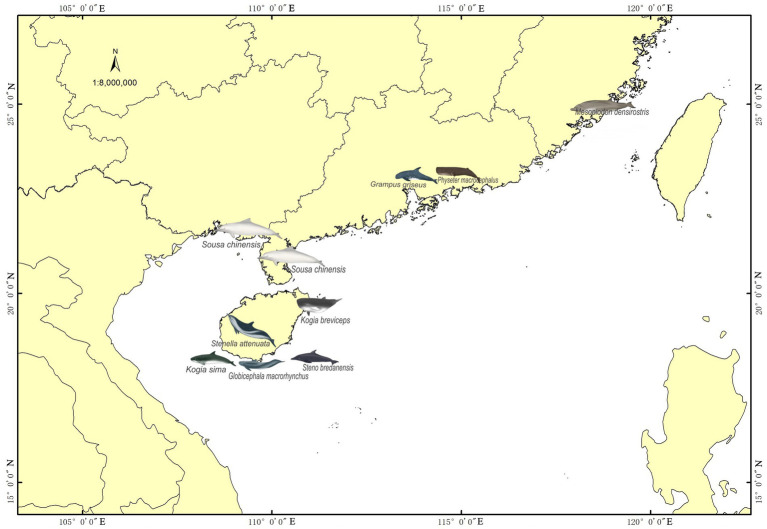
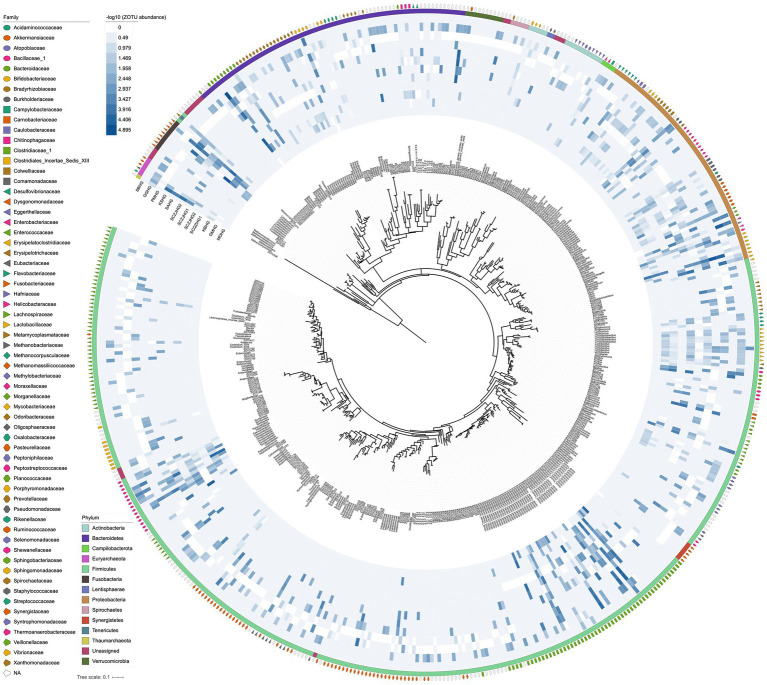
Cetaceans play a crucial role in marine ecosystems; however, research on their gastrointestinal microbiota remains limited due to sampling constraints. In this study, we collected hindgut samples from 12 stranded cetaceans and performed 16S rRNA gene amplicon sequencing to investigate microbial composition and functional potentials. Analysis of ZOTUs profiles revealed that the phyla Firmicutes, Proteobacteria, and Bacteroidetes dominated all hindgut samples. However, unique microbial profiles were observed among different cetacean species, with significant separation of gut microbiota communities according to biological evolutionary lineages. Different genera that contain pathogens were observed distinguishing delphinids from physeteroids/ziphiids. Delphinid samples exhibited higher abundances of , , and , whereas physeteroid and ziphiid samples showed higher abundances of , , and . Functional analysis indicated convergence in the gut microbiota among all cetaceans, with shared bacterial infection pathways across hindgut samples. In addition, a comparison of the gastrointestinal microbial composition between a stranded short-finned pilot whale () and a stranded rough-toothed dolphin () using 16S rRNA gene sequencing revealed distinct microbial community structures and functional capacities. To the best of our knowledge, this study represents the first report on the gastrointestinal microbiota of the pantropical spotted dolphin (), Blainville's beaked whale (), and rough-toothed dolphin, with various comparisons conducted among different cetacean species. Our findings enhance the understanding of microbial composition and diversity in cetacean gastrointestinal microbiota, providing new insights into co-evolution and complex interactions between cetacean microbes and hosts.
鲸目动物在海洋生态系统中发挥着至关重要的作用;然而,由于采样限制,对其胃肠道微生物群的研究仍然有限。在本研究中,我们从12头搁浅的鲸目动物身上采集了后肠样本,并进行了16S rRNA基因扩增子测序,以研究微生物组成和功能潜力。对ZOTUs图谱的分析表明,厚壁菌门、变形菌门和拟杆菌门在所有后肠样本中占主导地位。然而,在不同的鲸目动物物种中观察到了独特的微生物图谱,根据生物进化谱系,肠道微生物群群落有明显的分离。观察到含有病原体的不同属将海豚科与抹香鲸类/喙鲸科区分开来。海豚科样本中 、 和 的丰度较高,而抹香鲸类和喙鲸科样本中 、 和 的丰度较高。功能分析表明,所有鲸目动物的肠道微生物群存在趋同现象,后肠样本中存在共同的细菌感染途径。此外,使用16S rRNA基因测序对一头搁浅的短鳍领航鲸( )和一头搁浅的糙齿海豚( )的胃肠道微生物组成进行比较,发现了不同的微生物群落结构和功能能力。据我们所知,本研究首次报道了泛热带斑海豚( )、布兰氏喙鲸( )和糙齿海豚的胃肠道微生物群,并在不同鲸目动物物种之间进行了各种比较。我们的研究结果加深了对鲸目动物胃肠道微生物群中微生物组成和多样性的理解,为鲸目动物微生物与宿主之间的共同进化和复杂相互作用提供了新的见解。