Centre for Experimental Medicine and Biomedicine, Hull York Medical School, University of York, York, United Kingdom.
Front Immunol. 2021 Oct 21;12:772017. doi: 10.3389/fimmu.2021.772017. eCollection 2021.
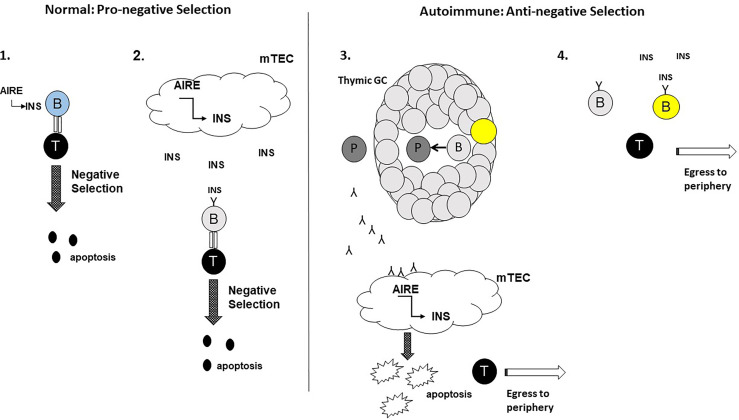
Type 1 diabetes (T1d) results from a sustained autoreactive T and B cell response towards insulin-producing β cells in the islets of Langerhans. The autoreactive nature of the condition has led to many investigations addressing the genetic or cellular changes in primary lymphoid tissues that impairs central tolerance- a key process in the deletion of autoreactive T and B cells during their development. For T cells, these studies have largely focused on medullary thymic epithelial cells (mTECs) critical for the effective negative selection of autoreactive T cells in the thymus. Recently, a new cellular player that impacts positively or negatively on the deletion of autoreactive T cells during their development has come to light, thymic B cells. Normally a small population within the thymus of mouse and man, thymic B cells expand in T1d as well as other autoimmune conditions, reside in thymic ectopic germinal centres and secrete autoantibodies that bind selective mTECs precipitating mTEC death. In this review we will discuss the ontogeny, characteristics and functionality of thymic B cells in healthy and autoimmune settings. Furthermore, we explore how approaches may help decipher the complex cellular interplay of thymic B cells with other cells within the thymic microenvironment leading to new avenues for therapeutic intervention.
1 型糖尿病(T1d)是由于胰岛中的胰岛素产生β细胞发生持续的自身反应性 T 和 B 细胞反应引起的。该疾病的自身反应性质导致了许多针对原发性淋巴组织中导致中央耐受受损的遗传或细胞变化的研究,中央耐受是在其发育过程中删除自身反应性 T 和 B 细胞的关键过程。对于 T 细胞,这些研究主要集中在骨髓胸腺上皮细胞(mTECs)上,mTECs 对于在胸腺中有效进行自身反应性 T 细胞的阴性选择至关重要。最近,一种新的细胞参与者在其发育过程中对自身反应性 T 细胞的删除产生积极或消极的影响,即胸腺 B 细胞。正常情况下,胸腺 B 细胞是小鼠和人类胸腺中的一小部分,但在 T1d 以及其他自身免疫性疾病中会扩增,存在于胸腺异位生发中心,并分泌自身抗体,与选择性 mTEC 结合,导致 mTEC 死亡。在这篇综述中,我们将讨论健康和自身免疫环境中胸腺 B 细胞的发生、特征和功能。此外,我们还探讨了如何利用这些方法来帮助阐明胸腺 B 细胞与胸腺微环境中的其他细胞之间的复杂细胞相互作用,从而为治疗干预开辟新途径。