Cheng Sen, Guo Jing, Wang Dawei, Fang Qiuyue, Liu Yulou, Xie Weiyan, Zhang Yazhuo, Li Chuzhong
Department of Neurosurgery, Beijing Tiantan Hospital Affiliated to Capital Medical University, Beijing, China.
Beijing Neurosurgical Institute, Capital Medical University, Beijing, China.
Front Genet. 2021 Oct 20;12:754503. doi: 10.3389/fgene.2021.754503. eCollection 2021.
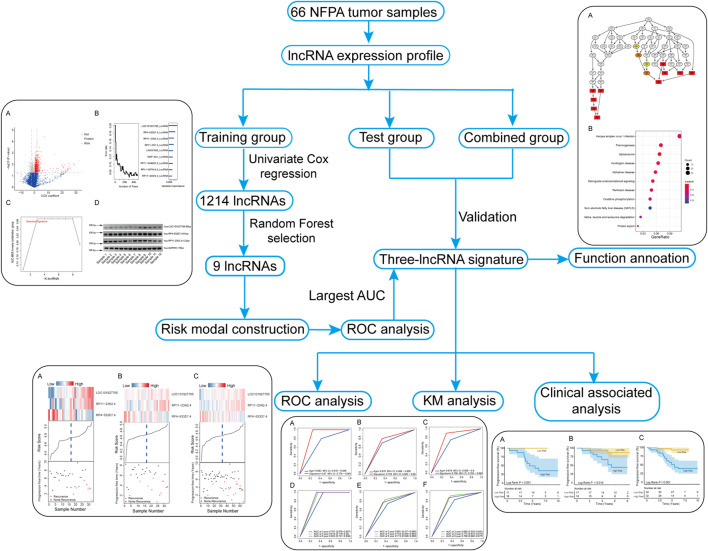
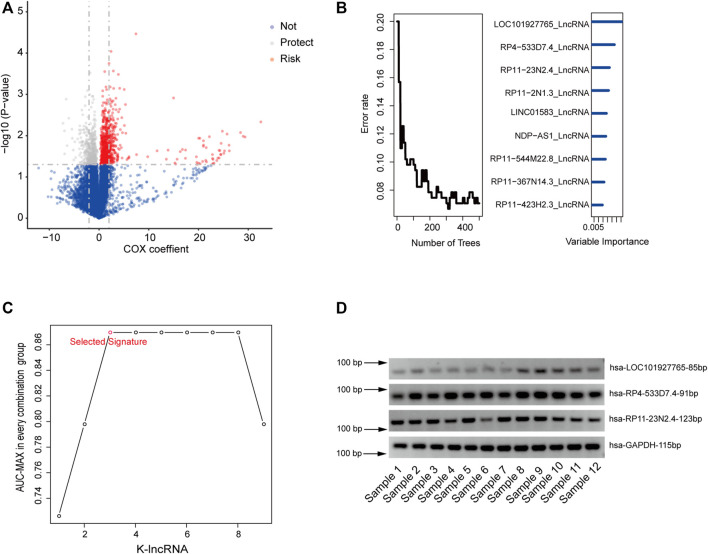
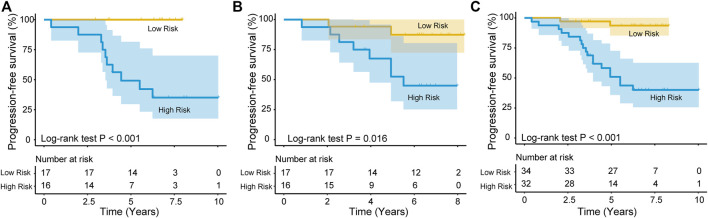
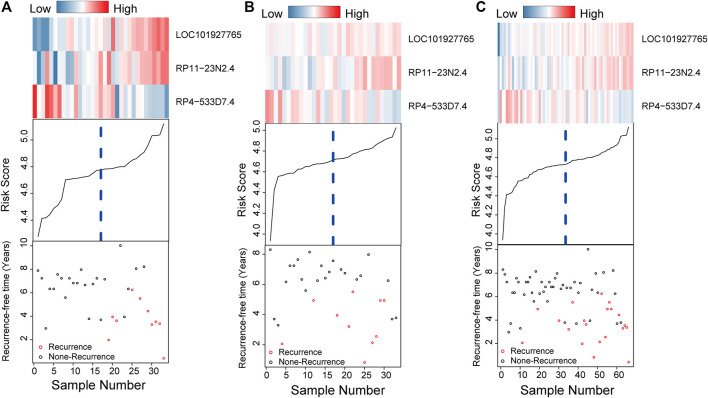
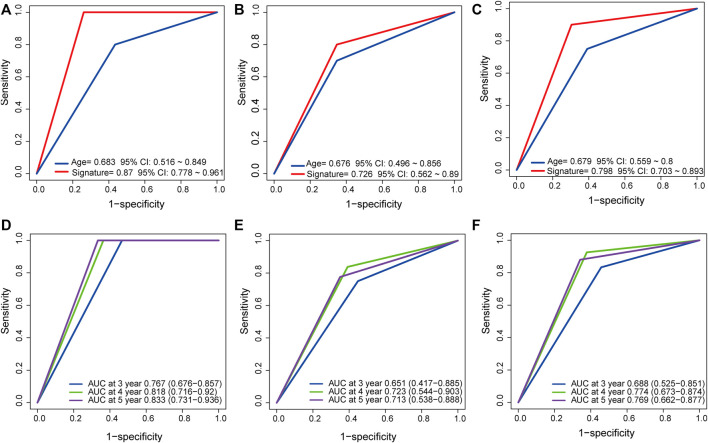
The nonfunctioning pituitary adenoma (NFPA) recurrence rate is relatively high after surgical resection. Here, we constructed effective long noncoding RNA (lncRNA) signatures to predict NFPA prognosis. LncRNAs expression microarray sequencing profiles were obtained from 66 NFPAs. Sixty-six patients were randomly separated into a training ( = 33) and test group ( = 33). Univariable Cox regression and a machine learning algorithm was used to filter lncRNAs. Time-dependent receiver operating characteristic (ROC) analysis was performed to improve the prediction signature. Three lncRNAs (LOC101927765, RP11-23N2.4 and RP4-533D7.4) were included in a prognostic signature with high prediction accuracy for tumor recurrence, which had the largest area under ROC curve (AUC) value in the training/test group (AUC = 0.87/0.73). The predictive ability of the signature was validated by Kaplan-Meier survival analysis. A signature-based risk score model divied patients into two risk group, and the recurrence-free survival rates of the groups were significantly different (log-rank < 0.001). In addition, the ROC analysis showed that the lncRNA signature predictive ability was significantly better than that of age in the training/testing/entire group (AUC = 0.87/0.726/0.798 AUC = 0.683/0.676/0.679). We constructed and verified a three-lncRNA signature predictive of recurrence, suggesting potential therapeutic targets for NFPA.
无功能垂体腺瘤(NFPA)手术切除后的复发率相对较高。在此,我们构建了有效的长链非编码RNA(lncRNA)特征来预测NFPA的预后。从66例NFPA中获取lncRNAs表达微阵列测序图谱。66例患者被随机分为训练组(n = 33)和测试组(n = 33)。采用单变量Cox回归和机器学习算法筛选lncRNAs。进行时间依赖性受试者工作特征(ROC)分析以改进预测特征。一个预后特征纳入了三个lncRNAs(LOC101927765、RP11 - 23N2.4和RP4 - 533D7.4),对肿瘤复发具有较高的预测准确性,在训练/测试组中其ROC曲线下面积(AUC)值最大(AUC = 0.87/0.73)。通过Kaplan - Meier生存分析验证了该特征的预测能力。基于特征的风险评分模型将患者分为两个风险组,两组的无复发生存率有显著差异(对数秩检验P < 0.001)。此外,ROC分析表明,在训练/测试/整个组中,lncRNA特征的预测能力显著优于年龄(AUC = 0.87/0.726/0.798 对比 AUC = 0.683/0.676/0.679)。我们构建并验证了一个预测复发的三lncRNA特征,提示了NFPA潜在的治疗靶点。