Bibilashvili R Sh, Sidorova M V, Dudkina U S, Palkeeva M E, Molokoedov A S, Kozlovskaya L I, Egorov A M, Ishmukhametov A A, Parfyonova E V
National Medical Research Center for Cardiology, 3rd Cherepkovskaya 15А, 121552 Moscow, Russia.
Chumakov Federal Scientific Center for Research and Development of Immune-and-Biological products of the Russian Academy of Sciences, 108819 Moscow, Russia.
Biochem Mosc Suppl B Biomed Chem. 2021;15(4):274-280. doi: 10.1134/S199075082104003X. Epub 2021 Nov 2.
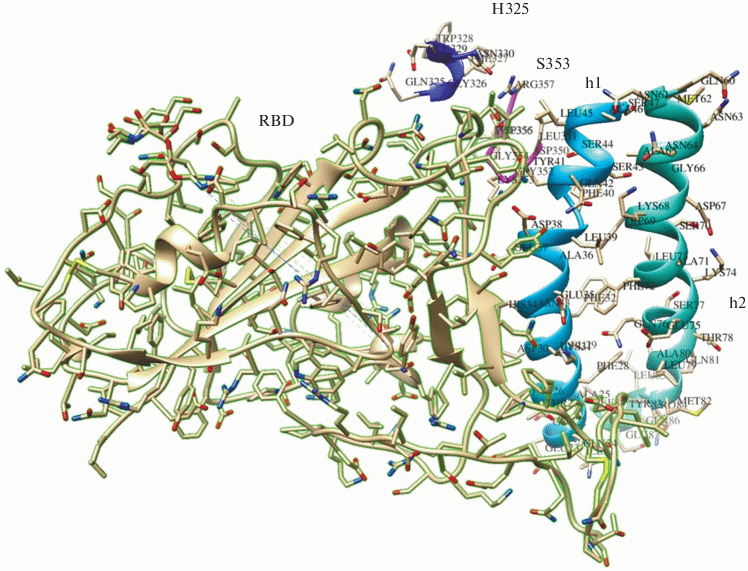
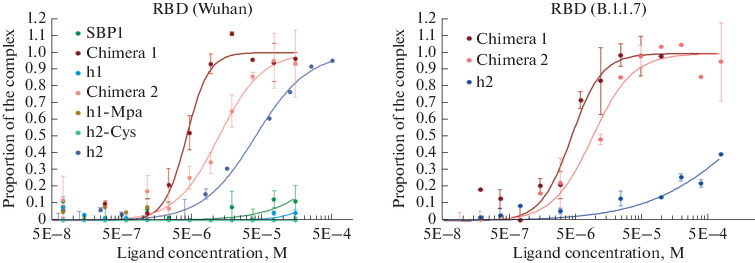
Computer simulation has been used to identify peptides that mimic the natural target of the SARS-CoV-2 coronavirus spike (S) protein, the angiotensin-converting enzyme type 2 (ACE2) cell receptor. Based on the structure of the complex of the protein S receptor-binding domain (RBD) and ACE2, the design of chimeric molecules consisting of two 22-23-mer peptides linked to each other by disulfide bonds was carried out. The chimeric molecule X1 was a disulfide dimer, in which terminal cysteine residues in the precursor molecules h1 and h2 were connected by the S-S bond. In the chimeric molecule X2, the disulfide bond was located in the middle of each precursor peptide molecule. The precursors h1 and h2 mimic amino acid sequences of α1- and α2-helices of the ACE2 extracellular peptidase domain, respectively, keeping intact most of the amino acid residues involved in the interaction with RBD. The aim of the work was to evaluate the binding efficiency of chimeric molecules and their constituent peptides with RBD (particularly in dependence of the middle and terminal methods of fixing the initial peptides h1 and h2). The proposed polypeptides and chimeric molecules were synthesized by chemical methods, purified to 95-97% purity, and characterized by HPLC and MALDI-TOF mass spectrometry. Binding of these peptides to the SARS-CoV-2 RBD was evaluated by microthermophoresis with recombinant domains corresponding in sequence to the original Chinese (GenBank ID NC_045512.2) and the British (B. 1.1.7, GISAID EPI_ISL_683466) variants. The original RBD of the Chinese variant bound to three synthesized peptides: linear h2 and both chimeric variants. Chimeric peptides were also bound to the RBD of the British variant. The antiviral activity of the proposed peptides was evaluated in Vero cell line.
计算机模拟已被用于识别模拟严重急性呼吸综合征冠状病毒2(SARS-CoV-2)刺突(S)蛋白天然靶标的肽,即2型血管紧张素转换酶(ACE2)细胞受体。基于S蛋白受体结合结构域(RBD)与ACE2复合物的结构,开展了由通过二硫键相互连接的两个22 - 23肽组成的嵌合分子的设计。嵌合分子X1是一种二硫键二聚体,其中前体分子h1和h2中的末端半胱氨酸残基通过S - S键连接。在嵌合分子X2中,二硫键位于每个前体肽分子的中间。前体h1和h2分别模拟ACE2细胞外肽酶结构域α1和α2螺旋的氨基酸序列,与RBD相互作用的大多数氨基酸残基保持完整。这项工作的目的是评估嵌合分子及其组成肽与RBD的结合效率(特别是取决于固定初始肽h1和h2的中间和末端方法)。所提出的多肽和嵌合分子通过化学方法合成,纯化至纯度为95 - 97%,并通过高效液相色谱(HPLC)和基质辅助激光解吸电离飞行时间质谱(MALDI - TOF)进行表征。通过微量热泳技术,使用与原始中国株(GenBank ID NC_045512.2)和英国株(B. 1.1.7,GISAID EPI_ISL_683466)变体序列对应的重组结构域,评估了这些肽与SARS-CoV-2 RBD的结合。中国变体的原始RBD与三种合成肽结合:线性h2和两种嵌合变体。嵌合肽也与英国变体的RBD结合。在所提出的肽在Vero细胞系中评估了其抗病毒活性。