Moradi Negahdari Faezeh, Hadjzadeh Mousa-Al-Reza, Gholamnezhad Zahra, Samadi Noshahr Zahra, Keshavarzi Zakieh
Applied Biomedical Research Center, Mashhad University of Medical Sciences, Mashhad, Iran.
Division of Neurocognitive Sciences, Psychiatry and Behavioral Sciences Research Center, Mashhad University of Medical Sciences, Mashhad, Iran.
Avicenna J Phytomed. 2021 Sep-Oct;11(5):484-493. doi: 10.22038/AJP.2021.55679.2785.
The effect of trans-anethole and metformin on biochemical and hormonal changes of testosterone-induced Polycystic ovary syndrome (PCOS) in rats was investigated.
Female Wister rats (n=48) were randomly divided into six groups: control; PCOS; PCOS+metformin (300 mg/kg); and PCOS+trans-anethole (20, 40, and 80 mg/kg). PCOS was induced by intraperitoneal injection of testosterone (1 mg/kg/day) for 35 days. After induction of PCOS, trans-anethole and metformin were given orally for 30 days. Finally, blood sugar, insulin, lipid profile, and testosterone and dehydroepiandrosterone (DHEAS) as well as animals' weight, and water and food intake were determined.
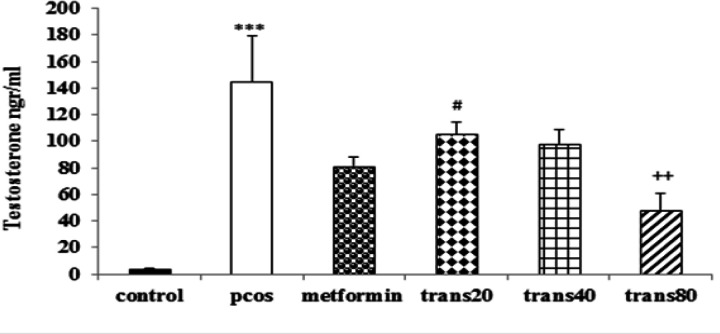
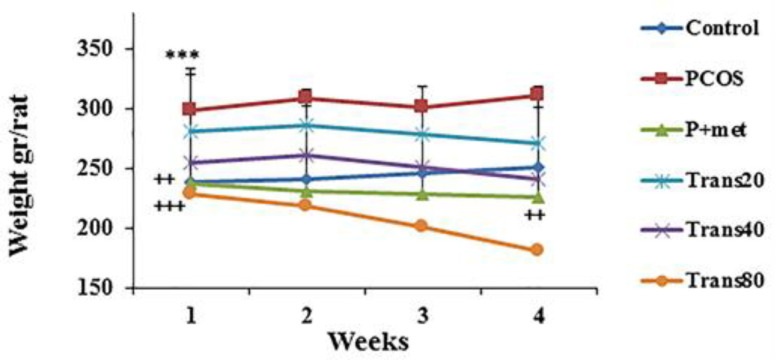
In all treated and untreated PCOS groups, serum testosterone levels were significantly increased compared to the control group (p<0.001 for all groups). Treatment of rats with trans-anethole or metformin significantly reduced serum levels of cholesterol, insulin, triglycerides, testosterone and DHEAS (only in PCOS+trans-anethole groups) compared to the PCOS group (p<0.01-p<0.001). Weight gain in the PCOS animals increased significantly compared to the control group (p<0.001), while in the metformin- and trans-anethole (40 and 80)-treated animals it decreased significantly compared to the PCOS group (p<0.01-p<0.001).
These results showed that trans-anethole significantly decreased serum levels of insulin, DHEAS and blood lipids. It can be concluded that trans-anethole ameliorates PCOS biochemical and hormonal change in PCOS rats; therefore, it might be suggested as a beneficial remedy for further clinical evaluations in PCOS patients.
研究反式茴香脑和二甲双胍对睾酮诱导的大鼠多囊卵巢综合征(PCOS)生化及激素变化的影响。
将48只雌性Wistar大鼠随机分为六组:对照组;PCOS组;PCOS+二甲双胍(300 mg/kg)组;以及PCOS+反式茴香脑(20、40和80 mg/kg)组。通过腹腔注射睾酮(1 mg/kg/天)35天诱导建立PCOS模型。诱导出PCOS后,口服给予反式茴香脑和二甲双胍30天。最后,测定血糖、胰岛素、血脂、睾酮和脱氢表雄酮(DHEAS),以及动物体重、水和食物摄入量。
与对照组相比,所有治疗和未治疗的PCOS组血清睾酮水平均显著升高(所有组p<均0.001)。与PCOS组相比,用反式茴香脑或二甲双胍治疗大鼠可显著降低血清胆固醇、胰岛素、甘油三酯、睾酮和DHEAS水平(仅在PCOS+反式茴香脑组)(p<0.01-p<0.001)。与对照组相比,PCOS动物体重增加显著(p<0.001),而与PCOS组相比,二甲双胍和反式茴香脑(40和80 mg/kg)治疗的动物体重显著降低(p<0.01-p<0.001)。
这些结果表明,反式茴香脑可显著降低血清胰岛素、DHEAS和血脂水平。可以得出结论,反式茴香脑可改善PCOS大鼠的生化和激素变化;因此,可能建议将其作为一种有益的药物用于PCOS患者的进一步临床评估。