Reinink Hendrik, Geurts Marjolein, Melis-Riemens Constance, Hollander Annemarie, Kappelle Jaap, van der Worp Bart
Department of Neurology and Neurosurgery, University Medical Center Utrecht, Utrecht, The Netherlands.
Department of Neurology Erasmus Medical Center, Rotterdam, The Netherlands.
Eur Stroke J. 2021 Sep;6(3):268-275. doi: 10.1177/23969873211041843. Epub 2021 Sep 5.
There is a lack of evidence concerning the palliative needs of patients with acute stroke during end-of-life care. We interviewed relatives of patients who deceased in our stroke unit about the quality of dying and compared their experiences with those of nurses.
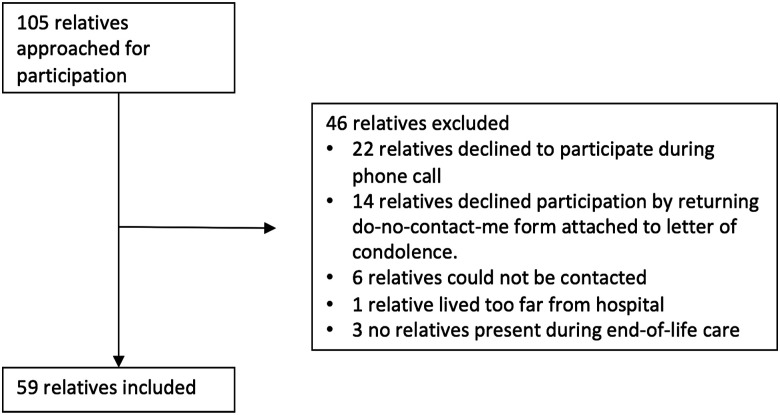
Relatives of 59 patients were interviewed approximately 6 weeks after the patient had died. The primary outcome was a score assessing the overall quality of dying on a scale ranging from 0 to 10, with 0 representing the worst quality and 10 the best quality. We investigated the frequency and appreciation of specific aspects of the dying phase with an adapted version of the Quality of Death and Dying Questionnaire. The nurse who was most frequently involved in the end-of-life care of the patient completed a similar questionnaire.
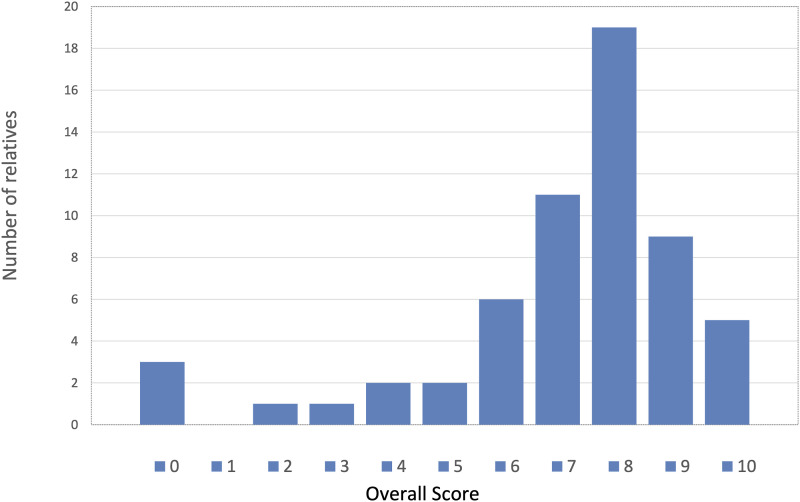
Family members were generally satisfied with the quality of dying (median overall score 8; interquartile range, 6-9) as well as with the care provided by nurses (9; 8-10) and doctors (8; 7-9). Breathing difficulties were frequently reported (by 46% of the relatives), but pain was not. Unsatisfactory experiences were related to feeding (69% unsatisfactory), inability to say goodbye to loved ones (51%), appearing not to have control (47%), and not retaining a sense of dignity (41%). Two-thirds of the relatives reported that palliative medication adequately resolved discomfort. There was a good correlation between the experiences of relatives and nurses.
Most relatives were satisfied with the overall quality of dying. Negative experiences concerned feeding problems, not being able to say goodbye to loved ones, sense of self control and dignity, and breathing difficulties. Experiences of nurses may be a reasonable and practical option when evaluating the quality of dying in acute stroke patients.
在临终关怀期间,急性中风患者的姑息治疗需求方面缺乏证据。我们就死亡质量采访了在我们中风单元去世患者的亲属,并将他们的经历与护士的经历进行了比较。
在患者死亡约6周后,对59名患者的亲属进行了访谈。主要结果是一个从0到10分的评分,用于评估死亡的总体质量,0分代表最差质量,10分代表最佳质量。我们使用改编后的《死亡与临终质量问卷》调查了临终阶段特定方面的发生频率和亲属的评价。最常参与患者临终关怀的护士完成了一份类似的问卷。
家庭成员总体上对死亡质量(中位数总体评分8;四分位间距,6 - 9)以及护士(9;8 - 10)和医生(8;7 - 9)提供的护理感到满意。呼吸困难的报告频率较高(46%的亲属),但疼痛的报告频率不高。不满意的经历与喂食(69%不满意)、无法与亲人告别(51%)、似乎失去控制(47%)以及没有保留尊严感(41%)有关。三分之二的亲属报告说姑息药物充分缓解了不适。亲属和护士的经历之间存在良好的相关性。
大多数亲属对死亡的总体质量感到满意。负面经历涉及喂食问题、无法与亲人告别、自我控制感和尊严感以及呼吸困难。在评估急性中风患者的死亡质量时,护士的经历可能是一个合理且实用的参考。