Parvez Mohammad K, Ahmed Sarfaraz, Al-Dosari Mohammed S, Abdelwahid Mazin A S, Arbab Ahmed H, Al-Rehaily Adnan J, Al-Oqail Mai M
Department of Pharmacognosy, College of Pharmacy, King Saud University, Riyadh 11451, Saudi Arabia.
Department of Pharmaceutical Chemistry, Al-Neelain University, Khartoum 11114, Sudan.
ACS Omega. 2021 Oct 21;6(43):29100-29110. doi: 10.1021/acsomega.1c04320. eCollection 2021 Nov 2.
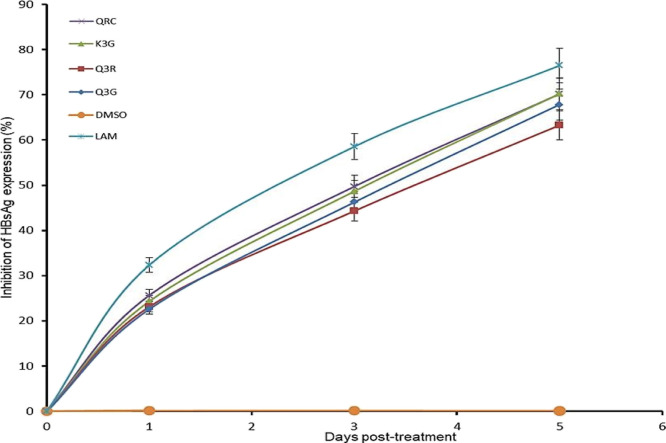
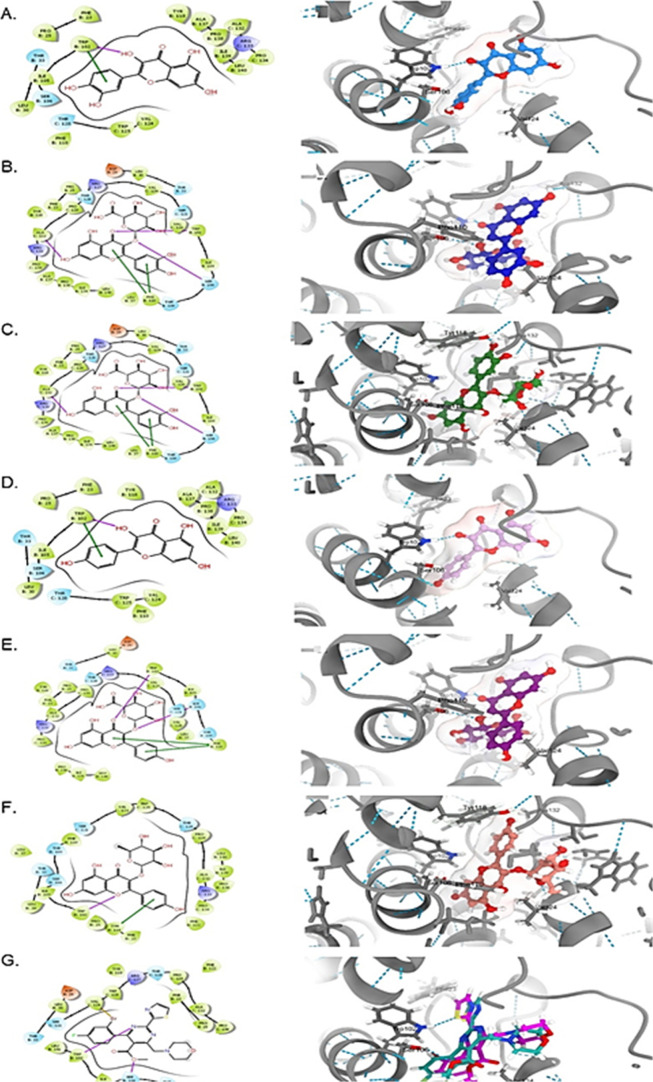
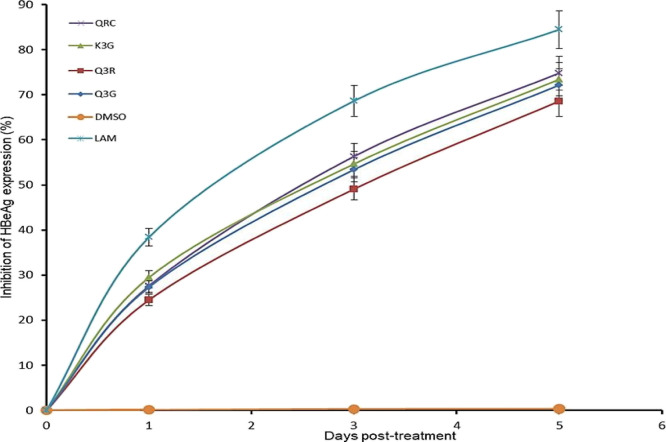
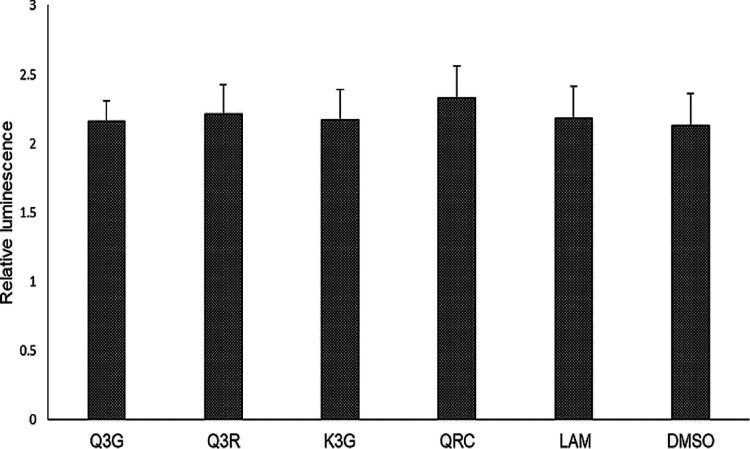
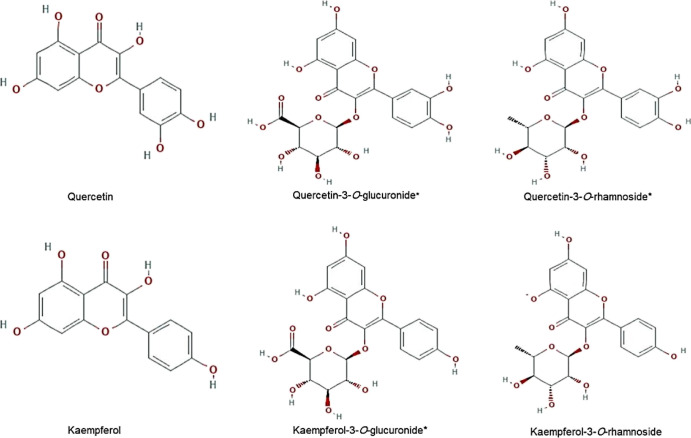
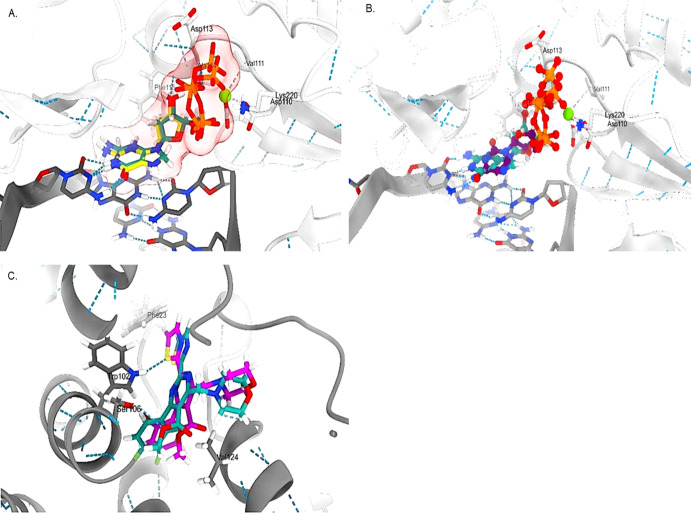
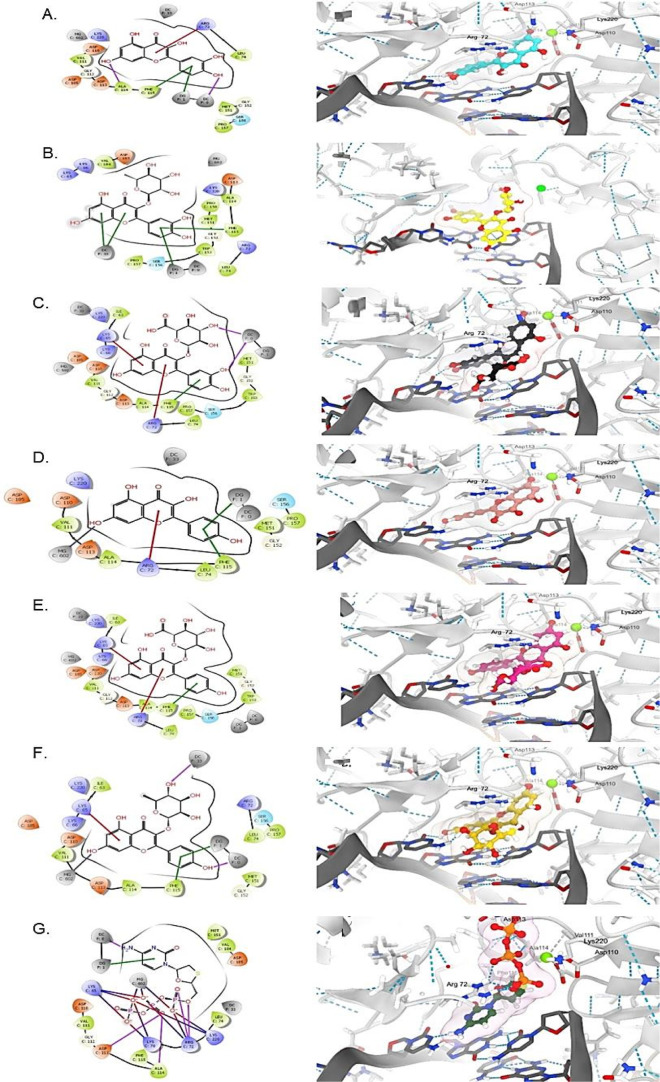
Natural or plant products, because of their structural diversity, are a potential source for identifying new anti-hepatitis B virus (HBV) agents. Here, we report the anti-HBV activity of and its quercetin (QRC) and kaempferol derivatives. The anti-HBV-active methanol fraction of was subjected to chromatographic techniques, leading to isolation of three flavonols, following their structure determination by H and C NMR spectroscopies. Their cytotoxicity and anti-HBV potential were assessed using HBV reporter HepG2.2.15 cells, and their modes of action were delineated by molecular docking. The isolated compounds identified as quercetin-3--glucuronide (Q3G), quercetin-3--rhamnoside (Q3R), and kaempferol-3--glucuronide (K3G) were non-cytotoxic to HepG2.2.15 cells. The viral HBsAg/HBeAg production on day 5 was significantly inhibited by K3G (∼70.2/∼73.4%), Q3G (∼67.8/∼72.1%), and Q3R (∼63.2%/∼68.2%) as compared to QRC (∼70.3/∼74.8%) and lamivudine (∼76.5/∼84.5%) used as standards. The observed anti-HBV potential was strongly supported by analysis, which suggested their structure-based activity interfering with viral Pol/RT and core proteins. In conclusion, this is the first report on the anti-HBV activity of -derived quercitrin-3--glucuronide, quercitrin-3--rhamnoside, and kaempferol-3--glucuronide, most likely through interfering with HBV proteins.
天然或植物产品因其结构多样性,是鉴定新型抗乙型肝炎病毒(HBV)药物的潜在来源。在此,我们报告了[具体植物名称未给出]及其槲皮素(QRC)和山奈酚衍生物的抗HBV活性。对[具体植物名称未给出]的抗HBV活性甲醇提取物进行色谱技术分离,通过氢谱和碳谱核磁共振光谱确定结构后,分离得到三种黄酮醇。使用HBV报告基因HepG2.2.15细胞评估它们的细胞毒性和抗HBV潜力,并通过分子对接描绘其作用模式。鉴定出的分离化合物槲皮素 - 3 - β - 葡萄糖醛酸苷(Q3G)、槲皮素 - 3 - β - 鼠李糖苷(Q3R)和山奈酚 - 3 - β - 葡萄糖醛酸苷(K3G)对HepG2.2.15细胞无细胞毒性。与用作标准的QRC(约70.3%/约74.8%)和拉米夫定(约76.5%/约84.5%)相比,第5天K3G(约70.2%/约73.4%)、Q3G(约67.8%/约72.1%)和Q3R(约63.2%/约68.2%)对病毒HBsAg/HBeAg产生有显著抑制作用。分子对接分析有力支持了观察到的[具体植物名称未给出]抗HBV潜力,表明它们基于结构的活性干扰病毒Pol/RT和核心蛋白。总之,这是关于[具体植物名称未给出]衍生的槲皮苷 - 3 - β - 葡萄糖醛酸苷、槲皮苷 - 3 - β - 鼠李糖苷和山奈酚 - 3 - β - 葡萄糖醛酸苷抗HBV活性的首次报道,最有可能是通过干扰HBV蛋白发挥作用。