Parvez Mohammad K, Tabish Rehman Md, Alam Perwez, Al-Dosari Mohammed S, Alqasoumi Saleh I, Alajmi Mohammed F
Department of Pharmacognosy, College of Pharmacy, King Saud University, Riyadh 11451, Saudi Arabia.
Saudi Pharm J. 2019 Mar;27(3):389-400. doi: 10.1016/j.jsps.2018.12.008. Epub 2018 Dec 26.
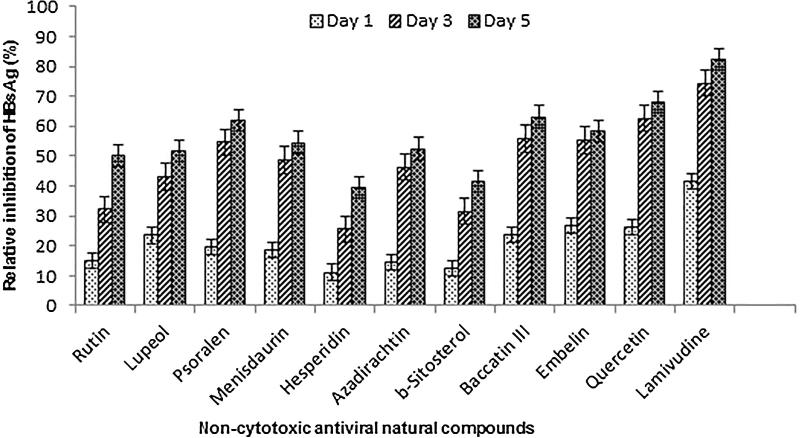
Despite high anti-HBV efficacies, while the nucleoside analogs (e.g., lamivudine) lead to the emergence of drug-resistance, interferons (e.g., IFN-α causes adverse side-effects. Comparatively, various natural or plant products have shown similar or even better efficacy. Hence, new antiviral strategies must focus not only on synthetic molecules but also on potential natural compounds. In this report, we have combined the in vitro cell culture and in silico molecular docking methods to assess the novel anti-HBV activity and delineate the inhibitory mechanism of selected plant-derived pure compounds of different classes. Of the tested (2.5-50 μg/ml) twelve non-cytotoxic compounds, ten (10 μg/ml) were found to maximally inhibit HBsAg production at day 5. Compared to quercetin (73%), baccatin III (71%), psoralen (67%), embelin (65%), menisdaurin (64%) and azadirachtin (62%) that showed high inhibition of HBeAg synthesis, lupeol (52%), rutin (47%), β-sitosterol (43%) and hesperidin (41%) had moderate efficacies against HBV replication. Further assessment of quercetin in combination with the highly active compounds, enhanced its anti-HBV activity up to 10%. Being the most important drug target, a 3-D structure of HBV polymerase (Pol/RT) was modeled and docked with the active compounds, including lamivudine as standard. Docking of lamivudine indicated strong interaction with the modeled HBV Pol active-site residues that formed stable complex (∆G = -5.2 kcal/mol). Similarly, all the docked antiviral compounds formed very stable complexes with HBV Pol (∆G = -6.1 to -9.3 kcal/mol). Taken together, our data suggest the anti-HBV potential of the tested natural compounds as novel viral Pol/RT inhibitors.
尽管核苷类似物(如拉米夫定)具有较高的抗乙肝病毒疗效,但会导致耐药性的出现,而干扰素(如 IFN-α)会引起不良副作用。相比之下,各种天然或植物产品已显示出相似甚至更好的疗效。因此,新的抗病毒策略不仅必须关注合成分子,还必须关注潜在的天然化合物。在本报告中,我们结合了体外细胞培养和计算机分子对接方法,以评估新型抗乙肝病毒活性,并阐明不同类别的选定植物源纯化合物的抑制机制。在测试的(2.5 - 50μg/ml)12 种无细胞毒性的化合物中,有 10 种(10μg/ml)在第 5 天被发现能最大程度地抑制 HBsAg 的产生。与显示出对 HBeAg 合成有高抑制作用的槲皮素(73%)、浆果赤霉素 III(71%)、补骨脂素(67%)、紫铆因(65%)、千金藤素(64%)和印楝素(62%)相比,羽扇豆醇(52%)、芦丁(47%)、β-谷甾醇(43%)和橙皮苷(41%)对乙肝病毒复制具有中等疗效。槲皮素与高活性化合物联合使用的进一步评估表明,其抗乙肝病毒活性提高了 10%。作为最重要的药物靶点,构建了乙肝病毒聚合酶(Pol/RT)的三维结构,并与包括作为标准的拉米夫定在内的活性化合物进行对接。拉米夫定的对接表明与建模的乙肝病毒 Pol 活性位点残基有强烈相互作用,形成了稳定的复合物(∆G = -5.2 kcal/mol)。同样,所有对接的抗病毒化合物都与乙肝病毒 Pol 形成了非常稳定的复合物(∆G = -6.1 至 -9.3 kcal/mol)。综上所述,我们的数据表明所测试的天然化合物作为新型病毒 Pol/RT 抑制剂具有抗乙肝病毒的潜力。