State Key Laboratory of Phytochemistry and Plant Resources in West China and Yunnan Key Laboratory of Natural Medicinal Chemistry, Kunming Institute of Botany, Chinese Academy of Sciences, Kunming 650201, P. R. China.
University of Chinese Academy of Sciences, Beijing 100049, P. R. China.
Plant Commun. 2021 Aug 12;2(5):100233. doi: 10.1016/j.xplc.2021.100233. eCollection 2021 Sep 13.
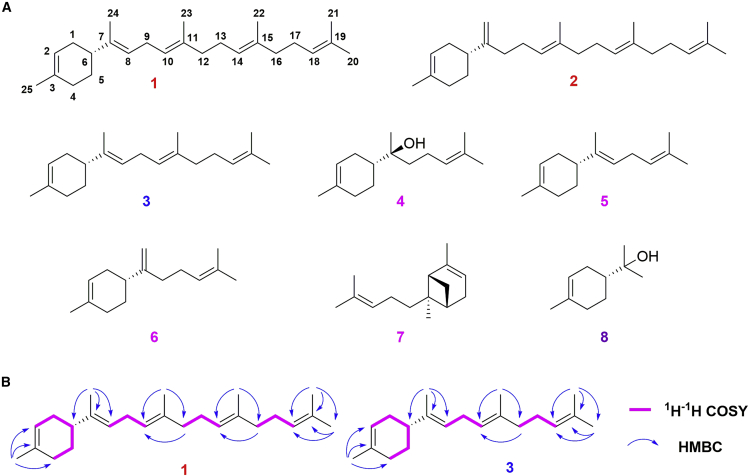
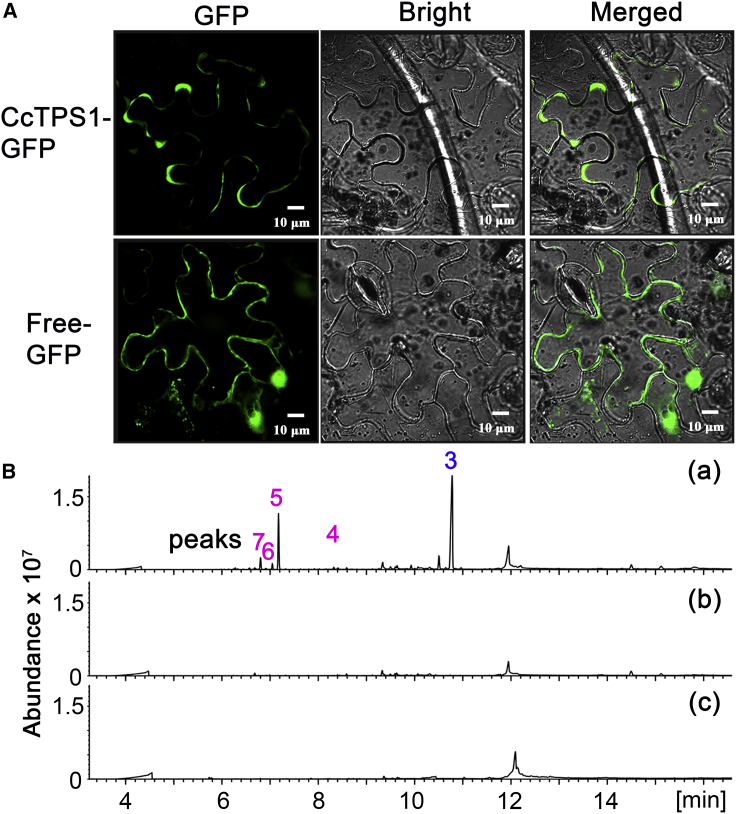
Terpenoids are the largest class of natural products with complex structures and extensive bioactivities; their scaffolds are generated by diverse terpenoid synthases (TPSs) from a limited number of isoprenoid diphosphate precursors. Promiscuous TPSs play important roles in the evolution of terpenoid chemodiversity, but they remain largely unappreciated. Here, an extremely promiscuous terpenoid synthase (CcTPS1) of the TPS-b subfamily was cloned and functionally characterized from a leaf-specific transcriptome of the Lamiaceae plant var. . CcTPS1 is the first sester-/di-/sesqui-/mono-TPS identified from the plant kingdom, accepting C/C/C/C diphosphate substrates to generate a panel of sester-/di-/sesqui-/mono-terpenoids. Engineered expressing produced three previously unreported terpenoids (two sesterterpenoids and a diterpenoid) with rare cyclohexane-containing skeletons, along with four sesquiterpenoids and one monoterpenoid. Their structures were elucidated by extensive nuclear magnetic resonance spectroscopy. transiently expressing also produced the diterpenoid and sesquiterpenoids, demonstrating the enzyme's promiscuity . Its highly leaf-specific expression pattern combined with detectable terpenoid products in leaves of . var. and expressing suggested that CcTPS1 was mainly responsible for diterpenoid and sesquiterpenoid biosynthesis in plants. expression and the terpenoid products could be induced by methyl jasmonate, suggesting their possible role in plant-environment interaction. CcTPS1 was localized to the cytosol and may differ from mono-TPSs in subcellular compartmentalization and substrate tolerance. These findings will greatly aid our understanding of plant TPS evolution and terpenoid chemodiversity; they also highlight the enormous potential of transcriptome mining and heterologous expression for the exploration of unique enzymes and natural products hidden in plants.
萜类化合物是具有复杂结构和广泛生物活性的最大类天然产物;它们的骨架由多种多样的萜烯合酶(TPS)从有限数量的异戊烯二磷酸前体生成。混杂的 TPS 在萜类化合物化学多样性的进化中发挥着重要作用,但它们在很大程度上仍未被认识。在这里,从唇形科植物的叶特异性转录组中克隆并功能表征了一个极其混杂的萜烯合酶(CcTPS1),属于 TPS-b 亚家族。CcTPS1 是从植物界鉴定出的第一个甾体/二萜/倍半萜/单萜合酶,接受 C/C/C/C 二磷酸底物生成一组甾体/二萜/倍半萜/单萜。工程化的 表达产生了三种以前未报道的萜类化合物(两种甾体萜和一种二萜),它们具有罕见的环己烷骨架,以及四种倍半萜和一种单萜。通过广泛的核磁共振波谱对它们的结构进行了阐明。 瞬时表达 也产生了二萜和倍半萜,证明了该酶的混杂性。它的高度叶特异性表达模式与 var. 叶中的可检测萜类产物相结合,表明 CcTPS1 主要负责植物中二萜和倍半萜的生物合成。 表达和萜类产物可以被茉莉酸甲酯诱导,这表明它们可能在植物与环境的相互作用中发挥作用。CcTPS1 定位于细胞质中,可能与单萜合酶在亚细胞区室化和底物耐受性方面存在差异。这些发现将极大地帮助我们理解植物 TPS 进化和萜类化合物化学多样性;它们还突出了转录组挖掘和异源表达在探索植物中隐藏的独特酶和天然产物方面的巨大潜力。