Kallel Ameni, Rekik Molka, Khemakhem Mahdi
Data Engineering and Semantics Research Unit, Faculty of Sciences of Sfax, University of Sfax, Sfax, Tunisia.
Département Technologies de l'Informatique, Higher Institute of Technological Studies (ISET), Sidi Bouzid, Tunisia.
J Supercomput. 2022;78(5):7078-7105. doi: 10.1007/s11227-021-04166-9. Epub 2021 Nov 5.
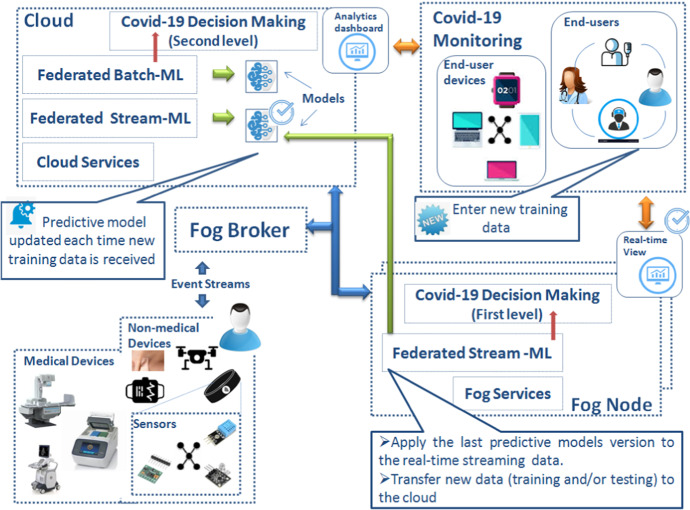
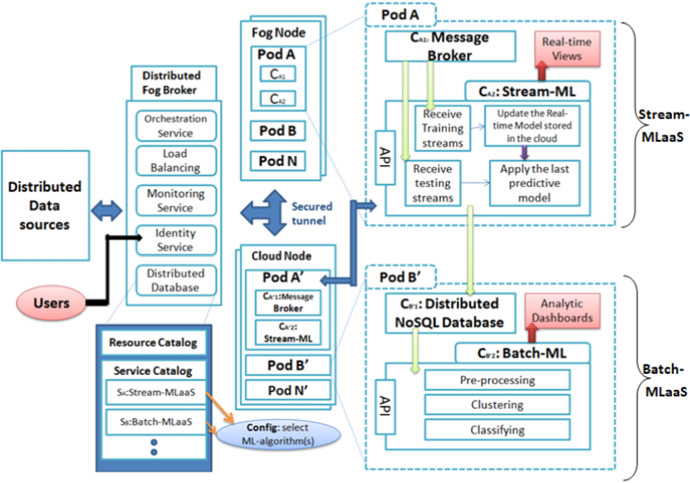
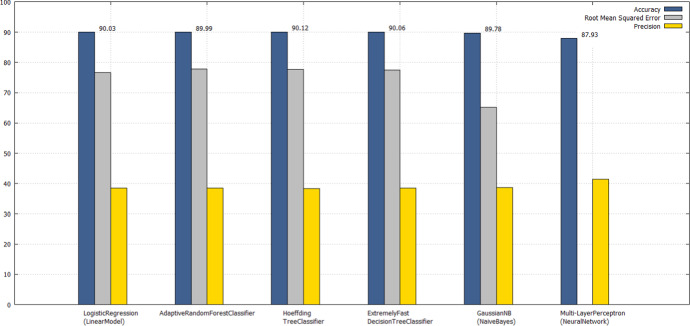
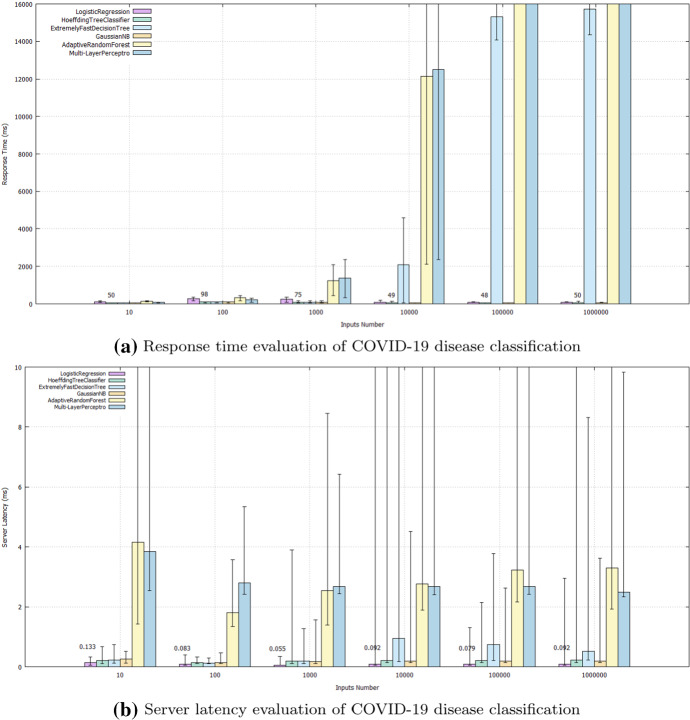
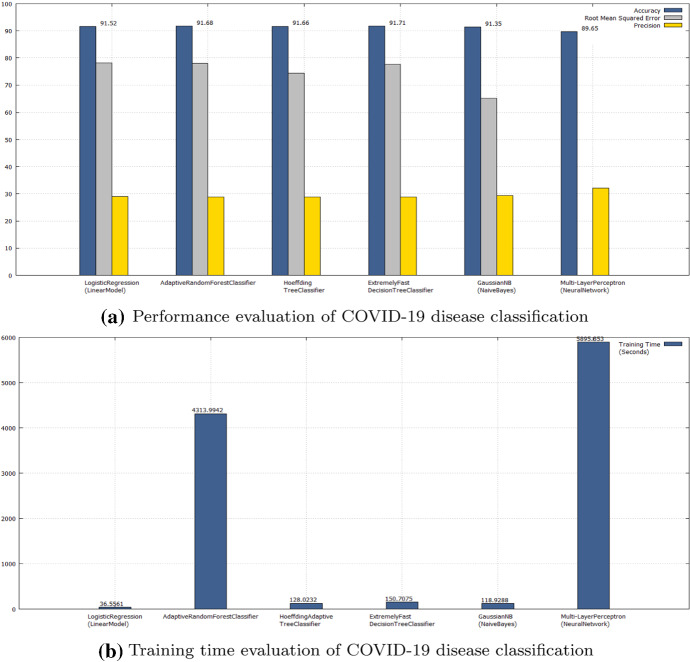
The COronaVIrus Disease 2019 (COVID-19) pandemic is unfortunately highly transmissible across the people. In order to detect and track the suspected COVID-19 infected people and consequently limit the pandemic spread, this paper entails a framework integrating the machine learning (ML), cloud, fog, and Internet of Things (IoT) technologies to propose a novel smart COVID-19 disease monitoring and prognosis system. The proposal leverages the IoT devices that collect streaming data from both medical (e.g., X-ray machine, lung ultrasound machine, etc.) and non-medical (e.g., bracelet, smartwatch, etc.) devices. Moreover, the proposed hybrid fog-cloud framework provides two kinds of federated ML as a service (federated MLaaS); (i) the distributed batch MLaaS that is implemented on the cloud environment for a long-term decision-making, and (ii) the distributed stream MLaaS, which is installed into a hybrid fog-cloud environment for a short-term decision-making. The stream MLaaS uses a shared federated prediction model stored into the cloud, whereas the real-time symptom data processing and COVID-19 prediction are done into the fog. The federated ML models are determined after evaluating a set of both batch and stream ML algorithms from the Python's libraries. The evaluation considers both the quantitative (i.e., performance in terms of accuracy, precision, root mean squared error, and 1 score) and qualitative (i.e., quality of service in terms of server latency, response time, and network latency) metrics to assess these algorithms. This evaluation shows that the stream ML algorithms have the potential to be integrated into the COVID-19 prognosis allowing the early predictions of the suspected COVID-19 cases.
不幸的是,2019年冠状病毒病(COVID-19)大流行在人群中具有高度传染性。为了检测和追踪疑似感染COVID-19的人群,从而限制大流行的传播,本文提出了一个整合机器学习(ML)、云、雾和物联网(IoT)技术的框架,以构建一个新型的智能COVID-19疾病监测与预后系统。该方案利用物联网设备从医疗设备(如X光机、肺部超声机等)和非医疗设备(如手环、智能手表等)收集流数据。此外,所提出的混合雾云框架提供两种联邦机器学习即服务(federated MLaaS);(i)在云环境中实现的用于长期决策的分布式批处理MLaaS,以及(ii)安装在混合雾云环境中用于短期决策的分布式流MLaaS。流MLaaS使用存储在云中的共享联邦预测模型,而实时症状数据处理和COVID-19预测则在雾中进行。联邦ML模型是在评估了Python库中的一组批处理和流ML算法后确定的。评估考虑了定量指标(即准确率、精确率、均方根误差和F1分数方面的性能)和定性指标(即服务器延迟、响应时间和网络延迟方面的服务质量)来评估这些算法。该评估表明,流ML算法有潜力被集成到COVID-19预后中,从而实现对疑似COVID-19病例的早期预测。