Unità di Botanica, Dipartimento di Biologia, Università di Pisa, 56126, Pisa, Italy.
Dipartimento di Scienze Biologiche, Geologiche e Ambientali, Centro Interuniversitario per la Biodiversità Vegetale Big Data - PLANT DATA, Alma Mater Studiorum Università di Bologna, 40126, Bologna, Italy.
New Phytol. 2022 Feb;233(3):1494-1504. doi: 10.1111/nph.17844. Epub 2021 Nov 26.
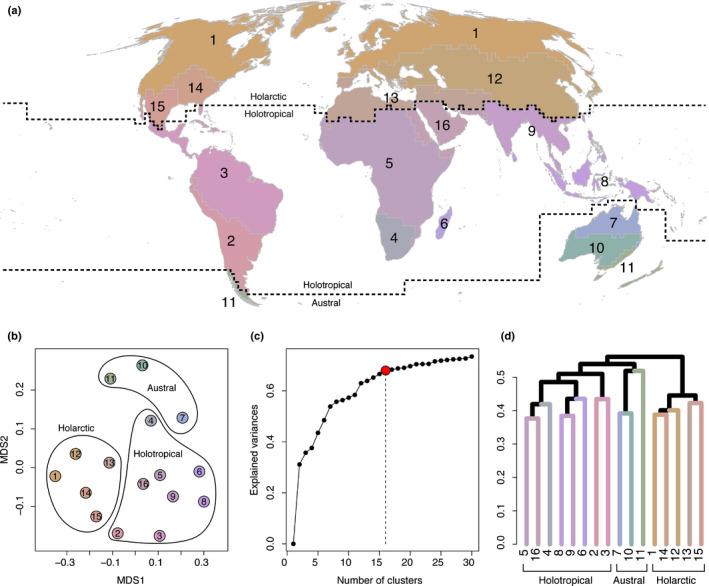
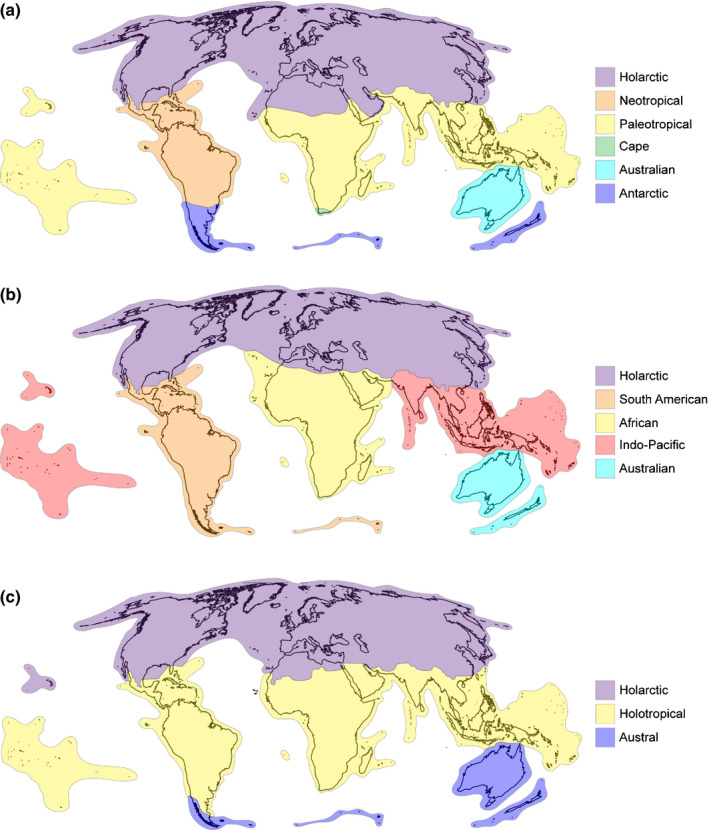
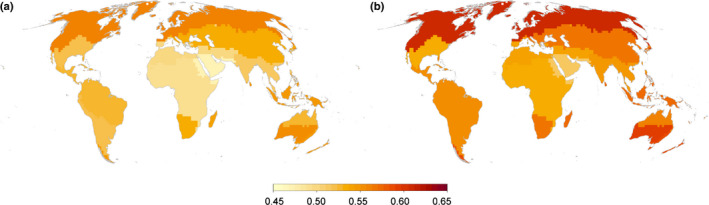
Existing global regionalization schemes for plants consider the compositional affinities among biotas, but these have not explicitly considered phylogenetic information. Here, we present for the first time, a phytogeographical delineation of the global vascular flora based on species-level evolutionary relationships. We analysed 8737 820 geographical occurrence records for vascular plants together with a time-calibrated phylogeny including 67 269 species. We constructed a global phylogenetic regionalization by estimating species composition and phylogenetic beta diversity among 200 km × 200 km grid cells across the world. We identified de novo 16 phytogeographical units that are deeply split into two clusters: Laurasian and Gondwanan. Our regionalization broadly matches previous schemes, but also highlights the separation of the Gondwanan biota into an Holotropical cluster and an Australian-Neozealandic-Patagonian cluster. In contrast, no clear split among Laurasian and Gondwanan biotas was retrieved when omitting phylogenetic information. The integration of phylogenetic and geographical information provides new insights into the delineation of phytogeographical areas and their historical relationships, enabling the identification of three large, clearly differentiated biotas, here referred to as kingdoms: Holarctic, Holotropical, and Austral. Our results provide further evidence for delineating transition zones and show a clear latitudinal pattern of increasing evolutionary distinctiveness towards the poles.
现有的植物全球区域化方案考虑了生物群之间的组成亲缘关系,但这些方案并没有明确考虑系统发育信息。在这里,我们首次根据物种水平的进化关系,对全球维管植物进行了植物地理学的划分。我们分析了 8737820 个维管植物的地理分布记录,以及一个包含 67269 个物种的时间校准的系统发育树。我们通过估计全球 200km×200km 网格细胞之间的物种组成和系统发育β多样性,构建了一个全球系统发育区域化。我们新识别出 16 个植物地理单元,这些单元被深分为两个集群:Laurasian 和 Gondwanan。我们的区域化方案与以前的方案大致相符,但也突出了冈瓦纳生物群的分离,分为全热带集群和澳大利亚-新西兰-巴塔哥尼亚集群。相比之下,当排除系统发育信息时,Laurasian 和 Gondwanan 生物群之间没有明显的分裂。系统发育和地理信息的整合为植物地理区域的划定及其历史关系提供了新的见解,能够识别出三个大的、明显分化的生物群,这里称为王国:全北极、全热带和澳大利亚。我们的结果为划定过渡带提供了进一步的证据,并显示出向极地进化独特性逐渐增加的明显纬度模式。