Gross Collin P, Wright April M, Daru Barnabas H
Department of Biology, Stanford University, Stanford, CA 94305, USA.
Department of Biological Sciences, Southeastern Louisiana University, Hammond, LA 70402, USA.
Philos Trans R Soc Lond B Biol Sci. 2025 Jan 9;380(1917):20230211. doi: 10.1098/rstb.2023.0211.
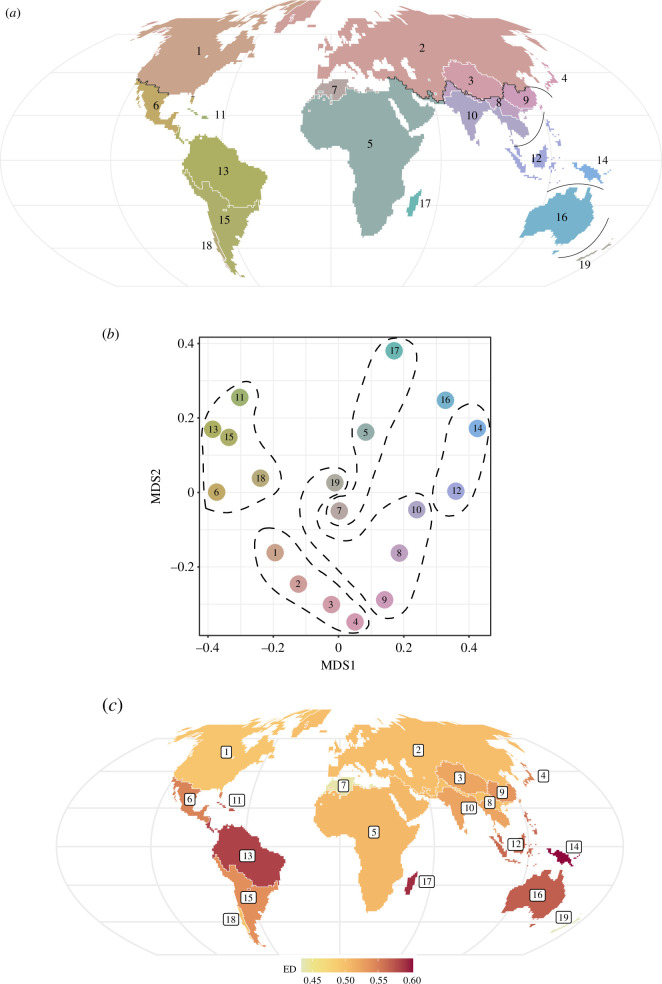
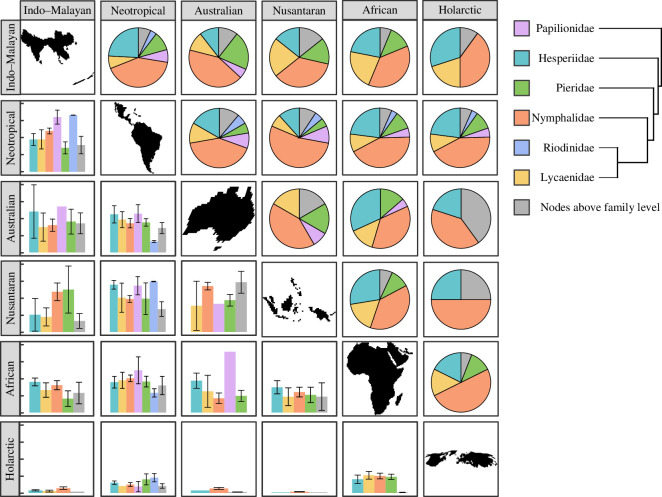
The partitioning of global biodiversity into biogeographic regions is critical for understanding the impacts of global-scale ecological and evolutionary processes on species assemblages as well as prioritizing areas for conservation. However, the lack of globally comprehensive data on species distributions precludes fine-scale estimation of biogeographical regionalization for numerous taxa of ecological, economic and conservation interest. Using a recently published phylogeny and novel curated native range maps for over 10 000 species of butterflies around the world, we delineated biogeographic regions for the world's butterflies using phylogenetic dissimilarity. We uncovered 19 distinct phylogenetically delimited regions (phyloregions) nested within 6 realms. Regional boundaries were predicted by spatial turnover in modern-day temperature and precipitation seasonality, but historical climate change also left a pronounced fingerprint on deeper- (realm-) level boundaries. We use a culturally and ecologically important group of insects to expand our understanding of how historical and contemporary factors drive the distribution of organismal lineages on the Earth. As insects and global biodiversity more generally face unprecedented challenges from anthropogenic factors, our research provides the groundwork for prioritizing regions and taxa for conservation, especially with the goal of preserving the legacies of our biosphere's evolutionary history.This article is part of the discussion meeting issue 'Bending the curve towards nature recovery: building on Georgina Mace's legacy for a biodiverse future'.
将全球生物多样性划分为生物地理区域对于理解全球尺度的生态和进化过程对物种组合的影响以及确定保护重点区域至关重要。然而,缺乏关于物种分布的全球综合数据,使得无法对众多具有生态、经济和保护意义的分类群进行生物地理区域化的精细尺度估计。利用最近发表的系统发育树和为全球一万多种蝴蝶精心制作的新的原生范围地图,我们利用系统发育差异划定了世界蝴蝶的生物地理区域。我们发现了嵌套在6个生物地理界内的19个不同的系统发育界定区域(系统发育区)。区域边界由现代温度和降水季节性的空间周转率预测,但历史气候变化也在更深层次(生物地理界)的边界上留下了明显的印记。我们利用一组在文化和生态上具有重要意义的昆虫,来扩展我们对历史和当代因素如何驱动地球上生物谱系分布的理解。由于昆虫乃至全球生物多样性普遍面临着来自人为因素的前所未有的挑战,我们的研究为确定保护区域和分类群提供了基础,特别是以保护我们生物圈进化历史遗产为目标。本文是讨论会特刊“扭转自然恢复曲线:以乔治娜·梅斯的遗产为基础,实现生物多样性的未来”的一部分。