Jindal Tarun, Pawar Pravin, Agarwal Sanjit, Jain Prateek, Meena Monika, Sarwal Ankush, Dhanalakshmi M
Department of Uro-oncology, Tata Medical Centre, Kolkata, West Bengal, India.
Department of Breast Surgery, Tata Medical Centre, Kolkata, West Bengal, India.
Urol Ann. 2021 Oct-Dec;13(4):391-396. doi: 10.4103/UA.UA_112_20. Epub 2021 Jun 23.
The association between inflammation and malignancies is being recognized. In this study, we assessed the use of preoperative neutrophil-lymphocyte ratio (NLR) and lymphocyte-monocyte ratio (LMR) in predicting cancer-specific survival (CSS) and inguinal node involvement in patients with carcinoma penis.
Sixty-nine patients operated for squamous cell carcinoma penis with inguinal node dissection between 2012 and 2020 were identified. We recorded the type of surgery (partial/total penectomy), T stage, grade, lymphovascular invasion (LVI), perineural invasion (PNI), pathological status of inguinal nodes and nodal stage (pN1-3), extranodal extension (ENE), and CSS. The hemogram performed within 2 weeks of surgery was used for calculating NLR and LMR.
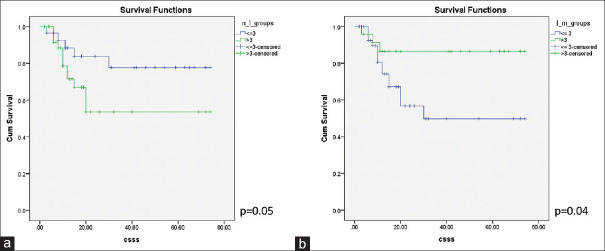
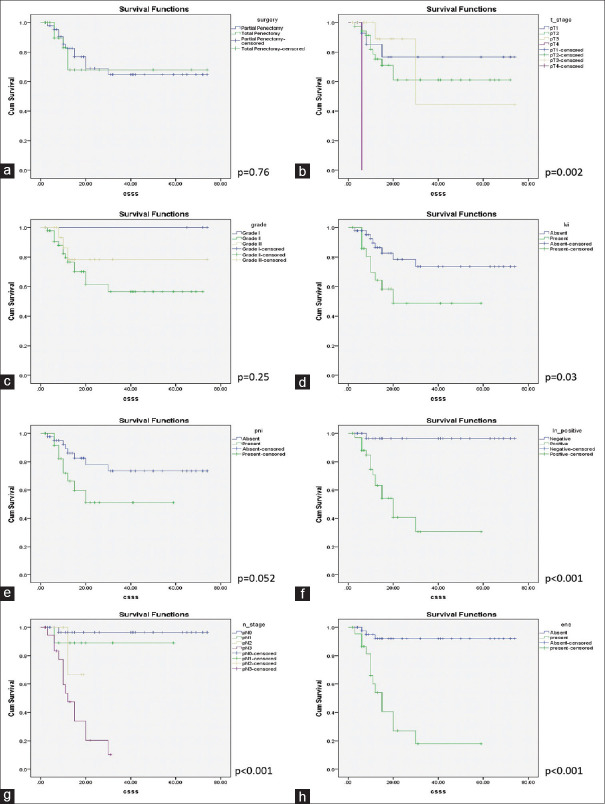
Partial penectomy was the most common surgery (65.22%) and pT2 was the most common stage (53.62%). Grade 2 was seen in 66.67%, LVI in 34.78%, PNI in 37.68%, 52.17% had inguinal node involvement with pN3 being the most common (36.23%), and 36.23% had ENE. Kaplan-Meier analysis revealed that NLR of >3 and the LMR ≤3 indicated an inferior CSS ( = 0.05 and 0.04, respectively). T stage, inguinal node involvement, LVI, pN stage, and ENE were also associated with inferior CSS ( < 0.05). On multivariate analysis, T stage was significantly associated with CSS ( = 0.02). The NLR >3 and LMR ≤3 were also significantly associated with the presence of pathological inguinal node involvement ( = 0.001 and 0.026).
NLR and LMR may help in predicting CSS and inguinal node involvement in patients of carcinoma penis.
炎症与恶性肿瘤之间的关联正逐渐被认识。在本研究中,我们评估了术前中性粒细胞与淋巴细胞比值(NLR)和淋巴细胞与单核细胞比值(LMR)在预测阴茎癌患者癌症特异性生存(CSS)及腹股沟淋巴结受累情况方面的应用。
确定了2012年至2020年间接受腹股沟淋巴结清扫术的69例阴茎鳞状细胞癌手术患者。我们记录了手术类型(部分/全阴茎切除术)、T分期、分级、淋巴管浸润(LVI)、神经周围浸润(PNI)、腹股沟淋巴结的病理状态及淋巴结分期(pN1 - 3)、结外扩展(ENE)和CSS。手术2周内进行的血常规用于计算NLR和LMR。
部分阴茎切除术是最常见的手术方式(65.22%),pT2是最常见的分期(53.62%)。2级见于66.67%的患者,LVI见于34.78%的患者,PNI见于37.68%的患者,52.17%的患者有腹股沟淋巴结受累,其中pN3最为常见(36.23%),36.23%的患者有ENE。Kaplan - Meier分析显示,NLR >3和LMR≤3表明CSS较差(分别为= 0.05和0.04)。T分期、腹股沟淋巴结受累、LVI、pN分期和ENE也与较差的CSS相关(< 0.05)。多因素分析显示,T分期与CSS显著相关(= 0.02)。NLR >3和LMR≤3也与病理腹股沟淋巴结受累的存在显著相关(= 0.001和0.026)。
NLR和LMR可能有助于预测阴茎癌患者的CSS和腹股沟淋巴结受累情况。