Huang Chun-Hou, Peng Tai-Chu, Cheng Yi-Tso, Huang Yen-Ta, Chang Bee-Song
Department of Nursing, Tzu Chi University, Hualien, Taiwan.
Department of Cardiovascular Surgery, Dalin Tzu Chi Hospital, Buddhist Tzu Chi Medical Foundation, Chiayi, Taiwan.
Tzu Chi Med J. 2021 Apr 26;33(4):412-418. doi: 10.4103/tcmj.tcmj_273_20. eCollection 2021 Oct-Dec.
During perioperative, lung cancer (LC) patients are often left to experience debilitating disease-related symptoms, impaired physical activity and health-related quality of life (HRQoL), and social difficulties, despite the progress achieved in terms of treatment efficacy. Nonpharmacological intervention, such as exercise, has been identified as an effective strategy in LC patients before and after lung resection. Therefore, we aimed to assess evidence of the effect of perioperative exercise among patients with LC.
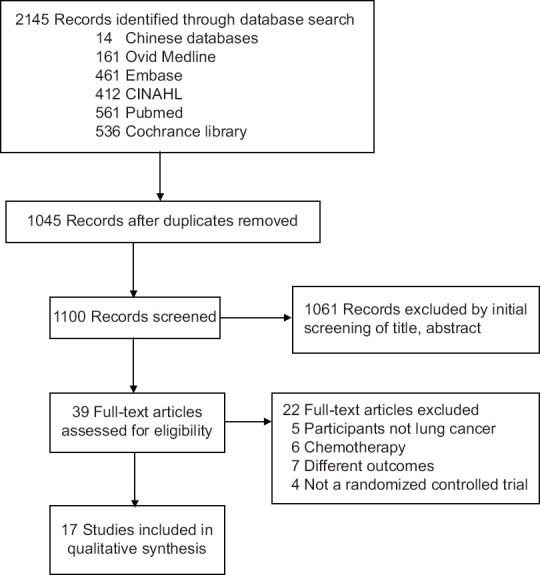
Seven databases were searched from January 1998 to September 2020. All randomized controlled trials (RCTs) that evaluated the effect of exercise on the physical and psychological status of patients with LC during the perioperative period were reviewed. Two reviewers independently assessed the quality of all studies included here using the revised Cochrane risk of bias tool for RCTs.
Seventeen RCTs (1199 participants) published between 2011 and 2019 met for this literature review. The outcome measures that emerged from these studies included subjective outcomes, such as HRQoL, pain score, fatigue, and objective effects, such as cardiorespiratory fitness, pulmonary function, physical activity, and biological markers. Overall, these studies suggest that exercise should be an optimal option for LC; however, its efficacy and effectiveness regarding HRQoL should be investigated further.
Perioperative exercise could be included in the rehabilitation program of patients with LC. More extensive, high-quality RCTs evidence is needed on the ideal exercise type, duration, intensity, and timing across the LC perioperative care.
在围手术期,尽管肺癌(LC)患者在治疗效果方面取得了进展,但他们常常会经历与疾病相关的衰弱症状、身体活动受损以及健康相关生活质量(HRQoL)下降,还有社交困难。非药物干预,如运动,已被确定为肺癌患者肺切除术前和术后的有效策略。因此,我们旨在评估围手术期运动对肺癌患者影响的证据。
检索了1998年1月至2020年9月的七个数据库。对所有评估运动对肺癌患者围手术期身体和心理状况影响的随机对照试验(RCT)进行了综述。两位评价者使用修订后的Cochrane随机对照试验偏倚风险工具独立评估了所有纳入研究的质量。
2011年至2019年间发表的17项随机对照试验(1199名参与者)符合本综述要求。这些研究得出的结果指标包括主观结果,如健康相关生活质量、疼痛评分、疲劳,以及客观效果,如心肺适能、肺功能、身体活动和生物标志物。总体而言,这些研究表明运动应该是肺癌患者的最佳选择;然而,其对健康相关生活质量的疗效和有效性仍需进一步研究。
围手术期运动可纳入肺癌患者的康复计划。需要更多关于肺癌围手术期护理中理想运动类型、持续时间、强度和时间安排的广泛、高质量随机对照试验证据。