Mohamed Amr, Jiang Renjian, Philip Philip A, Diab Maria, Behera Madhusmita, Wu Christina, Alese Olatunji, Shaib Walid L, Gaines Tyra M, Balch Glen G, El-Rayes Bassel F, Akce Mehmet
Case Comprehensive Cancer Center, Case Western Reserve University, Cleveland, OH, United States.
Winship Research Informatics Shared Resource, Winship Cancer Institute, Emory University, Atlanta, GA, United States.
Front Oncol. 2021 Oct 25;11:755113. doi: 10.3389/fonc.2021.755113. eCollection 2021.
High-risk features, such as T4 disease, bowel obstruction, poorly/undifferentiated histology, lymphovascular, perineural invasion, and <12 lymph nodes sampled, indicate poor prognosis and define high-risk stage II disease in proficient mismatch repair stage II colon cancer (CC). The prognostic role of high-risk features in dMMR/MSI-H stage II CC is unknown. Similarly, the role of adjuvant therapy in high-risk stage II CC with dMMR/MSI-H (≥1 high-risk feature) has not been studied in prospective trials. The aim of this analysis of the National Cancer Database is to evaluate the prognostic value of high-risk features in stage II dMMR/MSI-H CC.
Univariate (UVA) and multivariate (MVA) Cox proportional hazards (Cox-PH) models were built to assess the association between clinical and demographic characteristics and overall survival. Kaplan-Meier survival curves were generated with log-rank tests to evaluate the association between adjuvant chemotherapy in high-risk and low-risk cohorts separately.
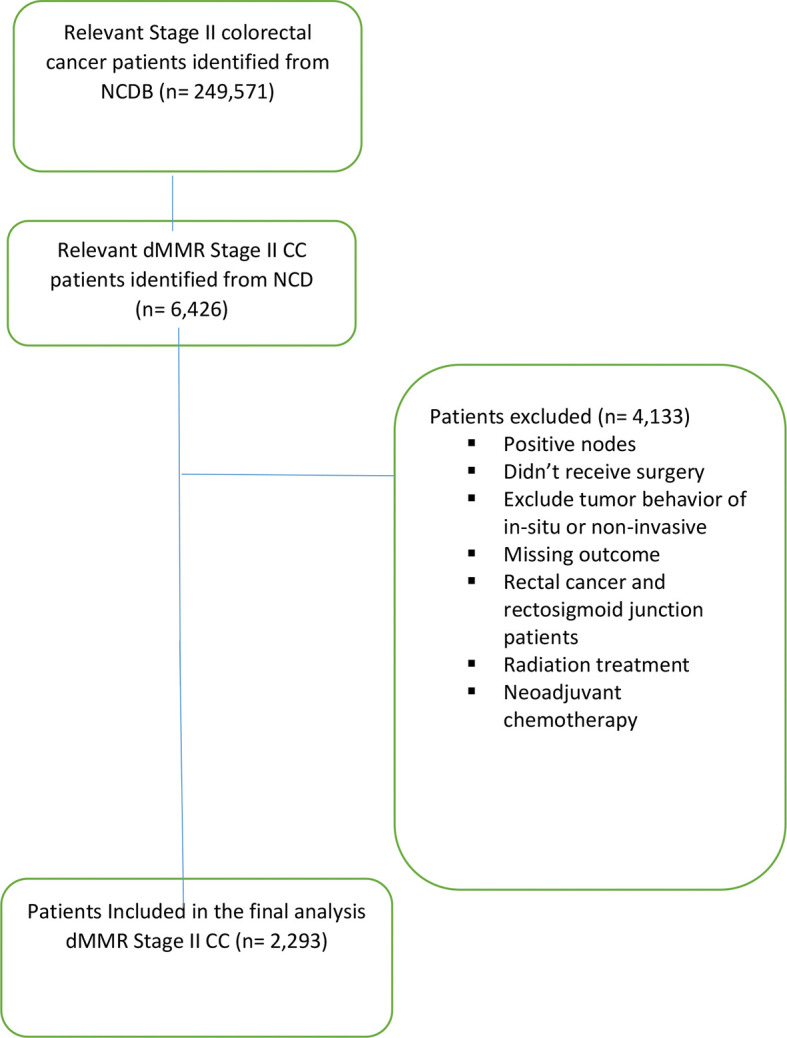
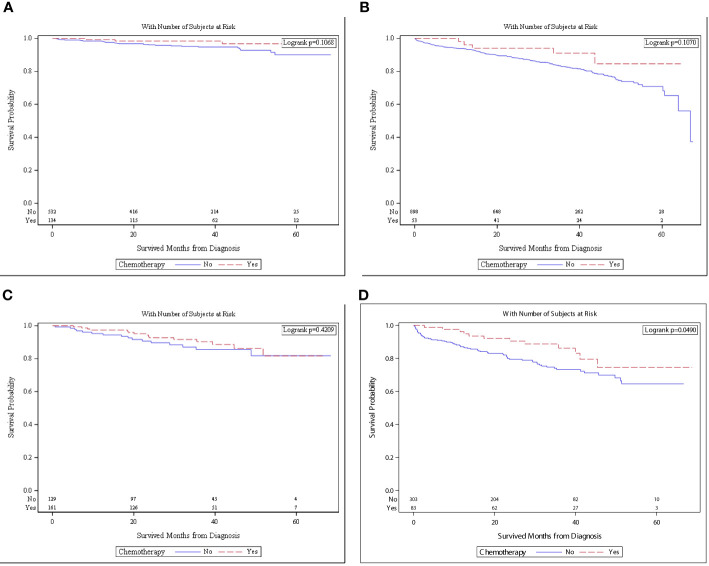
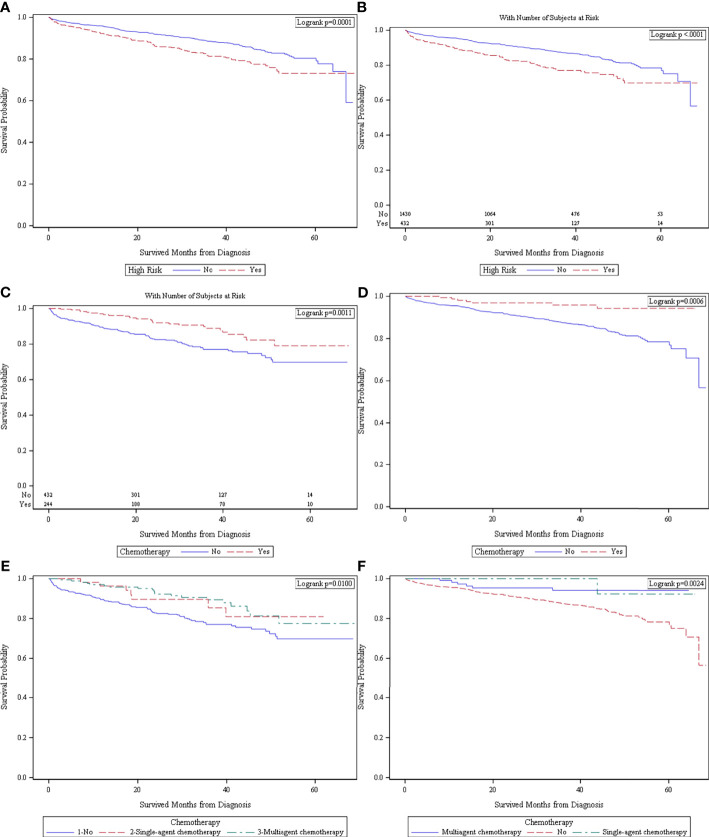
A total of 2,293 stage II CC patients have dMMR/MSI-H; of those, 29.5% ( = 676) had high-risk features. The high-risk dMMR/MSI-H patients had worse overall survival [5-year survival and 95%CI, 73.2% (67.3-78.1%) . 80.3% (76.7-83.5%), = 0.0001]. In patients with stage II dMMR/MSI-H CC, the high-risk features were associated with shorter overall survival (OS) along with male sex, positive carcinoembryonic antigen, Charlson-Deyo score >1, and older age. Adjuvant chemotherapy administration was associated with better OS, regardless of the high-risk features in dMMR/MSI-H (log-rank test, = 0.001) or not ( = 0.0006). When stratified by age, the benefit of chemotherapy was evident only in patients age ≥65 with high-risk features.
High-risk features are prognostic in the setting of dMMR/MSI-H stage II CC. Adjuvant chemotherapy may improve survival specifically in patients ≥65 years and with high-risk features.
高危特征,如T4期疾病、肠梗阻、组织学分级差/未分化、淋巴管、神经周围浸润以及取样淋巴结<12个,提示预后不良,并可定义错配修复功能正常的II期结肠癌(CC)的高危II期疾病。高危特征在错配修复缺陷/微卫星高度不稳定(dMMR/MSI-H)II期CC中的预后作用尚不清楚。同样,辅助治疗在具有dMMR/MSI-H(≥1个高危特征)的高危II期CC中的作用尚未在前瞻性试验中得到研究。本项对国家癌症数据库的分析旨在评估高危特征在II期dMMR/MSI-H CC中的预后价值。
构建单因素(UVA)和多因素(MVA)Cox比例风险(Cox-PH)模型,以评估临床和人口统计学特征与总生存期之间的关联。采用对数秩检验生成Kaplan-Meier生存曲线,分别评估高危和低危队列中辅助化疗与总生存期之间的关联。
共有2293例II期CC患者存在dMMR/MSI-H;其中,29.5%(n = 676)具有高危特征。高危dMMR/MSI-H患者的总生存期较差[5年生存率及95%CI,73.2%(67.3 - 78.1%)对80.3%(76.7 - 83.5%),P = 0.0001]。在II期dMMR/MSI-H CC患者中,高危特征与较短的总生存期(OS)相关,同时还与男性、癌胚抗原阳性、Charlson-Deyo评分>1以及年龄较大相关。无论dMMR/MSI-H中是否存在高危特征(对数秩检验,P = 0.001),辅助化疗均与较好的OS相关(P = 0.0006)。按年龄分层时,化疗的益处仅在年龄≥65岁且具有高危特征的患者中明显。
高危特征在dMMR/MSI-H II期CC中具有预后价值。辅助化疗可能会特别改善年龄≥65岁且具有高危特征患者的生存期。