Cherrier Nelda, Kearon Joanne, Tetreault Robin, Garasia Sophiya, Guindon Emmanuel
Department of Health Research Methods, Evidence and Impact, McMaster University, Hamilton, ON, Canada.
Centre for Health Economics and Policy Analysis, McMaster University, Hamilton, ON, Canada.
Pharmacoecon Open. 2022 May;6(3):329-342. doi: 10.1007/s41669-021-00309-z. Epub 2021 Nov 11.
As a core component of harm-reduction strategies to address the opioid crisis, several countries have instituted publicly funded programs to distribute naloxone for lay administration in the community. The effectiveness in reducing mortality from opioid overdose has been demonstrated in multiple systematic reviews. However, the economic impact of community naloxone distribution programs is not fully understood.
Our objective was to conduct a review of economic evaluations of community distribution of naloxone, assessing for quality and applicability to diverse contexts and settings.
The search strategy was performed on MEDLINE, Embase, and EconLit databases.
Search criteria were developed based on two themes: (1) papers involving naloxone or narcan and (2) any form of economic evaluation. A focused search of the grey literature was also conducted. Studies exploring the intervention of community distribution of naloxone were selected.
Data extraction was done using the British Medical Journal guidelines for economic submissions, assigning quality levels based on the impact of the missing or unclear components on the strength of the conclusions.
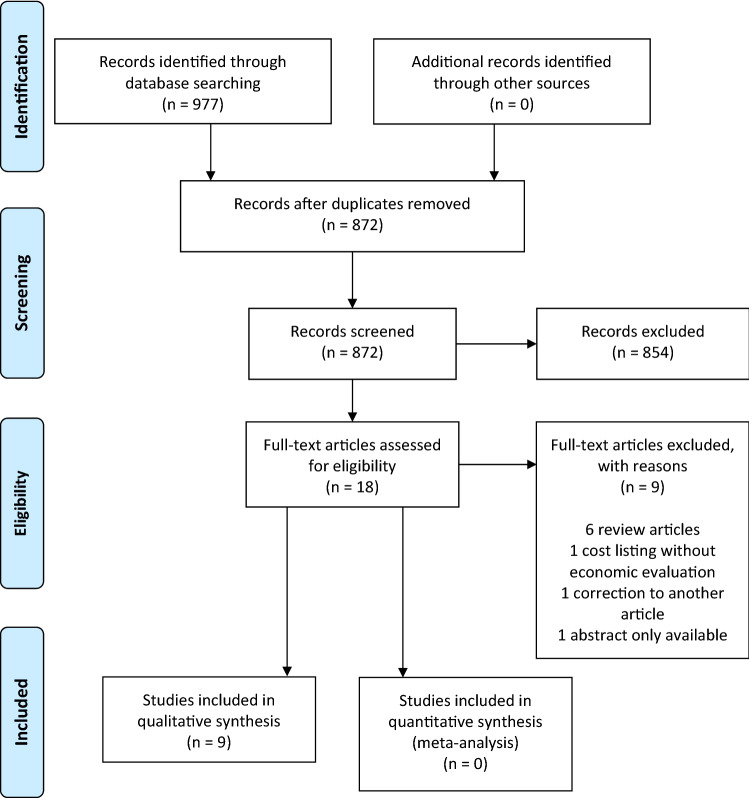
A total of nine articles matched our inclusion criteria: one cost-effectiveness analysis, eight cost-utility analyses, and one cost-benefit analysis. Overall, the quality of the studies was good (six of high quality, two of moderate quality, and one of low quality). All studies concluded that community distribution of naloxone was cost effective, with an incremental cost-utility ratio range of $US111-58,738 (year 2020 values) per quality-adjusted life-year gained.
Our search strategy was developed iteratively, rather than following an a priori design. Additionally, our search was limited to English terms.
Based on this review, community distribution of naloxone is a worthwhile investment and should be considered by other countries dealing with the opioid epidemic.
作为应对阿片类药物危机的减少伤害策略的核心组成部分,多个国家已设立公共资助项目,在社区分发纳洛酮以供非专业人员使用。多项系统评价已证明其在降低阿片类药物过量致死率方面的有效性。然而,社区纳洛酮分发项目的经济影响尚未得到充分了解。
我们的目的是对社区纳洛酮分发的经济评估进行综述,评估其质量以及对不同背景和环境的适用性。
检索策略在MEDLINE、Embase和EconLit数据库上执行。
检索标准基于两个主题制定:(1)涉及纳洛酮或纳曲酮的论文,以及(2)任何形式的经济评估。还对灰色文献进行了重点检索。选择了探索社区纳洛酮分发干预措施的研究。
使用《英国医学杂志》经济投稿指南进行数据提取,根据缺失或不明确成分对结论强度的影响确定质量水平。
共有9篇文章符合我们的纳入标准:1篇成本效益分析、8篇成本效用分析和1篇成本效益分析。总体而言,研究质量良好(6篇高质量,2篇中等质量,1篇低质量)。所有研究均得出结论,社区纳洛酮分发具有成本效益,每获得一个质量调整生命年的增量成本效用比范围为111 - 58,738美元(2020年价值)。
我们的检索策略是迭代制定的,而非遵循预先设计。此外,我们的检索仅限于英文术语。
基于本综述,社区纳洛酮分发是一项值得的投资,应对阿片类药物流行的其他国家应予以考虑。