Institut für Biologie, Humboldt-Universität zu Berlin, 10115, Berlin, Germany.
Molecular Biophysics and Integrated Bioimaging Division, Lawrence Berkeley National Laboratory, Berkeley, CA, 94720, USA.
Nat Commun. 2021 Nov 11;12(1):6531. doi: 10.1038/s41467-021-26781-z.
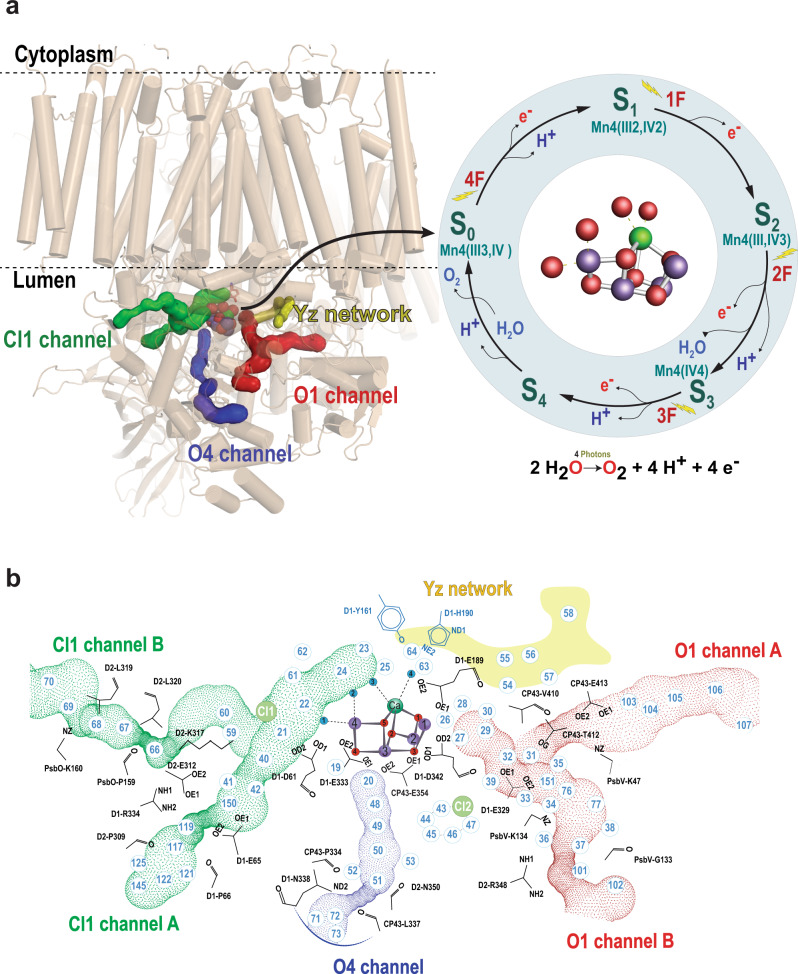
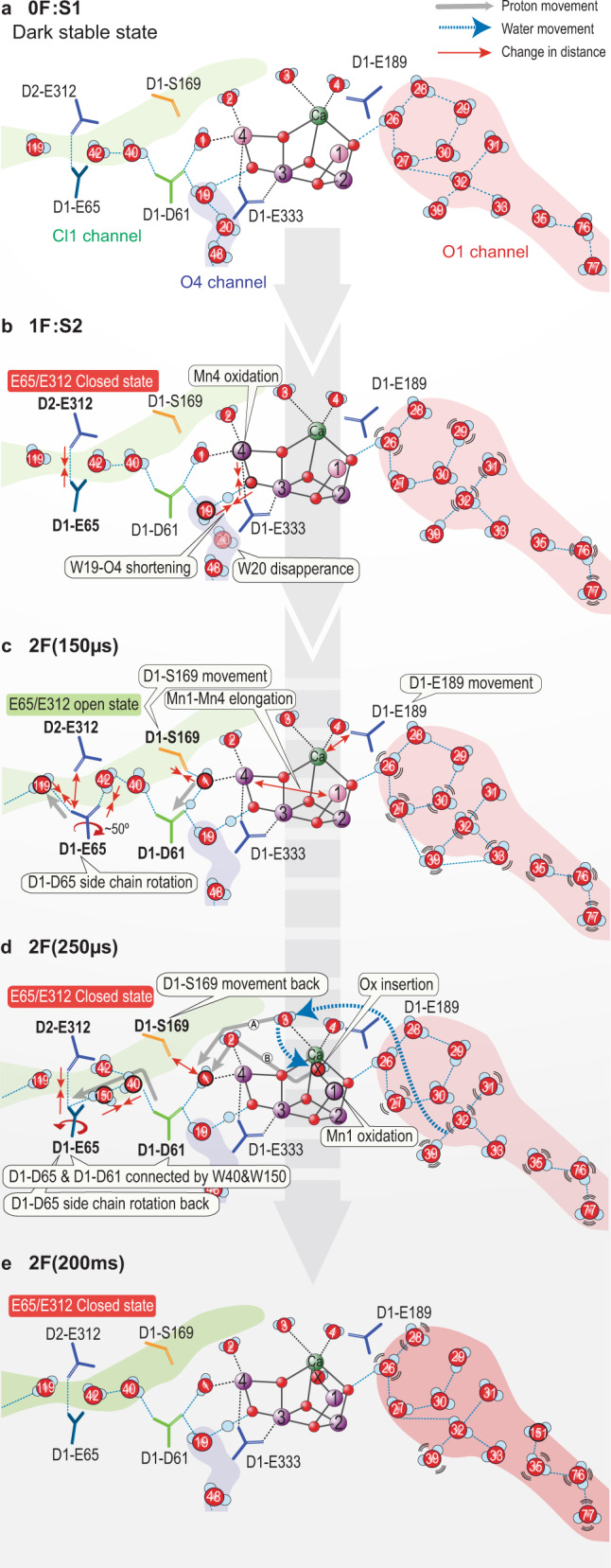
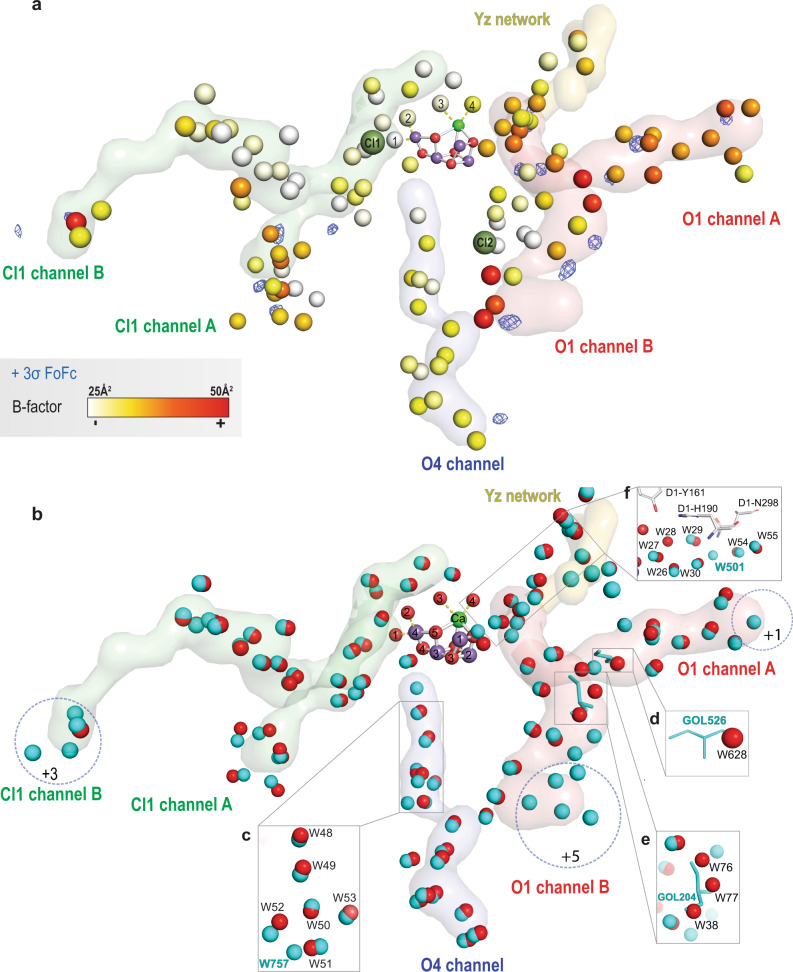
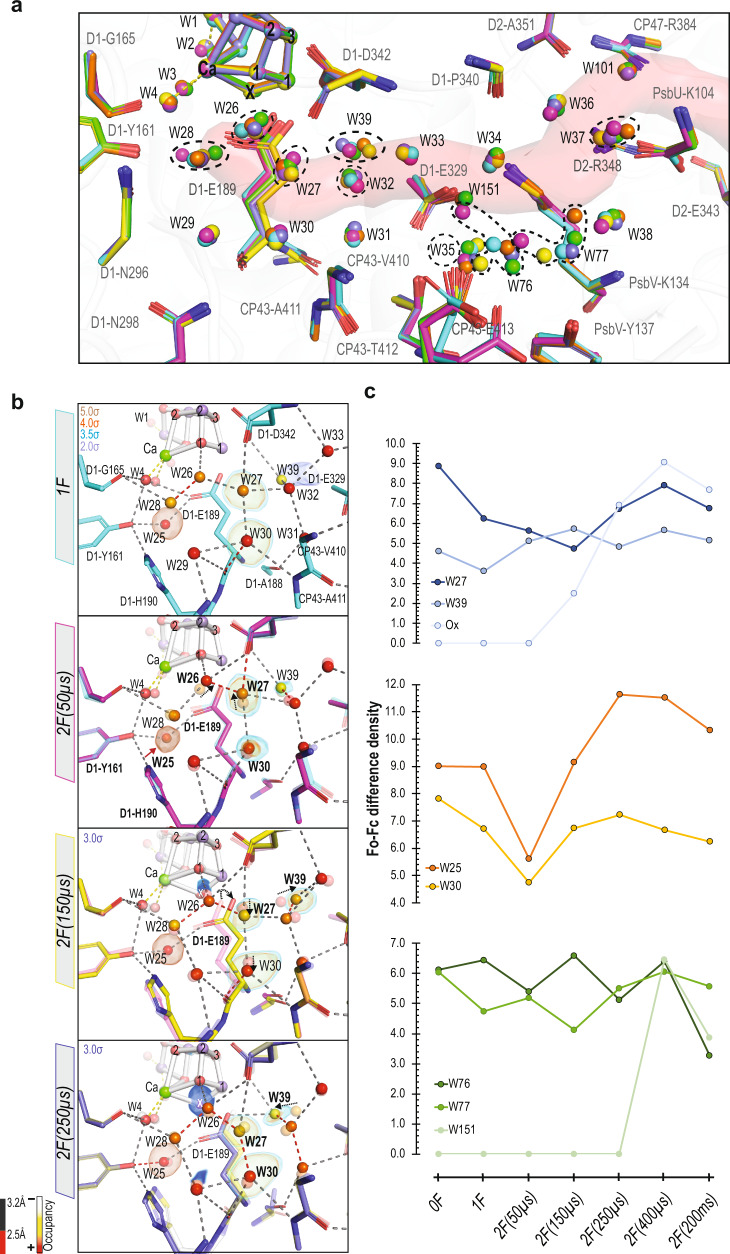
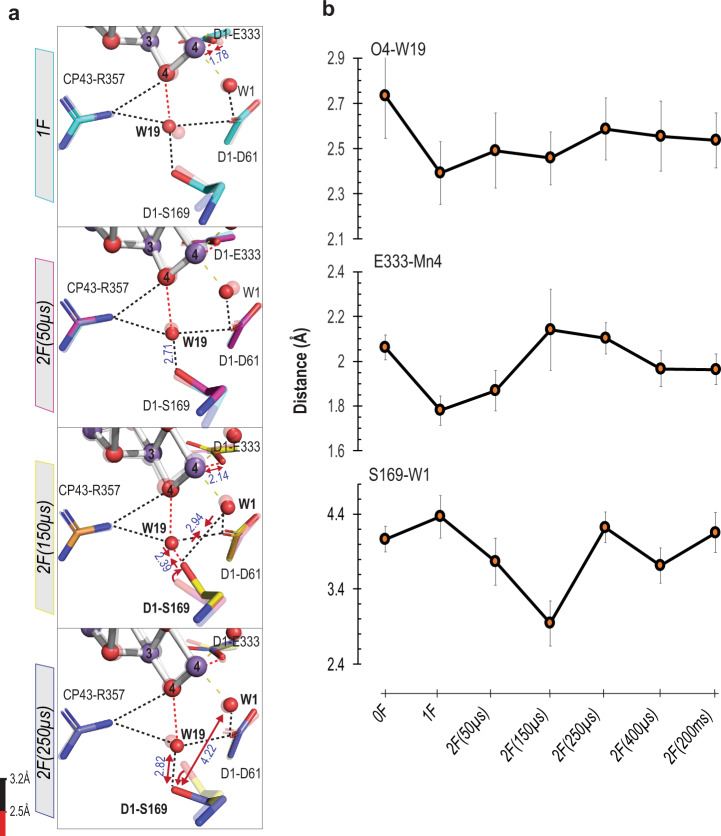
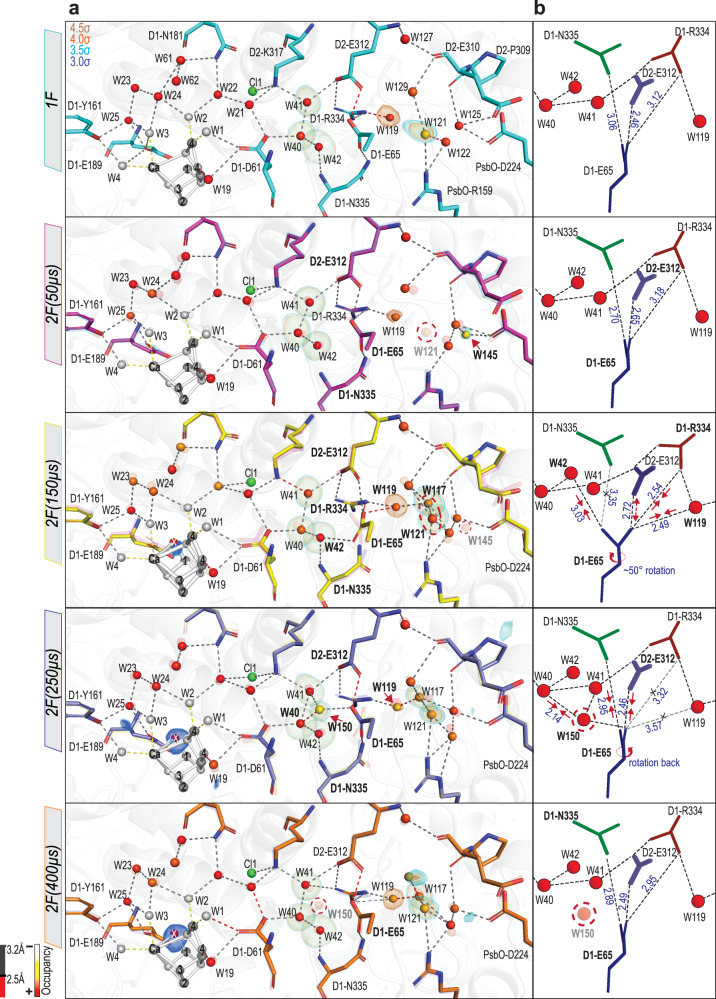
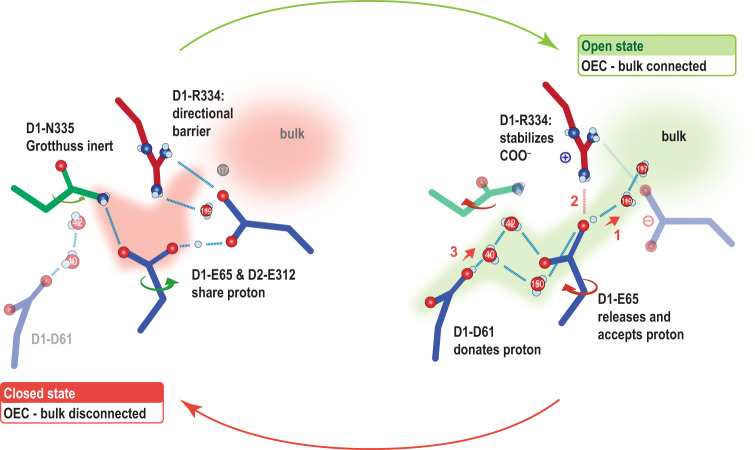
Light-driven oxidation of water to molecular oxygen is catalyzed by the oxygen-evolving complex (OEC) in Photosystem II (PS II). This multi-electron, multi-proton catalysis requires the transport of two water molecules to and four protons from the OEC. A high-resolution 1.89 Å structure obtained by averaging all the S states and refining the data of various time points during the S to S transition has provided better visualization of the potential pathways for substrate water insertion and proton release. Our results indicate that the O1 channel is the likely water intake pathway, and the Cl1 channel is the likely proton release pathway based on the structural rearrangements of water molecules and amino acid side chains along these channels. In particular in the Cl1 channel, we suggest that residue D1-E65 serves as a gate for proton transport by minimizing the back reaction. The results show that the water oxidation reaction at the OEC is well coordinated with the amino acid side chains and the H-bonding network over the entire length of the channels, which is essential in shuttling substrate waters and protons.
光驱动水氧化为分子氧是由光合作用系统 II(PS II)中的氧析出复合物(OEC)催化的。这种多电子、多质子催化需要将两个水分子运送到 OEC,并从 OEC 中释放出四个质子。通过对所有 S 态进行平均并对 S 态到 S 态转变过程中的各个时间点的数据进行细化,获得了分辨率为 1.89Å 的高分辨率结构,从而更好地可视化了底物水分子插入和质子释放的潜在途径。我们的结果表明,O1 通道可能是水摄入的途径,而 Cl1 通道可能是质子释放的途径,这是基于这些通道中水分子和氨基酸侧链的结构重排。特别是在 Cl1 通道中,我们建议残基 D1-E65 通过最小化反向反应来充当质子运输的门。结果表明,OEC 处的水氧化反应与通道全长的氨基酸侧链和氢键网络很好地协调,这对于穿梭底物水和质子是必不可少的。