Department of Orthopedics, China-Japan Union Hospital of Jilin University, Changchun, Jilin Province, People's Republic of China.
Department of Orthopedics, The Second Hospital of Jilin University, Changchun, Jilin Province, People's Republic of China.
Sci Rep. 2021 Nov 11;11(1):22122. doi: 10.1038/s41598-021-01531-9.
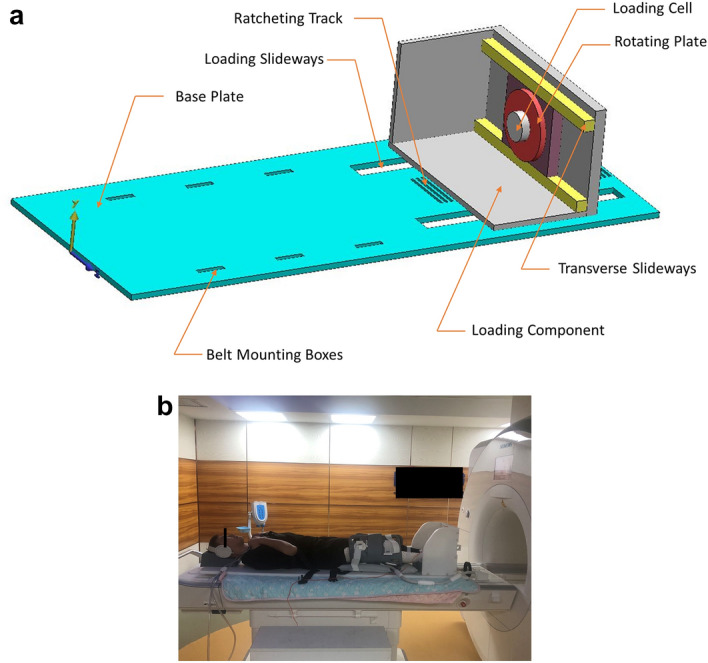
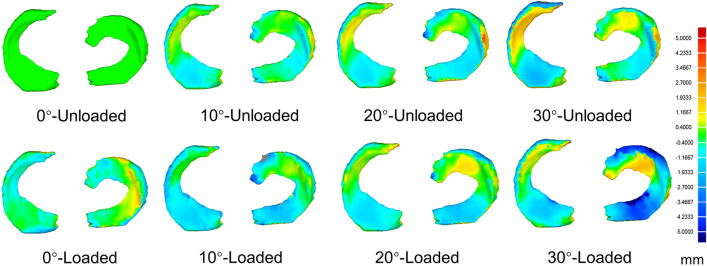
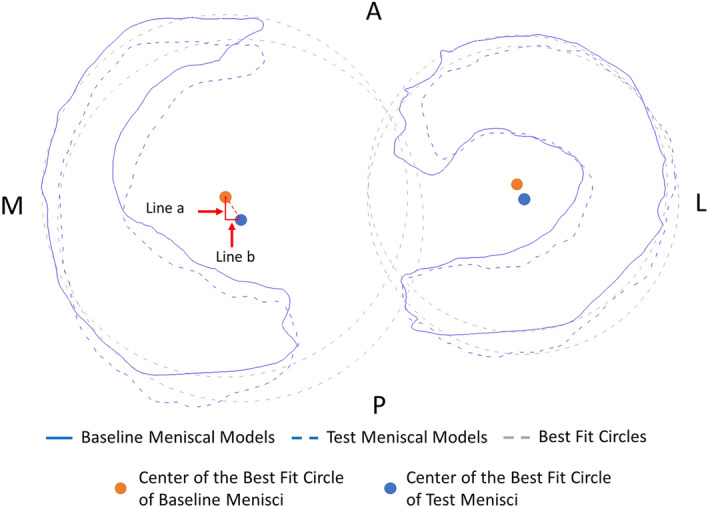
There are few studies investigate morphologic changes of knee meniscus in vivo mechanical loading and three-dimensions (3D) deformation and displacement of the whole meniscus between in vivo mechanical loading and unloading conditions are still unclear. To investigate the displacements and 3D morphological changes of the menisci under knee weight-bearing and early flexion conditions in healthy adults using a Magnetic Resonance Imaging (MRI)-compatible loading device (a 3.0 T MR imaging system) combined with a newly developed 3D comparison technique. Fifteen healthy volunteers were recruited in this cross-sectional observational study. Each subject underwent MRIs of their dominant right knee in eight different scanning conditions using a 3.0-T MRI scanner with a custom-made MRI-compatible loading device. The knee meniscus images were 3D reconstructed, and dimensional comparisons were made for each meniscal model with baseline (0°-unloaded model). The morphologic changes of the meniscal-anterior horn (AH), body (BD), and posterior horn (PH) regions were expressed as mean positive and negative deviations. The displacements were further investigated, and the meniscal extrusions of different subregions were measured. The morphologic changing patterns of human meniscus under loading and flexions were presented using 3D chromatic maps. The bilateral menisci were generally shifting laterally and posteriorly in most flexion angles and were changing medially and anteriorly under fully extended knee loading conditions. The mean deviations were more significant with loading at 0° of knee flexion, while the PH region in the lateral side changed further posteriorly with loading in 30° flexion. Most of the differences were not significant in other flexion angles between loading conditions. The extrusion of meniscus's medial body was greater in full extension compared to any other flexing angles. Mechanical loading can significantly deform the menisci in knee extension; however, this effect is limited during knee flexion. Current study can be used as a reference for the evaluations of the integrity in meniscal functions.
目前,很少有研究调查体内机械负荷下膝关节半月板的形态变化,以及在体内负荷和卸载条件下整个半月板的三维(3D)变形和位移。本研究旨在使用磁共振成像(MRI)兼容的加载设备(3.0T MRI 成像系统)结合新开发的 3D 比较技术,研究健康成年人膝关节负重和早期弯曲条件下半月板的位移和 3D 形态变化。本研究共纳入 15 名健康志愿者。每位受试者在 3.0T MRI 扫描仪上使用定制的 MRI 兼容加载设备,对其优势右膝进行 8 种不同扫描条件的 MRI 检查。对半月板图像进行三维重建,并与基线(0°-未加载模型)比较每个半月板模型的尺寸。以正负偏差的平均值表示半月板前角(AH)、体部(BD)和后角(PH)区域的形态变化。进一步研究了半月板的位移,并测量了不同亚区的半月板突出。使用 3D 彩色图谱呈现了加载和弯曲下人体半月板的形态变化模式。在大多数弯曲角度下,双侧半月板普遍向外侧和后侧移位,在完全伸展的膝关节加载条件下向内侧和前侧移位。在膝关节弯曲 0°时,半月板的平均偏差更为显著,而在 30°弯曲时,外侧的 PH 区进一步向后移位。在其他弯曲角度下,加载条件之间的差异大多不显著。与任何其他弯曲角度相比,半月板体部的内侧突出更大。膝关节伸展时,机械负荷可显著改变半月板的形态;然而,在膝关节弯曲时,这种影响是有限的。本研究可为评估半月板功能的完整性提供参考。