Department of Epidemiology and Biostatistics, National Clinical Research Center for Cancer, Key Laboratory of Cancer Prevention and Therapy of Tianjin, Tianjin's Clinical Research Center for Cancer, Key Laboratory of Molecular Cancer Epidemiology of Tianjin, Key Laboratory of Breast Cancer Prevention and Therapy in Ministry of Education, Tianjin Medical University Cancer Institute and Hospital, Huanhu Xi Road, Tiyuan Bei, Hexi District, Tianjin, 300060, People's Republic of China.
Department of Chronic Disease, Hexi Center for Disease Control, Tianjin, 300211, People's Republic of China.
Sci Rep. 2021 Nov 11;11(1):22111. doi: 10.1038/s41598-021-01738-w.
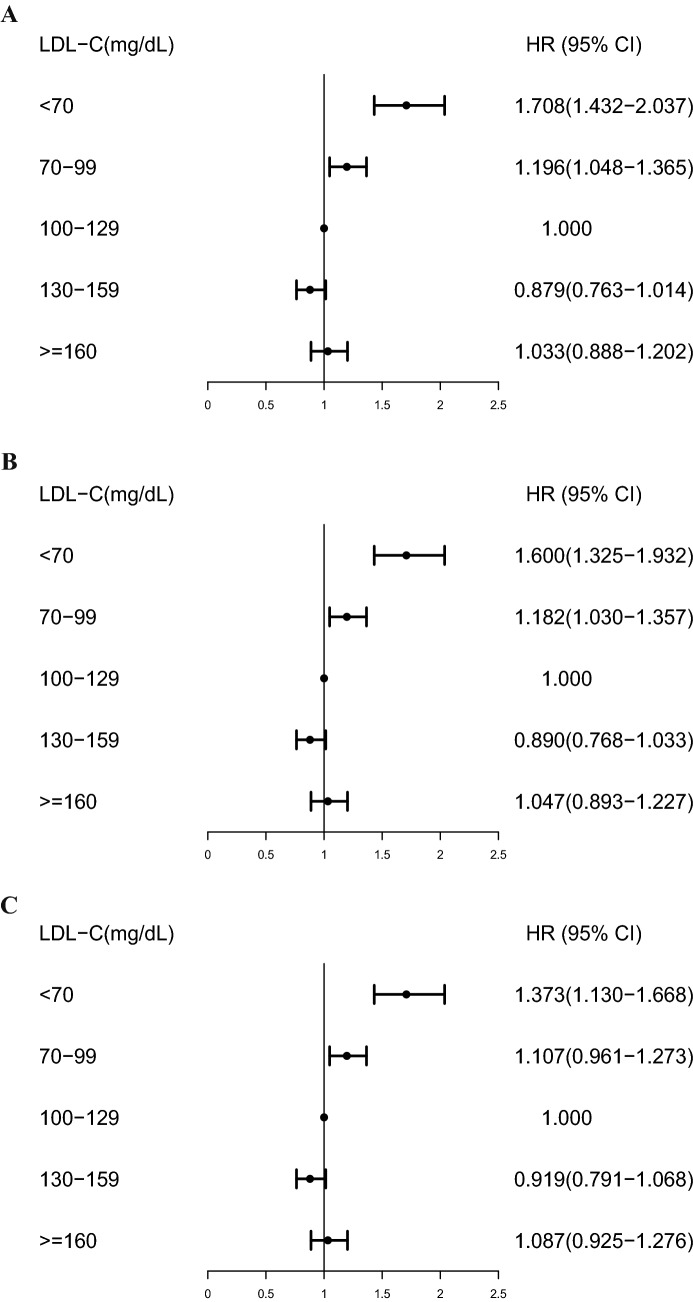
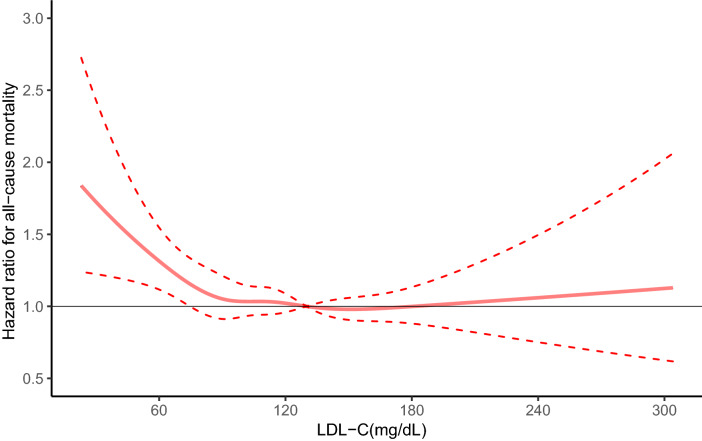
The association between low density lipoprotein cholesterol (LDL-C) and all-cause mortality has been examined in many studies. However, inconsistent results and limitations still exist. We used the 1999-2014 National Health and Nutrition Examination Survey (NHANES) data with 19,034 people to assess the association between LDL-C level and all-cause mortality. All participants were followed up until 2015 except those younger than 18 years old, after excluding those who died within three years of follow-up, a total of 1619 deaths among 19,034 people were included in the analysis. In the age-adjusted model (model 1), it was found that the lowest LDL-C group had a higher risk of all-cause mortality (HR 1.708 [1.432-2.037]) than LDL-C 100-129 mg/dL as a reference group. The crude-adjusted model (model 2) suggests that people with the lowest level of LDL-C had 1.600 (95% CI [1.325-1.932]) times the odds compared with the reference group, after adjusting for age, sex, race, marital status, education level, smoking status, body mass index (BMI). In the fully-adjusted model (model 3), people with the lowest level of LDL-C had 1.373 (95% CI [1.130-1.668]) times the odds compared with the reference group, after additionally adjusting for hypertension, diabetes, cardiovascular disease, cancer based on model 2. The results from restricted cubic spine (RCS) curve showed that when the LDL-C concentration (130 mg/dL) was used as the reference, there is a U-shaped relationship between LDL-C level and all-cause mortality. In conclusion, we found that low level of LDL-C is associated with higher risk of all-cause mortality. The observed association persisted after adjusting for potential confounders. Further studies are warranted to determine the causal relationship between LDL-C level and all-cause mortality.
低密度脂蛋白胆固醇(LDL-C)与全因死亡率之间的关系已在许多研究中进行了探讨。然而,仍然存在结果不一致和局限性。我们使用了 1999-2014 年全国健康和营养调查(NHANES)的数据,其中有 19034 人,评估了 LDL-C 水平与全因死亡率之间的关系。除了年龄小于 18 岁的参与者和随访三年内死亡的参与者外,所有参与者都被随访至 2015 年,在排除随访三年内死亡的参与者后,共有 19034 人中有 1619 人死亡纳入分析。在年龄调整模型(模型 1)中,与 LDL-C 100-129mg/dL 作为参考组相比,发现 LDL-C 最低组的全因死亡率风险更高(HR 1.708 [1.432-2.037])。在未调整模型(模型 2)中,与参考组相比,LDL-C 水平最低的人患全因死亡率的几率是参考组的 1.600(95%CI [1.325-1.932])倍,该模型调整了年龄、性别、种族、婚姻状况、教育程度、吸烟状况、体重指数(BMI)。在完全调整模型(模型 3)中,与参考组相比,LDL-C 水平最低的人患全因死亡率的几率是参考组的 1.373(95%CI [1.130-1.668])倍,该模型在模型 2 的基础上进一步调整了高血压、糖尿病、心血管疾病和癌症。受限三次样条(RCS)曲线的结果表明,当 LDL-C 浓度(130mg/dL)作为参考时,LDL-C 水平与全因死亡率之间存在 U 形关系。总之,我们发现低水平的 LDL-C 与全因死亡率的风险增加有关。在调整了潜在混杂因素后,观察到的相关性仍然存在。需要进一步研究来确定 LDL-C 水平与全因死亡率之间的因果关系。