Pekpe K Midzodzi, Zitouni Djamel, Gasso Gilles, Dhifli Wajdi, Guinhouya Benjamin C
Univ. Lille, CNRS, UMR 9189 - CRIStAL - Centre de Recherche en Informatique Signal et Automatique de Lille, F-59000 Lille, France.
Univ. Lille, ULR 2694 - METRICS : Évaluation des technologies de santé et des pratiques médicales, F-59000 Lille, France.
Appl Intell (Dordr). 2022;52(1):71-80. doi: 10.1007/s10489-021-02379-2. Epub 2021 Apr 23.
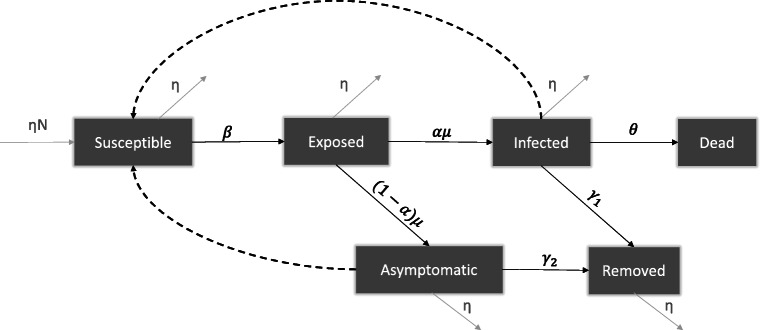
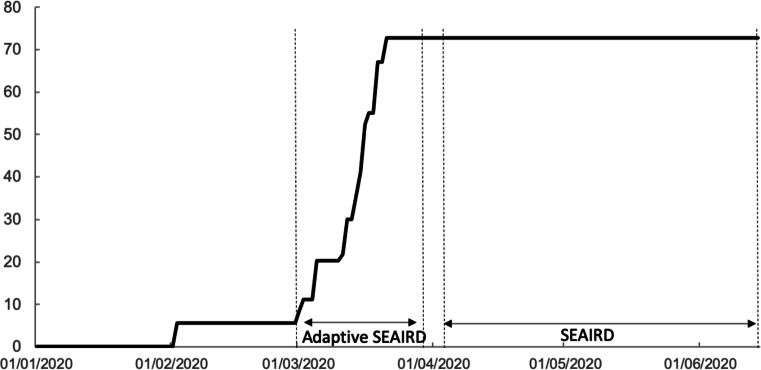
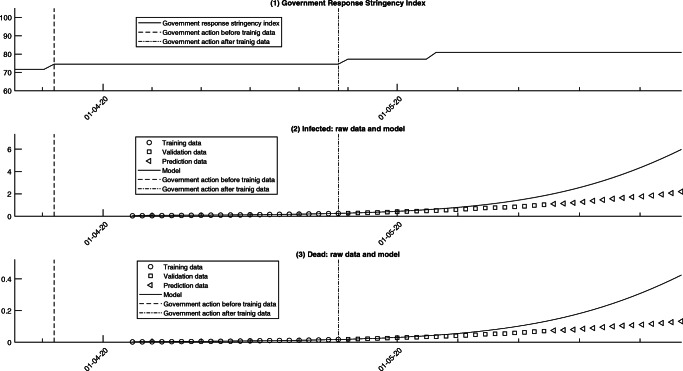
Common compartmental modeling for COVID-19 is based on a priori knowledge and numerous assumptions. Additionally, they do not systematically incorporate asymptomatic cases. Our study aimed at providing a framework for data-driven approaches, by leveraging the strengths of the grey-box system theory or grey-box identification, known for its robustness in problem solving under partial, incomplete, or uncertain data. Empirical data on confirmed cases and deaths, extracted from an open source repository were used to develop the SEAIRD compartment model. Adjustments were made to fit current knowledge on the COVID-19 behavior. The model was implemented and solved using an Ordinary Differential Equation solver and an optimization tool. A cross-validation technique was applied, and the coefficient of determination was computed in order to evaluate the goodness-of-fit of the model. Key epidemiological parameters were finally estimated and we provided the rationale for the construction of SEAIRD model. When applied to Brazil's cases, SEAIRD produced an excellent agreement to the data, with an ≥ 90. The probability of COVID-19 transmission was generally high (≥ 95). On the basis of a 20-day modeling data, the incidence rate of COVID-19 was as low as 3 infected cases per 100,000 exposed persons in Brazil and France. Within the same time frame, the fatality rate of COVID-19 was the highest in France (16.4%) followed by Brazil (6.9%), and the lowest in Russia (≤ 1). SEAIRD represents an asset for modeling infectious diseases in their dynamical stable phase, especially for new viruses when pathophysiology knowledge is very limited.
The online version contains supplementary material available at 10.1007/s10489-021-02379-2.
新冠病毒病(COVID-19)常见的 compartments 模型是基于先验知识和众多假设构建的。此外,这些模型没有系统地纳入无症状病例。我们的研究旨在通过利用灰箱系统理论或灰箱识别的优势,为数据驱动的方法提供一个框架,灰箱系统理论或灰箱识别以在部分、不完整或不确定数据下解决问题的稳健性而闻名。从一个开源数据库中提取的确诊病例和死亡的经验数据被用于开发 SEAIRD compartments 模型。进行了调整以符合当前关于 COVID-19 行为的知识。该模型使用常微分方程求解器和优化工具来实现和求解。应用了交叉验证技术,并计算了决定系数以评估模型的拟合优度。最终估计了关键的流行病学参数,并给出了构建 SEAIRD 模型的基本原理。当应用于巴西的病例时,SEAIRD 与数据产生了极好的一致性,决定系数≥90。COVID-19 的传播概率普遍较高(≥95)。根据 20 天的建模数据,巴西和法国每 10 万暴露人群中 COVID-19 的发病率低至 3 例感染病例。在同一时间范围内,COVID-19 的死亡率在法国最高(16.4%),其次是巴西(6.9%),在俄罗斯最低(≤1)。SEAIRD 是在传染病动态稳定阶段进行建模的一项资产,特别是对于病理生理学知识非常有限的新病毒。
在线版本包含可在 10.1007/s10489-021-02379-2 上获取的补充材料。