Fijałkowska Marta, Kowalski Marek, Koziej Mateusz, Antoszewski Bogusław
Department of Plastic, Reconstructive and Aesthetic Surgery, 2nd Chair of Surgery, Medical University of Lodz, Lodz, Poland.
Department of Immunology and Allergy, Medical University of Lodz, Lodz, Poland.
Cent Eur J Immunol. 2021;46(3):360-364. doi: 10.5114/ceji.2021.109707. Epub 2021 Oct 6.
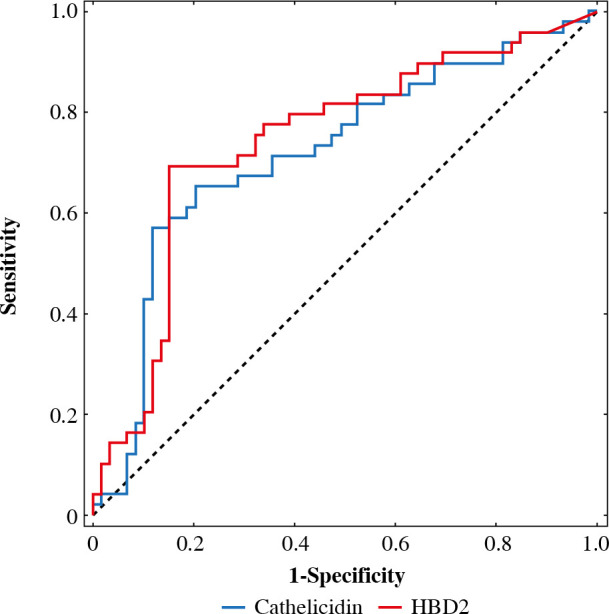
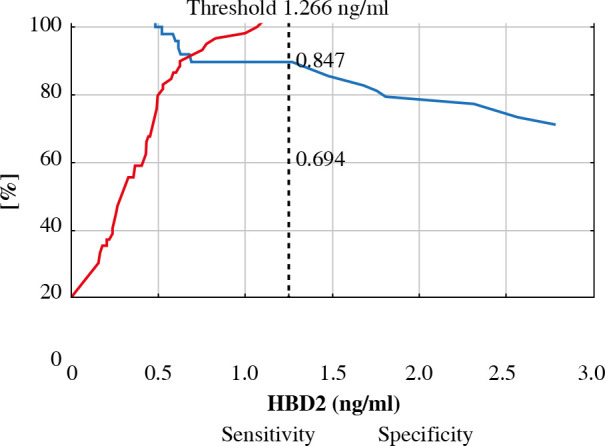
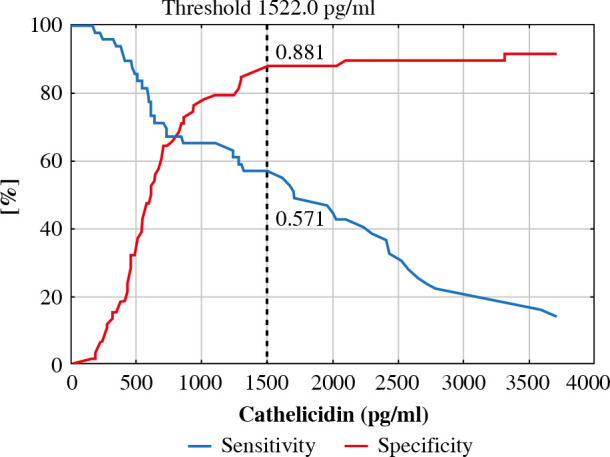
Antimicrobial peptides (AMPs) are one of the primary mechanisms used by the skin in the early stages of immune defense. AMPs have a broad antibacterial activity and also show antifungal and antiviral attributes. Various studies have also shown that levels of antimicrobial peptides change with the development of neoplasia. The aim of this paper is to assess the associations between the presence of basal cell carcinoma (BCC) and the plasma concentrations of cathelicidin and β-defensins (HBD1-3). We examined 108 patients (56 women, 52 men). The BCC group consisted of 49 patients with mean age 69.8 ±12.3 and the control group consisted of 59 participants with mean age 62.1 ±11.1. A statistical analysis of data was performed. The median serum concentration of cathelicidin was almost 3 times higher and the median concentration of HBD-2 more than 6 times higher in BCC patients than in the control group (p < 0.001). The logistic regression model revealed in univariate analysis that patients who had a detected cathelicidin level above ~1500 pg/ml had 9.9× higher likelihood of having BCC identified in the histopathology in comparison with the control group. In patients who had a HBD-2 level above ~1.2 ng/ml the OR of having BCC identified in the histopathology was 12.6 (p < 0.001). Elevated concentrations of cathelicidin and β-defensin 2 are associated with the presence of basal cell carcinoma. Additionally, the specificity of cathelicidin and β-defensin 2 in detecting basal cell carcinoma is high. However, it should be remembered that these factors are not specific only to this condition and further studies are needed.
抗菌肽(AMPs)是皮肤在免疫防御早期阶段使用的主要机制之一。抗菌肽具有广泛的抗菌活性,还表现出抗真菌和抗病毒特性。各种研究还表明,抗菌肽的水平会随着肿瘤形成的发展而变化。本文旨在评估基底细胞癌(BCC)的存在与血浆中cathelicidin和β-防御素(HBD1 - 3)浓度之间的关联。我们检查了108名患者(56名女性,52名男性)。BCC组由49名平均年龄为69.8±12.3岁的患者组成,对照组由59名平均年龄为62.1±11.1岁的参与者组成。对数据进行了统计分析。BCC患者中cathelicidin的血清中位数浓度几乎是对照组的3倍,HBD - 2的中位数浓度比对照组高6倍多(p < 0.001)。逻辑回归模型在单变量分析中显示,检测到的cathelicidin水平高于约1500 pg/ml的患者,与对照组相比,在组织病理学中被诊断为BCC的可能性高9.9倍。HBD - 2水平高于约1.2 ng/ml的患者,在组织病理学中被诊断为BCC的比值比为12.6(p < 0.001)。cathelicidin和β-防御素2浓度升高与基底细胞癌的存在有关。此外,cathelicidin和β-防御素2在检测基底细胞癌方面的特异性较高。然而,应该记住,这些因素并非仅针对这种情况具有特异性,还需要进一步研究。