Zhang Jing, Liang Yan, Bradford William H, Sheikh Farah
Department of Medicine, University of California San Diego, 9500 Gilman Drive, La Jolla, CA 92093 USA.
Biophys Rev. 2021 Sep 4;13(5):697-706. doi: 10.1007/s12551-021-00829-2. eCollection 2021 Oct.
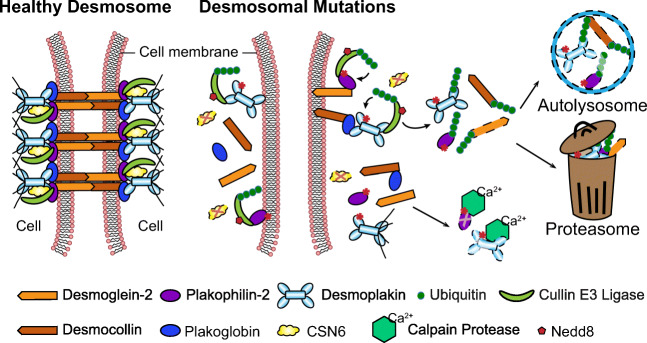
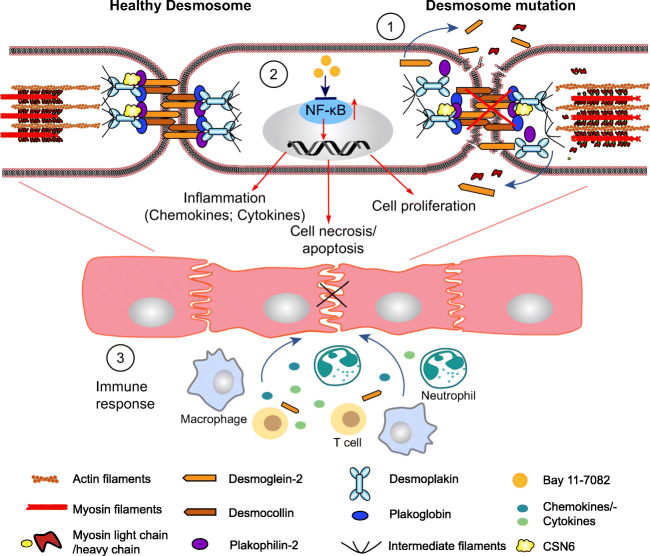
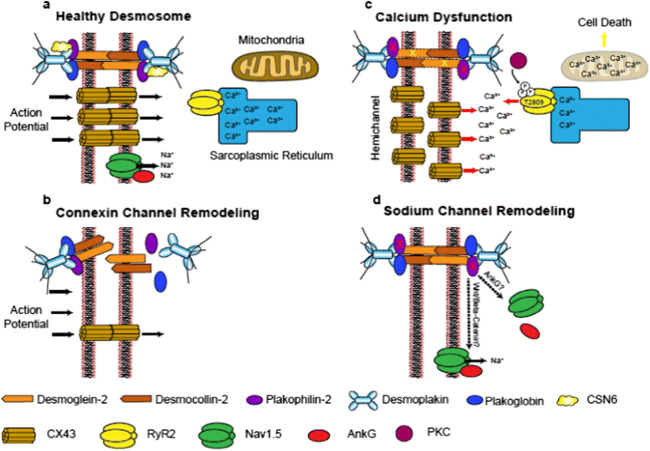
Desmosomes are critical adhesion structures in cardiomyocytes, with mutation/loss linked to the heritable cardiac disease, arrhythmogenic right ventricular cardiomyopathy (ARVC). Early studies revealed the ability of desmosomal protein loss to trigger ARVC disease features including structural remodeling, arrhythmias, and inflammation; however, the precise mechanisms contributing to diverse disease presentations are not fully understood. Recent mechanistic studies demonstrated the protein degradation component CSN6 is a resident cardiac desmosomal protein which selectively restricts cardiomyocyte desmosomal degradation and disease. This suggests defects in protein degradation can trigger the structural remodeling underlying ARVC. Additionally, a subset of ARVC-related mutations show enhanced vulnerability to calpain-mediated degradation, further supporting the relevance of these mechanisms in disease. Desmosomal gene mutations/loss has been shown to impact arrhythmogenic pathways in the absence of structural disease within ARVC patients and model systems. Studies have shown the involvement of connexins, calcium handling machinery, and sodium channels as early drivers of arrhythmias, suggesting these may be distinct pathways regulating electrical function from the desmosome. Emerging evidence has suggested inflammation may be an early mechanism in disease pathogenesis, as clinical reports have shown an overlap between myocarditis and ARVC. Recent studies focus on the association between desmosomal mutations/loss and inflammatory processes including autoantibodies and signaling pathways as a way to understand the involvement of inflammation in ARVC pathogenesis. A specific focus will be to dissect ongoing fields of investigation to highlight diverse pathogenic pathways associated with desmosomal mutations/loss.
桥粒是心肌细胞中的关键黏附结构,其突变/缺失与遗传性心脏病——致心律失常性右室心肌病(ARVC)相关。早期研究揭示了桥粒蛋白缺失引发ARVC疾病特征的能力,包括结构重塑、心律失常和炎症;然而,导致多种疾病表现的精确机制尚未完全明确。最近的机制研究表明,蛋白质降解成分CSN6是一种驻留于心脏的桥粒蛋白,它选择性地限制心肌细胞桥粒的降解及疾病发生。这表明蛋白质降解缺陷可引发ARVC潜在的结构重塑。此外,一部分与ARVC相关的突变显示出对钙蛋白酶介导的降解更敏感,进一步支持了这些机制在疾病中的相关性。在ARVC患者和模型系统中,已证实桥粒基因突变/缺失在无结构疾病的情况下会影响致心律失常途径。研究表明,连接蛋白、钙处理机制和钠通道参与其中,是心律失常的早期驱动因素,这表明这些可能是与桥粒不同的调节电功能的途径。新出现的证据表明,炎症可能是疾病发病机制中的早期机制,因为临床报告显示心肌炎和ARVC之间存在重叠。最近的研究聚焦于桥粒突变/缺失与炎症过程之间的关联,包括自身抗体和信号通路,以此来理解炎症在ARVC发病机制中的作用。一个特别的重点将是剖析正在进行的研究领域,以突出与桥粒突变/缺失相关的多种致病途径。