Hill James M, Clement Christian, Arceneaux L, Lukiw Walter J
LSU Neuroscience Center, Louisiana State University Health Sciences, New Orleans, USA.
Department of Ophthalmology, Louisiana State University Health Sciences Center, New Orleans, USA.
J Aging Sci. 2021;Vol 9(Suppl 7). Epub 2021 Sep 30.
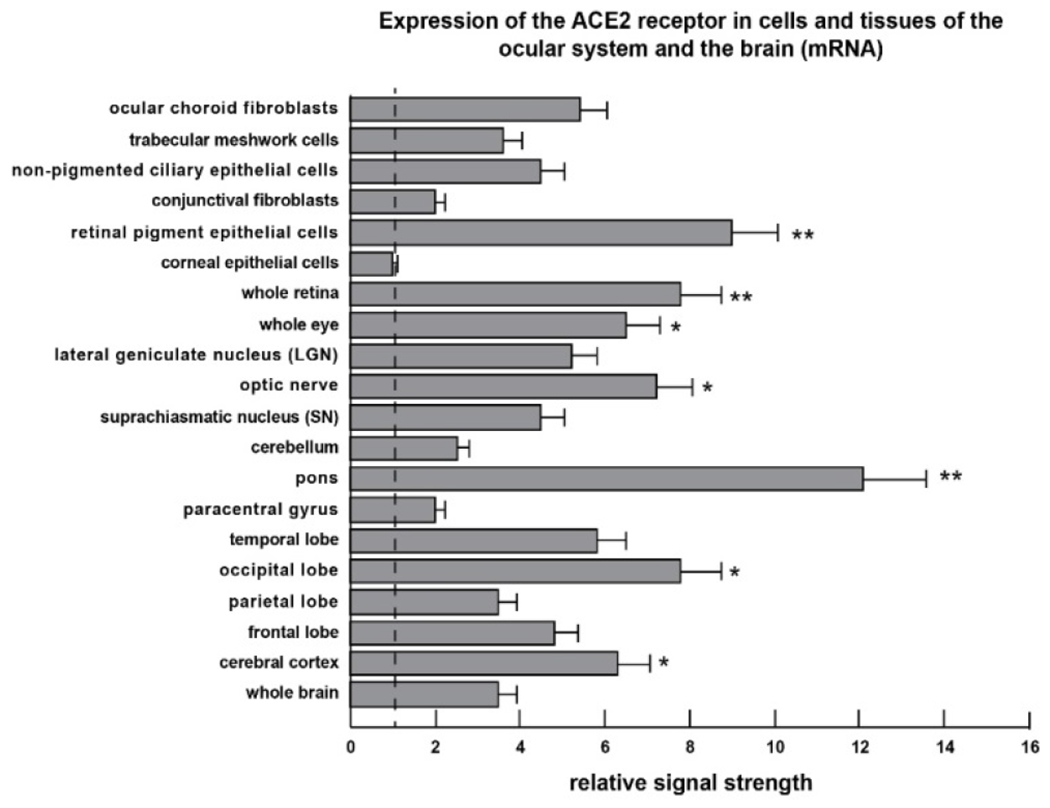
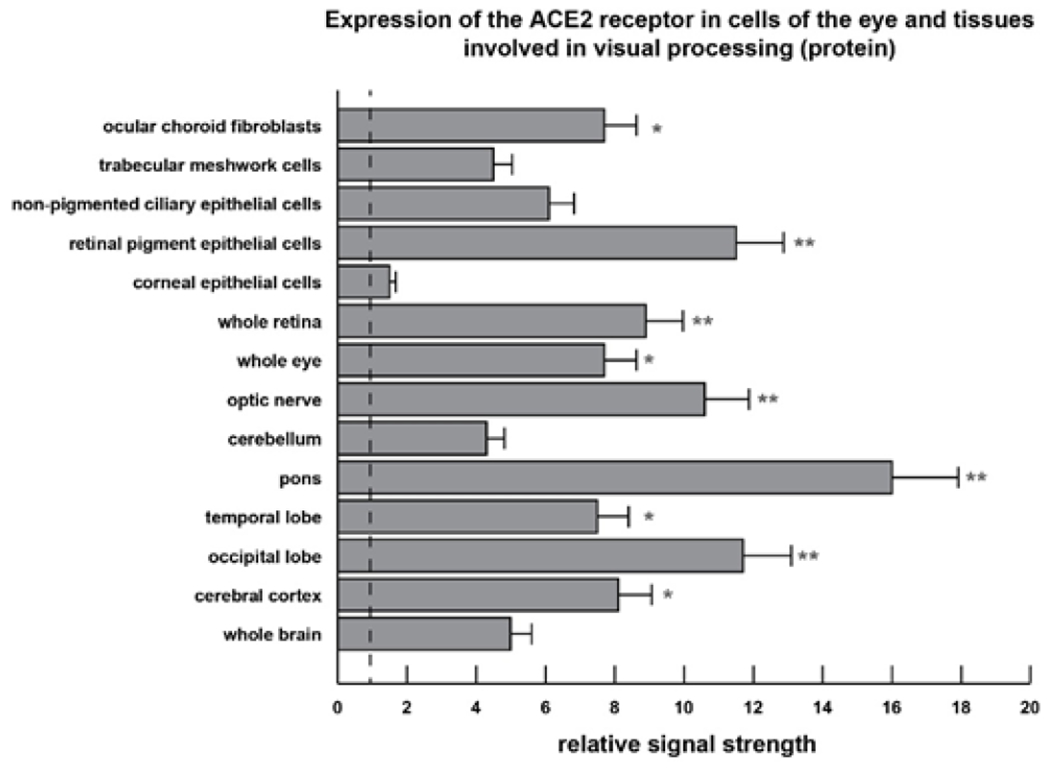
Multiple lines of evidence currently indicate that the severe acute respiratory syndrome coronavirus 2 (SARS-CoV-2) gains entry into human host cells a high-affinity interaction with the angiotensin-converting enzyme 2 (ACE2) transmembrane receptor. Research has further shown the widespread expression of the ACE2 receptor on the surface of many different immune, non-immune and neural host cell types, and that SARS-CoV-2 has the remarkable capability to attack many different types of human-host cells simultaneously. One principal neuroanatomical region for high ACE2 expression patterns occurs in the brainstem, an area of the brain containing regulatory centers for respiration, and this may in part explain the predisposition of many COVID-19 patients to respiratory distress. Early studies also indicated extensive ACE2 expression in the whole eye and the brain's visual circuitry in aged humans. In this study we analyzed ACE2 receptor expression at the mRNA and protein level in multiple cell types involved in human vision, including cell types of the external eye and several deep brain regions known to be involved in the processing of visual signals. Here we provide evidence: () that many different optical and neural cell types of the human visual system provide receptors essential for SARS-CoV-2 invasion; () of the remarkable ubiquity of ACE2 presence in cells of the eye and anatomical regions of the brain involved in visual signal processing; () that ACE2 receptor expression in different ocular cell types and visual processing centers of the brain provide multiple compartments for SARS-CoV-2 infiltration; and ( of a gradient of increasing ACE2 expression from the anterior surface of the eye to the visual signal processing areas of the occipital lobe and the primary visual neocortex. A gradient of ACE2 expression from the eye surface to the occipital lobe may provide the SARS-CoV-2 virus a novel pathway from the outer eye into deeper anatomical regions of the brain involved in vision. These findings may explain, in part, the many recently reported neuro-ophthalmic manifestations of SARS-CoV-2 infection in COVID-19 affected patients.
目前,多条证据表明严重急性呼吸综合征冠状病毒2(SARS-CoV-2)通过与血管紧张素转换酶2(ACE2)跨膜受体的高亲和力相互作用进入人类宿主细胞。研究进一步表明,ACE2受体在许多不同的免疫、非免疫和神经宿主细胞类型表面广泛表达,且SARS-CoV-2具有同时攻击多种不同类型人类宿主细胞的显著能力。ACE2高表达模式的一个主要神经解剖区域位于脑干,这是大脑中包含呼吸调节中心的区域,这可能部分解释了许多COVID-19患者易出现呼吸窘迫的原因。早期研究还表明,在老年人的全眼和大脑视觉回路中ACE2广泛表达。在本研究中,我们分析了参与人类视觉的多种细胞类型中ACE2受体在mRNA和蛋白质水平的表达,这些细胞类型包括眼球外部的细胞类型以及几个已知参与视觉信号处理的深部脑区。在此我们提供证据:(1)人类视觉系统中许多不同的光学和神经细胞类型提供了SARS-CoV-2入侵所必需的受体;(2)ACE2在参与视觉信号处理的眼部细胞和大脑解剖区域中显著普遍存在;(3)ACE2受体在不同眼细胞类型和大脑视觉处理中心的表达为SARS-CoV-2浸润提供了多个区域;(4)从眼球前表面到枕叶和初级视觉新皮质的视觉信号处理区域,ACE2表达呈递增梯度。从眼表面到枕叶的ACE2表达梯度可能为SARS-CoV-2病毒提供了一条从外眼进入参与视觉的大脑更深部解剖区域的新途径。这些发现可能部分解释了最近在受COVID-19影响的患者中报道的SARS-CoV-2感染的许多神经眼科表现。