Matthews Abigail A, Ee Pui Lai Rachel, Ge Ruowen
Department of Biological Sciences, Faculty of Science, National University of Singapore, 16 Science drive 4, Singapore, 117558 Singapore.
Department of Pharmacy, National University of Singapore, 18 Science Drive 4, Singapore, 117543 Singapore.
Mol Biomed. 2020;1(1):11. doi: 10.1186/s43556-020-00014-z. Epub 2020 Oct 30.
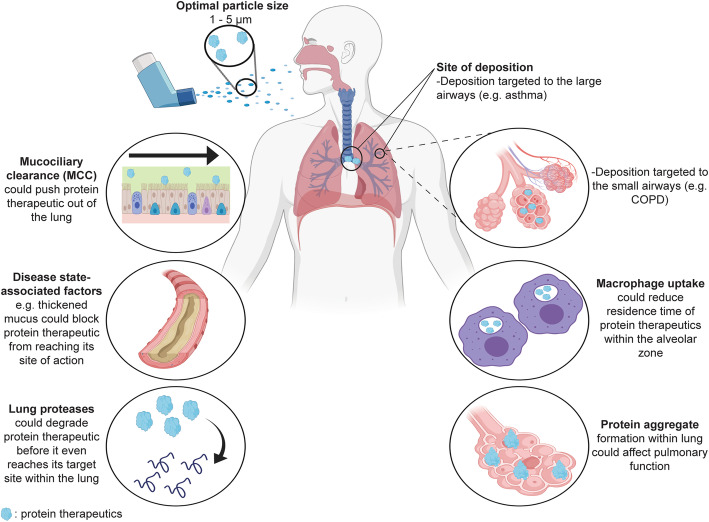
Biologic therapeutics such as protein/polypeptide drugs are conventionally administered systemically via intravenous injection for the treatment of diseases including lung diseases, although this approach leads to low target site accumulation and the potential risk for systemic side effects. In comparison, topical delivery of protein drugs to the lung via inhalation is deemed to be a more effective approach for lung diseases, as proteins would directly reach the target in the lung while exhibiting poor diffusion into the systemic circulation, leading to higher lung drug retention and efficacy while minimising toxicity to other organs. This review examines the important considerations and challenges in designing an inhaled protein therapeutics for local lung delivery: the choice of inhalation device, structural changes affecting drug deposition in diseased lungs, clearance mechanisms affecting an inhaled protein drug's lung accumulation, protein stability, and immunogenicity. Possible approaches to overcoming these issues will also be discussed.
诸如蛋白质/多肽药物之类的生物疗法传统上是通过静脉注射进行全身给药,用于治疗包括肺部疾病在内的多种疾病,尽管这种方法会导致药物在靶部位的积累量较低,并存在产生全身副作用的潜在风险。相比之下,通过吸入方式将蛋白质药物局部递送至肺部被认为是治疗肺部疾病更有效的方法,因为蛋白质可直接到达肺部的靶标,同时进入体循环的扩散能力较差,从而在将对其他器官的毒性降至最低的同时,实现更高的肺部药物滞留率和疗效。本综述探讨了设计用于肺部局部递送的吸入性蛋白质疗法时的重要考量因素和挑战:吸入装置的选择、影响药物在患病肺部沉积的结构变化、影响吸入性蛋白质药物肺部蓄积的清除机制、蛋白质稳定性和免疫原性。还将讨论克服这些问题的可能方法。