Massicotte-Azarniouch David, Sood Manish M, Fergusson Dean A, Chassé Michaël, Tinmouth Alan, Knoll Greg A
Division of Nephrology, Department of Medicine, University of Ottawa, Ontario, Canada.
Division of Nephrology, Department of Medicine, Clinical Epidemiology Program, Ottawa Hospital Research Institute, University of Ottawa, Ontario, Canada.
PLoS One. 2021 Nov 12;16(11):e0259270. doi: 10.1371/journal.pone.0259270. eCollection 2021.
Receipt of a red blood cell transfusion (RBCT) post-kidney transplantation may alter immunity which could predispose to subsequent infection.
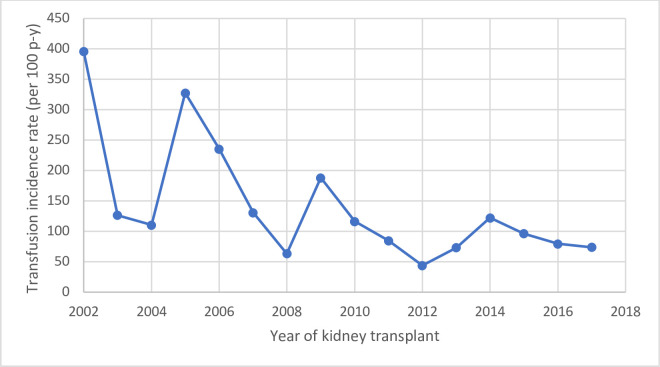
We carried out a single-center, retrospective cohort study of 1,258 adult kidney transplant recipients from 2002 to 2018 (mean age 52, 64% male). The receipt of RBCT post-transplant (468 participants transfused, total 2,373 RBCT) was analyzed as a time-varying, cumulative exposure. Adjusted cox proportional hazards models were used to calculate hazard ratios (HR) for outcomes of bacterial or viral (BK or CMV) infection.
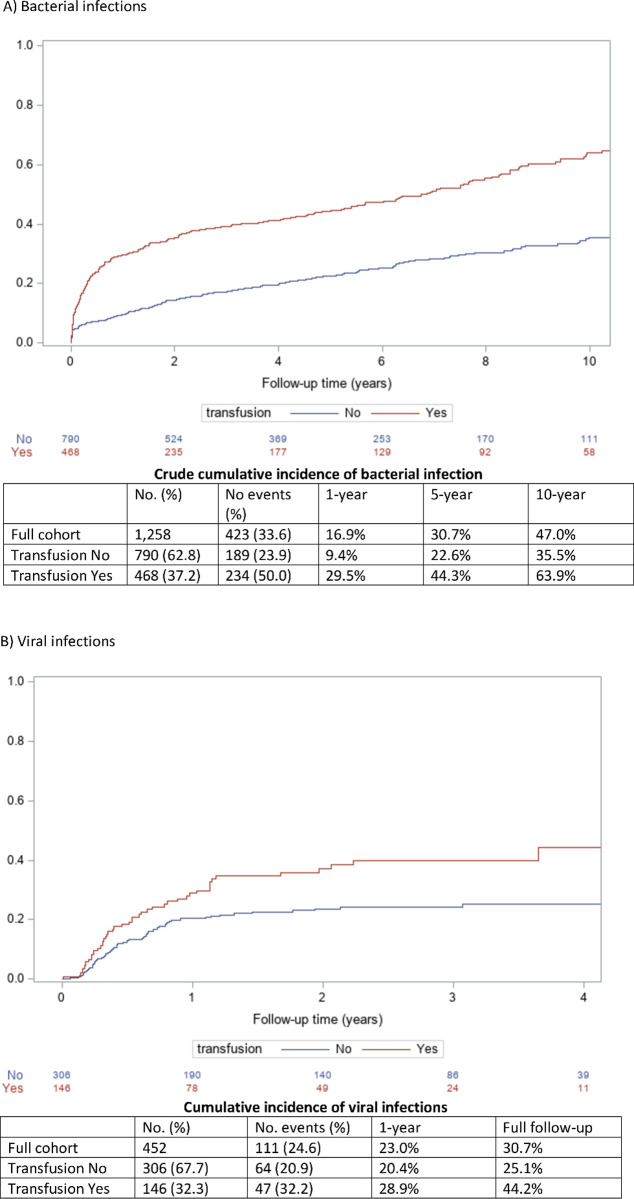
Over a median follow-up of 3.8 years, bacterial infection occurred in 34% of participants at a median of 409 days post-transplant and viral infection occurred in 25% at a median of 154 days post-transplant. Transfusion was associated with a step-wise higher risk of bacterial infection (HR 1.35, 95%CI 0.95-1.91; HR 1.29, 95%CI 0.92-1.82; HR 2.63, 95%CI 1.94-3.56; HR 3.38, 95%CI 2.30-4.95, for 1, 2, 3-5 and >5 RBCT respectively), but not viral infection. These findings were consistent in multiple additional analyses, including accounting for reverse causality.
Blood transfusion after kidney transplant is associated with a higher risk for bacterial infection, emphasizing the need to use transfusions judiciously in this population already at risk for infections.
肾移植后接受红细胞输血(RBCT)可能会改变免疫力,从而增加后续感染的易感性。
我们对2002年至2018年期间的1258例成年肾移植受者进行了一项单中心回顾性队列研究(平均年龄52岁,64%为男性)。将移植后接受RBCT的情况(468名参与者接受输血,共2373次RBCT)作为随时间变化的累积暴露因素进行分析。使用校正后的Cox比例风险模型计算细菌或病毒(BK或CMV)感染结局的风险比(HR)。
在中位随访3.8年期间,34%的参与者在移植后中位409天发生细菌感染,25%的参与者在移植后中位154天发生病毒感染。输血与细菌感染风险逐步升高相关(分别接受1次、2次、3 - 5次和>5次RBCT时,HR分别为1.35,95%CI 0.95 - 1.91;HR 1.29,95%CI 0.92 - 1.82;HR 2.63,95%CI 1.94 - 3.56;HR 3.38,95%CI 2.30 - 4.95),但与病毒感染无关。这些发现在多项额外分析中一致,包括考虑反向因果关系。
肾移植后输血与细菌感染风险较高相关,强调在这个已经有感染风险的人群中谨慎使用输血的必要性。