Martín-Fernández Marta, Aller Rocío, Heredia-Rodríguez María, Gómez-Sánchez Esther, Martínez-Paz Pedro, Gonzalo-Benito Hugo, Sánchez-de Prada Laura, Gorgojo Óscar, Carnicero-Frutos Irene, Tamayo Eduardo, Tamayo-Velasco Álvaro
BioCritic. Group for Biomedical Research in Critical Care Medicine, 47005 Valladolid, Spain; Department of Medicine, Dermatology and Toxicology, Faculty of Medicine, Universidad de Valladolid, 47005 Valladolid, Spain.
BioCritic. Group for Biomedical Research in Critical Care Medicine, 47005 Valladolid, Spain; Department of Medicine, Dermatology and Toxicology, Faculty of Medicine, Universidad de Valladolid, 47005 Valladolid, Spain; Gastroenterology Department, Hospital Clínico Universitario de Valladolid, 47003 Valladolid, Spain.
Redox Biol. 2021 Nov 6;48:102181. doi: 10.1016/j.redox.2021.102181.
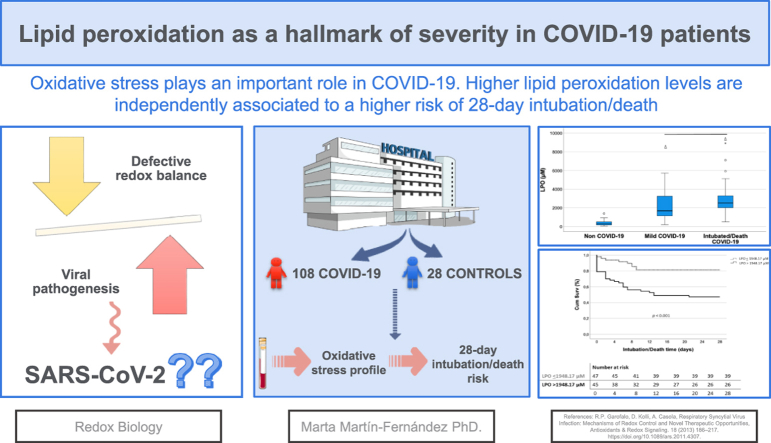
Oxidative stress may be a key player in COVID-19 pathogenesis due to its significant role in response to infections. A defective redox balance has been related to viral pathogenesis developing a massive induction of cell death provoked by oxidative stress. The aim of this study is to perform a complete oxidative stress profile evaluation regarding antioxidant enzymes, total antioxidant capacity and oxidative cell damage in order to characterize its role in diagnosis and severity of this disease.
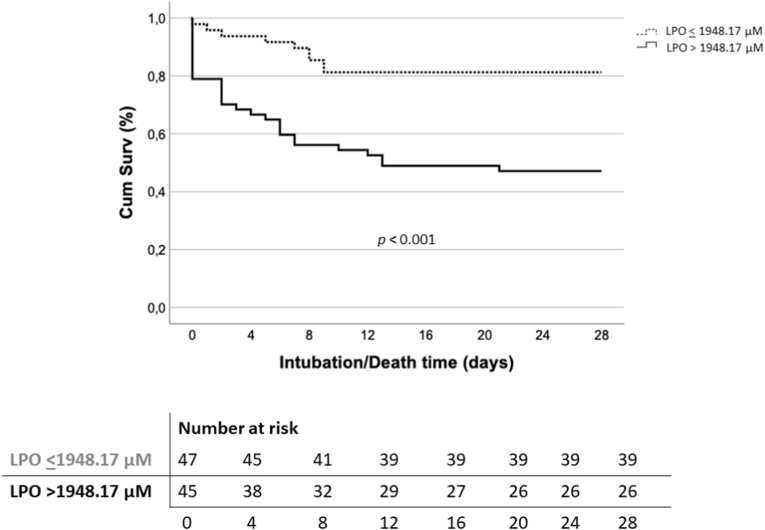
Blood samples were obtained from 108 COVID-19 patients and 28 controls and metabolites representative of oxidative stress were assessed. The association between lipid peroxidation and 28-day intubation/death risk was evaluated by multivariable regression analysis. Probability of intubation/death to day-28 was analyzed by using Kaplan-Meier curves and tested with the log-rank test.
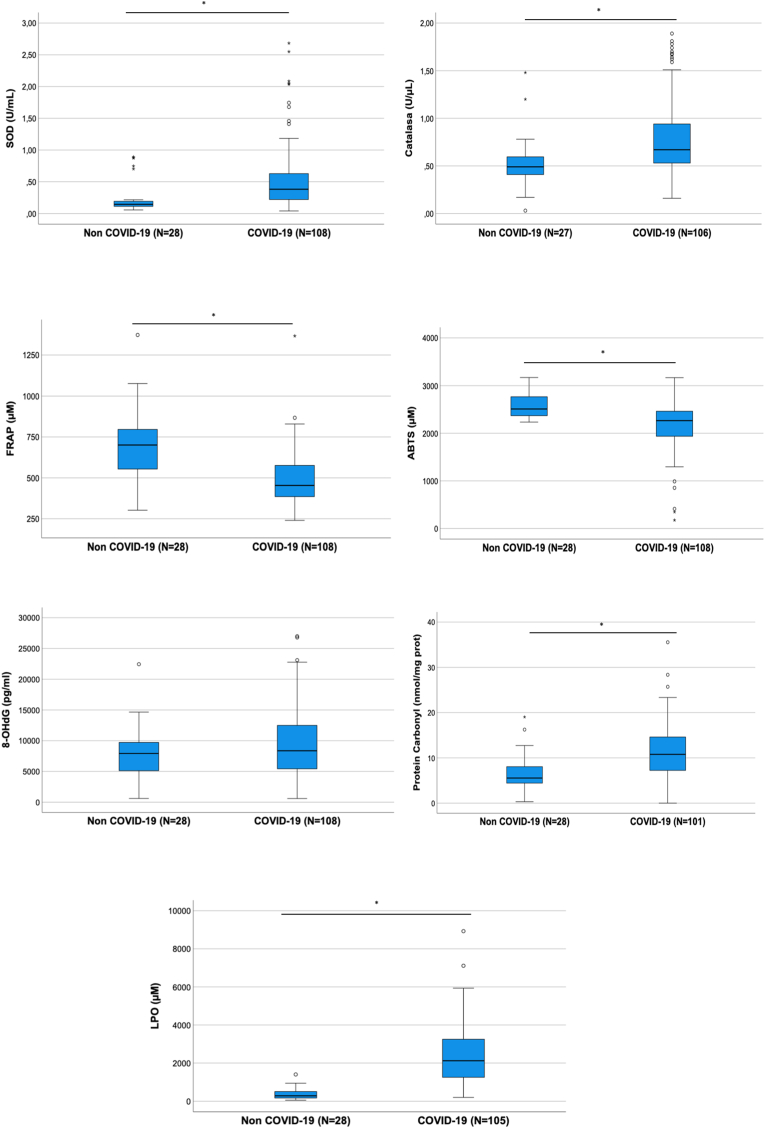
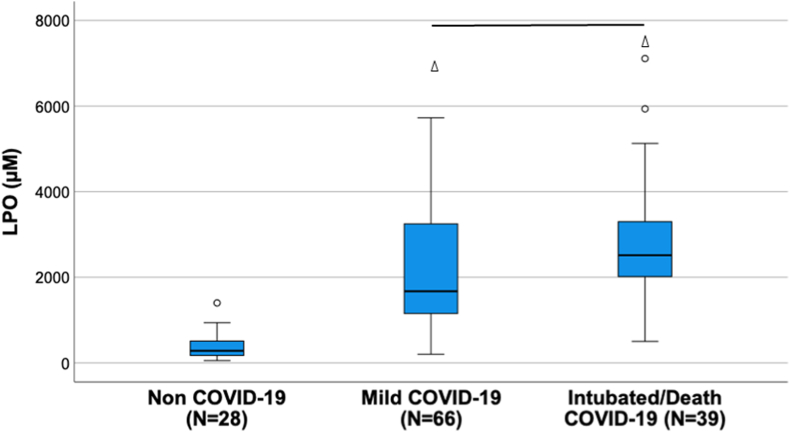
Antioxidant enzymes (Superoxide dismutase (SOD) and Catalase) and oxidative cell damage (Carbonyl and Lipid peroxidation (LPO)) levels were significantly higher in COVID-19 patients while total antioxidant capacity (ABTS and FRAP) levels were lower in these patients. The comparison of oxidative stress molecules' levels across COVID-19 severity revealed that only LPO was statistically different between mild and intubated/death COVID-19 patients. COX multivariate regression analysis identified LPO levels over the OOP (LPO>1948.17 μM) as an independent risk factor for 28-day intubation/death in COVID-19 patients [OR: 2.57; 95% CI: 1.10-5.99; p = 0.029]. Furthermore, Kaplan-Meier curve analysis revealed that COVID-19 patients showing LPO levels above 1948.17 μM were intubated or died 8.4 days earlier on average (mean survival time 15.4 vs 23.8 days) when assessing 28-day intubation/death risk (p < 0.001).
These findings deepen our knowledge of oxidative stress status in SARS-CoV-2 infection, supporting its important role in COVID-19. In fact, higher lipid peroxidation levels are independently associated to a higher risk of intubation or death at 28 days in COVID-19 patients.
氧化应激可能在新型冠状病毒肺炎(COVID-19)发病机制中起关键作用,因为其在应对感染方面具有重要作用。氧化还原平衡失调与病毒发病机制有关,可引发由氧化应激导致的大量细胞死亡。本研究的目的是全面评估抗氧化酶、总抗氧化能力和氧化细胞损伤方面的氧化应激情况,以明确其在该疾病诊断和严重程度中的作用。
采集108例COVID-19患者和28例对照者的血样,评估代表氧化应激的代谢产物。通过多变量回归分析评估脂质过氧化与28天插管/死亡风险之间的关联。使用Kaplan-Meier曲线分析28天插管/死亡概率,并进行对数秩检验。
COVID-19患者的抗氧化酶(超氧化物歧化酶(SOD)和过氧化氢酶)和氧化细胞损伤(羰基和脂质过氧化(LPO))水平显著升高,而这些患者的总抗氧化能力(ABTS和FRAP)水平较低。对不同严重程度COVID-19患者的氧化应激分子水平进行比较发现,只有LPO在轻症与插管/死亡的COVID-19患者之间存在统计学差异。COX多变量回归分析确定,COVID-19患者中LPO水平超过OOP(LPO>1948.17μM)是28天插管/死亡的独立危险因素[比值比:2.57;95%可信区间:1.10-5.99;p=0.029]。此外,Kaplan-Meier曲线分析显示,在评估28天插管/死亡风险时,LPO水平高于1948.17μM的COVID-19患者平均提前8.4天插管或死亡(平均生存时间15.4天对23.8天)(p<0.001)。
这些发现加深了我们对严重急性呼吸综合征冠状病毒2(SARS-CoV-2)感染中氧化应激状态的认识,支持了其在COVID-19中的重要作用。事实上,较高的脂质过氧化水平与COVID-19患者28天插管或死亡的较高风险独立相关。