Department of Translational Hematology and Oncology Research, Taussig Cancer Institute, Cleveland Clinic, Cleveland, OH.
Department of Biomedicine and Prevention, PhD in Immunology, Molecular Medicine and Applied Biotechnology, University of Rome Tor Vergata, Rome, Italy.
Blood Adv. 2022 Jan 11;6(1):100-107. doi: 10.1182/bloodadvances.2021005418.
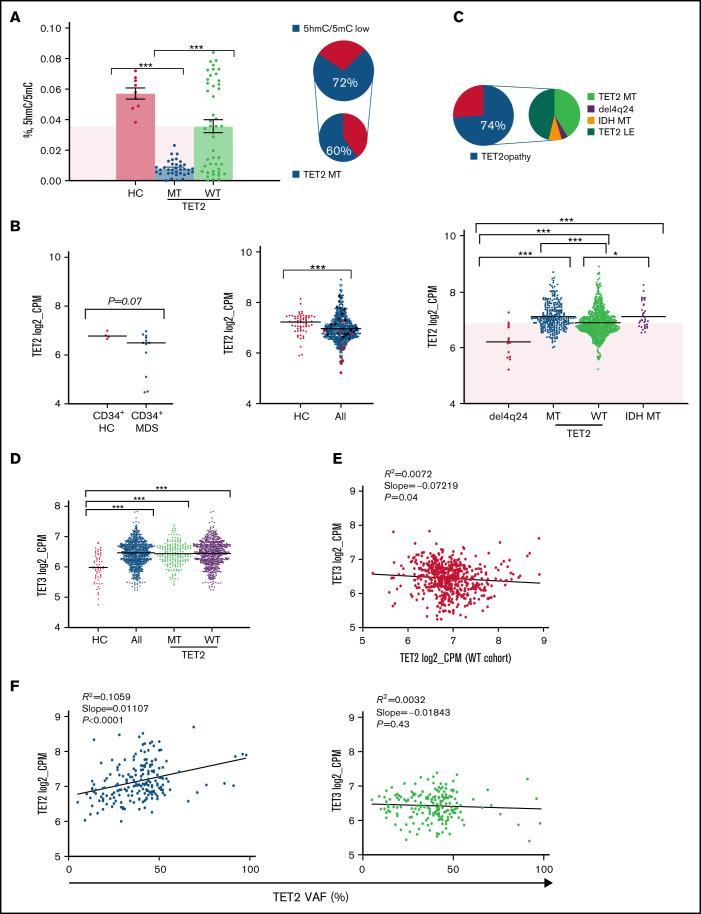
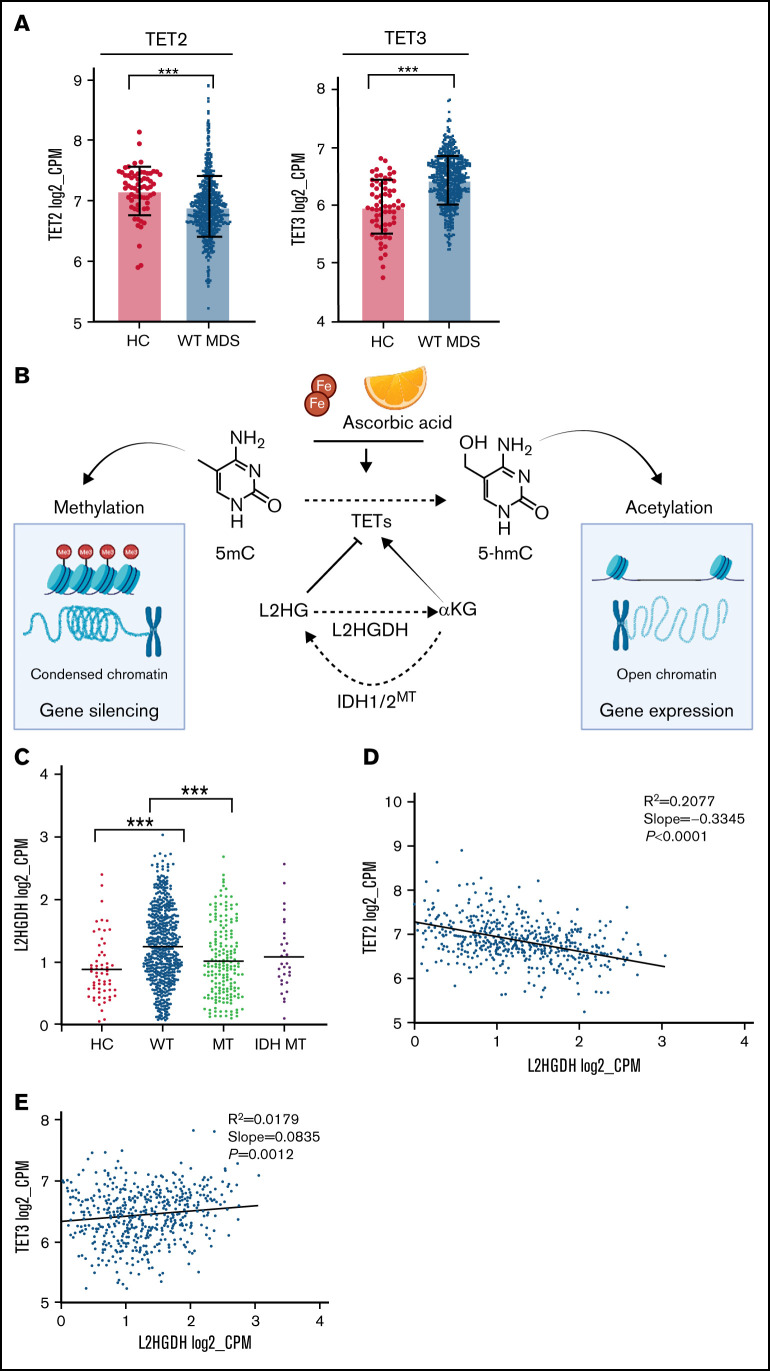
Decrease in DNA dioxygenase activity generated by TET2 gene family is crucial in myelodysplastic syndromes (MDS). The general downregulation of 5-hydroxymethylcytosine (5-hmC) argues for a role of DNA demethylation in MDS beyond TET2 mutations, which albeit frequent, do not convey any prognostic significance. We investigated TETs expression to identify factors which can modulate the impact of mutations and thus 5-hmC levels on clinical phenotypes and prognosis of MDS patients. DNA/RNA-sequencing and 5-hmC data were collected from 1665 patients with MDS and 91 controls. Irrespective of mutations, a significant fraction of MDS patients exhibited lower TET2 expression, whereas 5-hmC levels were not uniformly decreased. In searching for factors explaining compensatory mechanisms, we discovered that TET3 was upregulated in MDS and inversely correlated with TET2 expression in wild-type cases. Although TET2 was reduced across all age groups, TET3 levels were increased in a likely feedback mechanism induced by TET2 dysfunction. This inverse relationship of TET2 and TET3 expression also corresponded to the expression of L-2-hydroxyglutarate dehydrogenase, involved in agonist/antagonist substrate metabolism. Importantly, elevated TET3 levels influenced the clinical phenotype of TET2 deficiency whereby the lack of compensation by TET3 (low TET3 expression) was associated with poor outcomes of TET2 mutant carriers.
TET2 基因家族活性降低导致 DNA 双加氧酶活性降低,这在骨髓增生异常综合征(MDS)中至关重要。5-羟甲基胞嘧啶(5-hmC)的普遍下调表明 DNA 去甲基化在 MDS 中除 TET2 突变外也发挥作用,尽管 TET2 突变频繁,但不具有任何预后意义。我们研究了 TETs 的表达,以确定可以调节突变和 5-hmC 水平对 MDS 患者临床表型和预后影响的因素。从 1665 例 MDS 患者和 91 例对照中收集了 DNA/RNA 测序和 5-hmC 数据。无论是否存在突变,相当一部分 MDS 患者的 TET2 表达降低,而 5-hmC 水平并非均匀降低。在寻找解释代偿机制的因素时,我们发现 MDS 中 TET3 上调,且在野生型病例中与 TET2 表达呈负相关。尽管 TET2 在所有年龄组中均降低,但 TET3 水平升高,这可能是由 TET2 功能障碍引起的反馈机制所致。TET2 和 TET3 表达的这种反向关系也与 L-2-羟戊二酸脱氢酶的表达相对应,该酶参与激动剂/拮抗剂底物代谢。重要的是,TET3 水平的升高影响了 TET2 缺陷的临床表型,其中 TET3 缺乏补偿(TET3 低表达)与 TET2 突变携带者预后不良相关。