Drouin Leonor, Guani Benedetta, Balaya Vincent, Azaïs Henri, Betrian Sarah, Bolze Pierre-Adrien, Dabi Yohann, Kerbage Yohan, Sanson Claire, Zaccarini François, Mathevet Patrice, Lécuru Fabrice, Guyon Fréderic, Akladios Cherif, Bendifallah Sofiane, Deluche Elise
Department of Gynecology, CHU de Limoges, 87000 Limoges, France.
Department of Gynecology and Obstetrics, 1700 Fribourg, Switzerland.
J Clin Med. 2021 Oct 21;10(21):4829. doi: 10.3390/jcm10214829.
The aim of this study was to assess current French practices in the management of patients with advanced epithelial ovarian cancer.
a 58-question electronic survey was distributed anonymously to the members of the SFOG (French Society of Gynaecological Oncology), GINECO-ARCAGY (National Investigators Group for Ovarian and Breast Cancer Studies in France) and FRANCOGYN (French research group in oncological and gynaecological surgery). Initial diagnostic workup and staging, pathological data, surgical data, treatments and follow-up strategies were assessed.
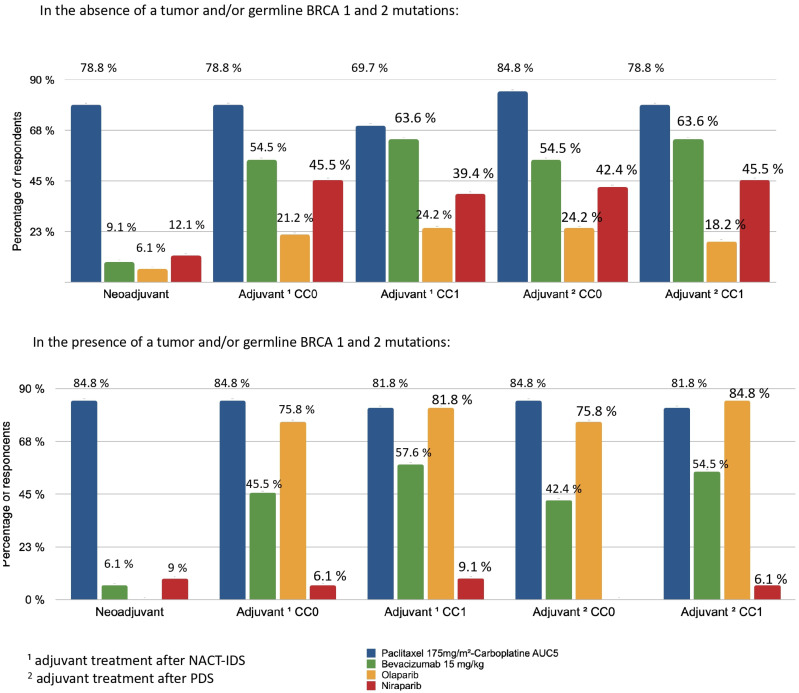
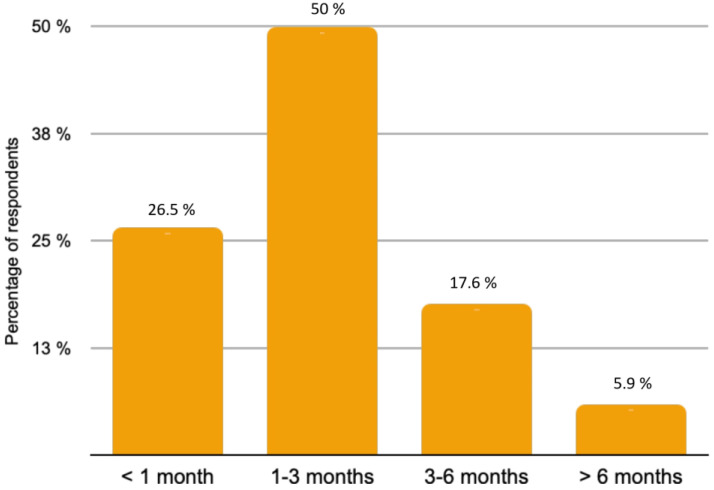
a total of 107 participants responded to emailed surveys. Most of the respondents were obstetrician-gynaecologists (37.4%), surgical oncologists (34.6%) and medical oncologists (17.8%). According to most (76.8%) participants, less than 50% of patients were eligible for primary debulking surgery (PDS). The LION study criteria were applied in 69.5% of cases during PDS and 39% after chemotherapy. The timing of BRCA testing was very heterogeneous and ranged from 1 to 6 months. The use of bevacizumab as an adjuvant schedule was lower in cases of no residual disease (for 54.5% of respondents) compared to cases of residual disease (for 63.6% of respondents). In cases of BRCA1-2 mutations, olaparib was given by 75.8-84.8% of respondents, whereas niraparib was given in cases of BRCA wild-type diseases.
this survey provides an extensive and a unique review of current French practices in the management of patients with advanced epithelial ovarian cancer in 2021.
本研究旨在评估法国目前对晚期上皮性卵巢癌患者的管理实践。
向法国妇科肿瘤学会(SFOG)、法国卵巢和乳腺癌研究国家调查组(GINECO-ARCAGY)以及法国肿瘤与妇科外科学研究组(FRANCOGYN)的成员匿名发放了一份包含58个问题的电子调查问卷。对初始诊断检查和分期、病理数据、手术数据、治疗方法及随访策略进行了评估。
共有107名参与者回复了电子邮件调查。大多数受访者是妇产科医生(37.4%)、外科肿瘤学家(34.6%)和内科肿瘤学家(17.8%)。据大多数(76.8%)参与者称,不到50%的患者适合进行初次肿瘤细胞减灭术(PDS)。在PDS期间,69.5%的病例应用了LION研究标准,化疗后这一比例为39%。BRCA检测的时间差异很大,从1个月到6个月不等。与有残留病灶的病例(63.6%的受访者)相比,无残留病灶的病例中使用贝伐单抗作为辅助治疗方案的比例较低(54.5%)。在BRCA1-2基因突变的病例中,75.8%-84.8%的受访者使用了奥拉帕利,而在BRCA野生型疾病的病例中使用了尼拉帕利。
本次调查对2021年法国目前晚期上皮性卵巢癌患者的管理实践进行了全面且独特的综述。