School of Agriculture and Biology, Shanghai Jiao Tong University, Shanghai 200240, China.
Institute of Plant Protection, Shandong Academy of Agricultural Sciences, Jinan 250100, China.
Int J Mol Sci. 2021 Oct 27;22(21):11604. doi: 10.3390/ijms222111604.
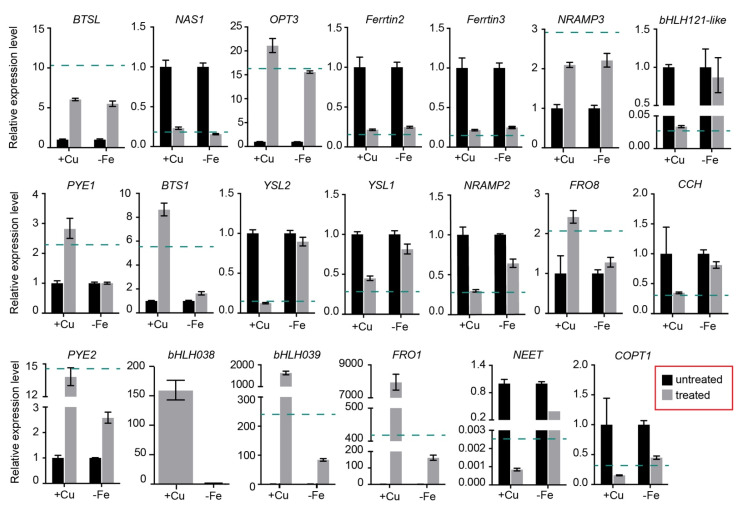
Copper (Cu) is an essential element for most living plants, but it is toxic for plants when present in excess. To better understand the response mechanism under excess Cu in plants, especially in flowers, transcriptome sequencing on petunia buds and opened flowers under excess Cu was performed. Interestingly, the transcript level of FIT-independent Fe deficiency response genes was significantly affected in Cu stressed petals, probably regulated by basic-helix-loop-helix 121 (bHLH121), while no difference was found in Fe content. Notably, the expression level of bHLH121 was significantly down-regulated in petals under excess Cu. In addition, the expression level of genes related to photosystem II (PSII), photosystem I (PSI), cytochrome / complex, the light-harvesting chlorophyll II complex and electron carriers showed disordered expression profiles in petals under excess Cu, thus photosynthesis parameters, including the maximum PSII efficiency (F/F), nonphotochemical quenching (NPQ), quantum yield of the PSII (ΦPS(II)) and photochemical quenching coefficient (qP), were reduced in Cu stressed petals. Moreover, the chlorophyll a content was significantly reduced, while the chlorophyll b content was not affected, probably caused by the increased expression of (). Together, we provide new insight into excess Cu response and the Cu-Fe crosstalk in flowers.
铜(Cu)是大多数活体植物必需的元素,但当过量存在时,它对植物是有毒的。为了更好地了解植物中过量铜的响应机制,特别是在花朵中,对过量铜胁迫下的矮牵牛花蕾和盛开花朵进行了转录组测序。有趣的是,在 Cu 胁迫的花瓣中,FIT 非依赖性缺铁响应基因的转录水平受到显著影响,可能受碱性螺旋-环-螺旋 121(bHLH121)调控,而 Fe 含量没有差异。值得注意的是,bHLH121 的表达水平在过量 Cu 下的花瓣中显著下调。此外,在过量 Cu 下花瓣中与光系统 II(PSII)、光系统 I(PSI)、细胞色素/复合物、光捕获叶绿素 II 复合物和电子载体相关的基因的表达水平表现出紊乱的表达谱,因此光合作用参数,包括 PSII 的最大效率(F/F)、非光化学猝灭(NPQ)、PSII 的量子产量(ΦPS(II)) 和光化学猝灭系数(qP),在 Cu 胁迫的花瓣中降低。此外,叶绿素 a 含量显著降低,而叶绿素 b 含量不受影响,这可能是由于()的表达增加所致。总之,我们为过量 Cu 响应和花朵中的 Cu-Fe 交叉对话提供了新的见解。