National Institute for Gastroenterology, IRCCS "S. De Bellis" Research Hospital, 70013 Castellana Grotte, Italy.
Department of Emergency and Organ Transplant, School and Chair of Allergology and Clinical Immunology, University of Bari Medical School, 70124 Bari, Italy.
Int J Mol Sci. 2021 Oct 29;22(21):11765. doi: 10.3390/ijms222111765.
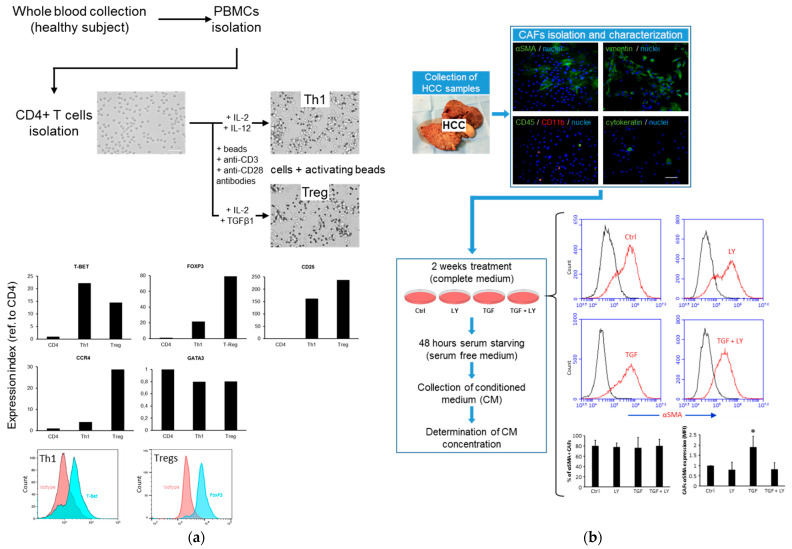
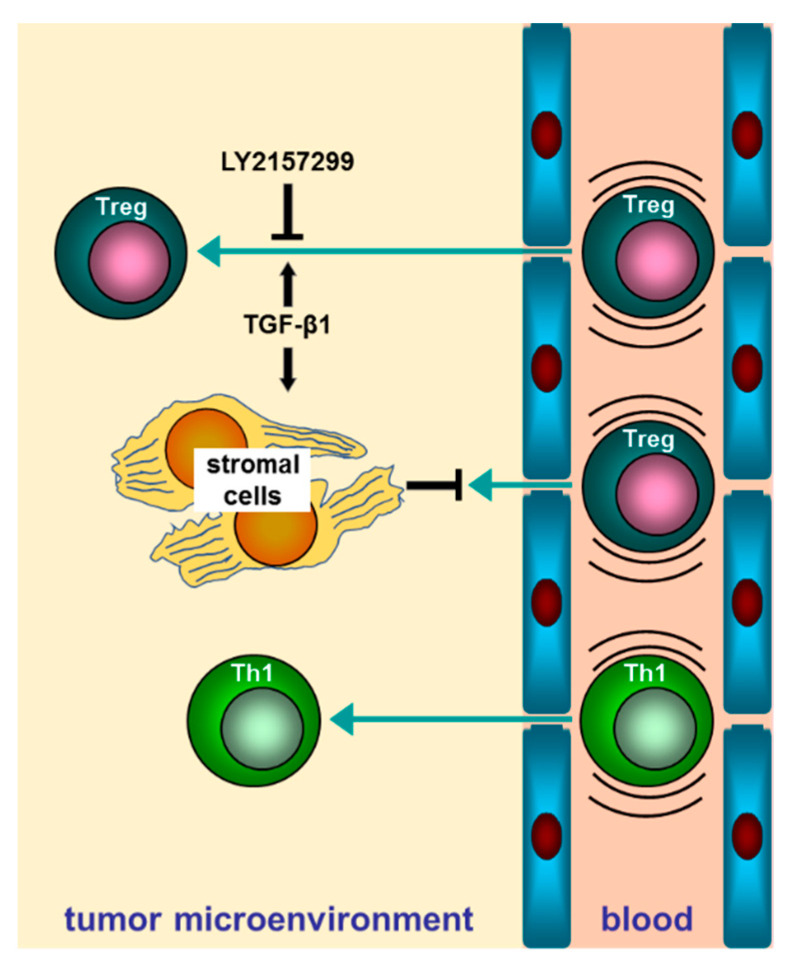
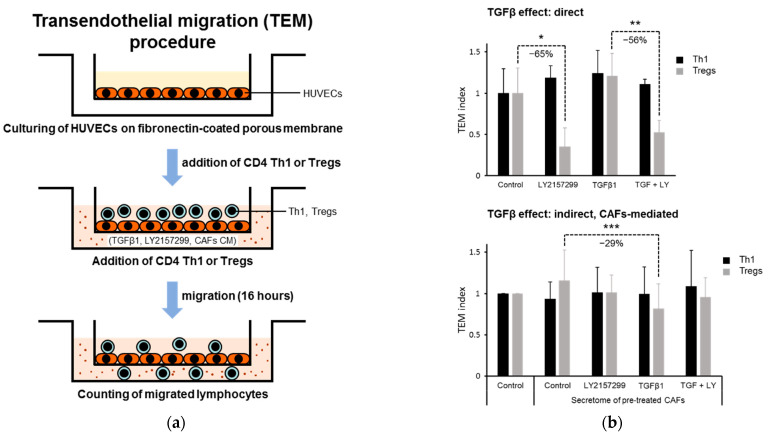
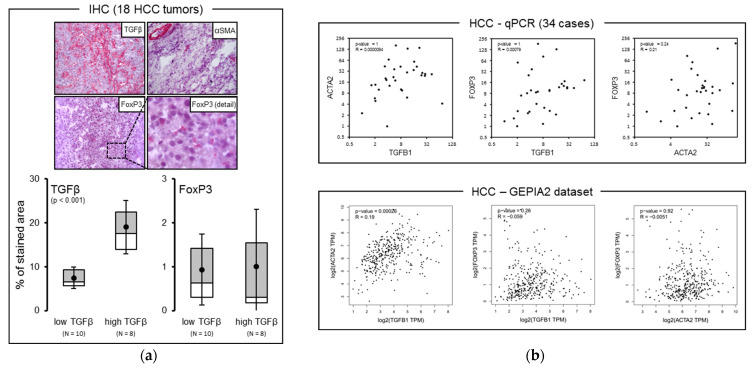
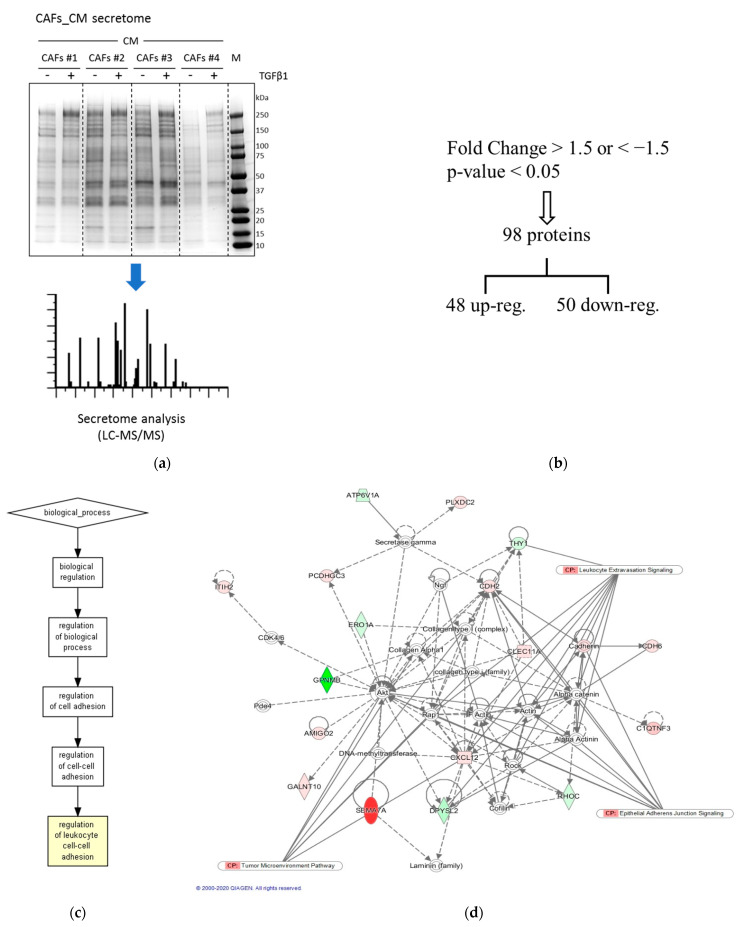
The balance between anti-tumor and tumor-promoting immune cells, such as CD4+ Th1 and regulatory T cells (Tregs), respectively, is assumed to dictate the progression of hepatocellular carcinoma (HCC). The transforming growth factor beta (TGFβ) markedly shapes the HCC microenvironment, regulating the activation state of multiple leukocyte subsets and driving the differentiation of cancer associated fibroblasts (CAFs). The fibrotic (desmoplastic) reaction in HCC tissue strongly depends on CAFs activity. In this study, we attempted to assess the role of TGFβ on transendothelial migration of Th1-oriented and Treg-oriented CD4+ T cells via a direct or indirect, CAF-mediated mechanisms, respectively. We found that the blockage of TGFβ receptor I-dependent signaling in Tregs resulted in impaired transendothelial migration (TEM) of these cells. Interestingly, the secretome of TGFβ-treated CAFs inhibited the TEM of Tregs but not Th1 cells, in comparison to the secretome of untreated CAFs. In addition, we found a significant inverse correlation between alpha-SMA and FoxP3 (marker of Tregs) mRNA expression in a microarray analysis involving 78 HCCs, thus suggesting that TGFβ-activated stromal cells may counteract the trafficking of Tregs into the tumor. The apparent dual behavior of TGFβ as both pro- and anti-tumorigenic cytokines may add a further level of complexity to the mechanisms that regulate the interactions among cancerous, stromal, and immune cells within HCC, as well as other solid tumors, and contribute to better manipulation of the TGFβ signaling as a therapeutic target in HCC patients.
抗肿瘤和促肿瘤免疫细胞(如 CD4+Th1 和调节性 T 细胞[Tregs])之间的平衡,分别假定决定了肝细胞癌(HCC)的进展。转化生长因子β(TGFβ)显著塑造了 HCC 微环境,调节多种白细胞亚群的激活状态,并驱动癌相关成纤维细胞(CAFs)的分化。HCC 组织中的纤维化(促结缔组织形成)反应强烈依赖于 CAFs 的活性。在这项研究中,我们试图评估 TGFβ 通过直接或间接的、CAF 介导的机制分别对 Th1 定向和 Treg 定向 CD4+T 细胞跨内皮迁移的作用。我们发现,Tregs 中 TGFβ 受体 I 依赖性信号的阻断导致这些细胞的跨内皮迁移(TEM)受损。有趣的是,与未经处理的 CAFs 的分泌组相比,TGFβ 处理的 CAFs 的分泌组抑制了 Tregs 的 TEM,但不抑制 Th1 细胞的 TEM。此外,我们在涉及 78 个 HCC 的微阵列分析中发现α-SMA 和 FoxP3(Tregs 的标志物)mRNA 表达之间存在显著的负相关,这表明 TGFβ 激活的基质细胞可能会阻碍 Tregs 进入肿瘤。TGFβ 作为促肿瘤和抗肿瘤细胞因子的双重作用可能为调节 HCC 以及其他实体瘤中癌细胞、基质和免疫细胞之间相互作用的机制增加了一个新的复杂性,有助于更好地操纵 TGFβ 信号作为 HCC 患者的治疗靶点。