Department of Medical Physiology, Division of Heart & Lungs, University Medical Center Utrecht, Utrecht University, 3584CM Utrecht, The Netherlands.
Laboratory Experimental Cardiology, Division of Heart & Lungs, University Medical Center Utrecht, Utrecht University, 3508GA Utrecht, The Netherlands.
Int J Mol Sci. 2021 Oct 30;22(21):11823. doi: 10.3390/ijms222111823.
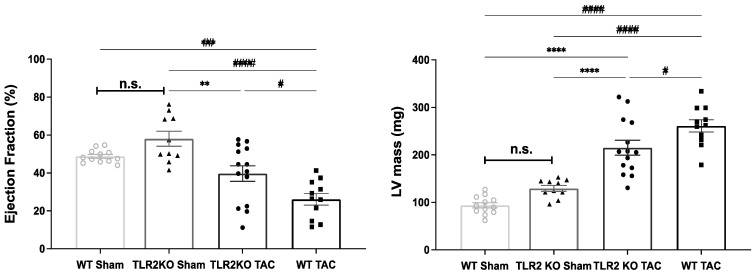
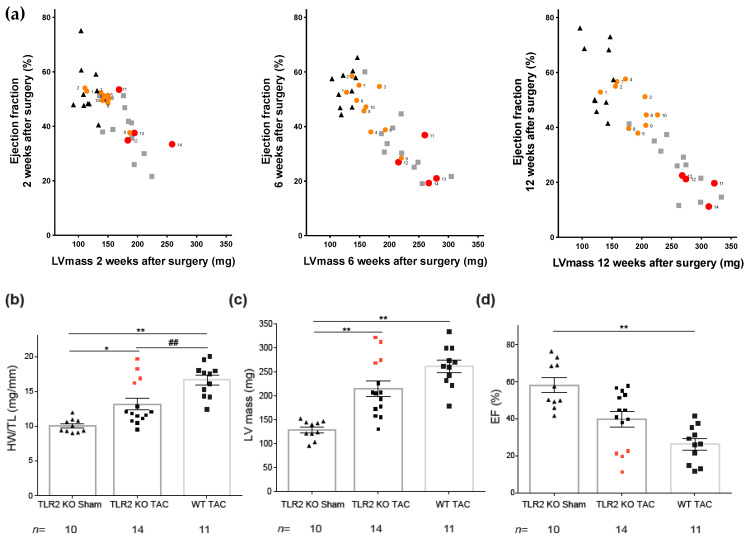
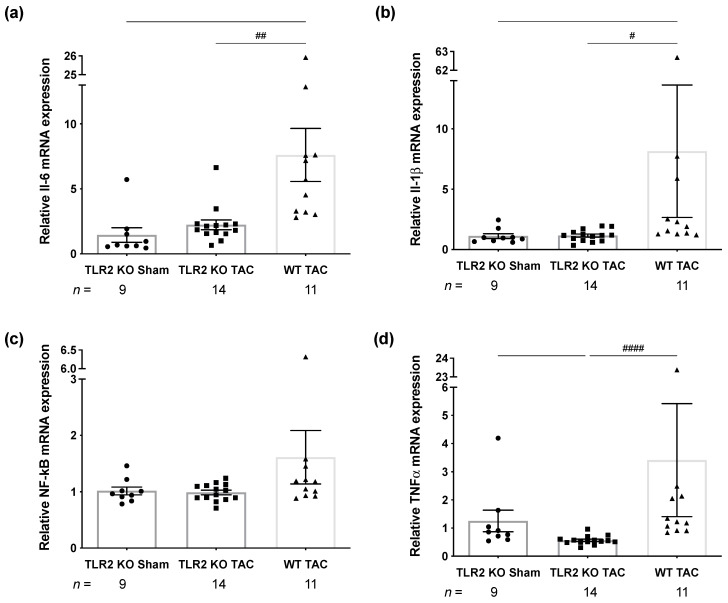
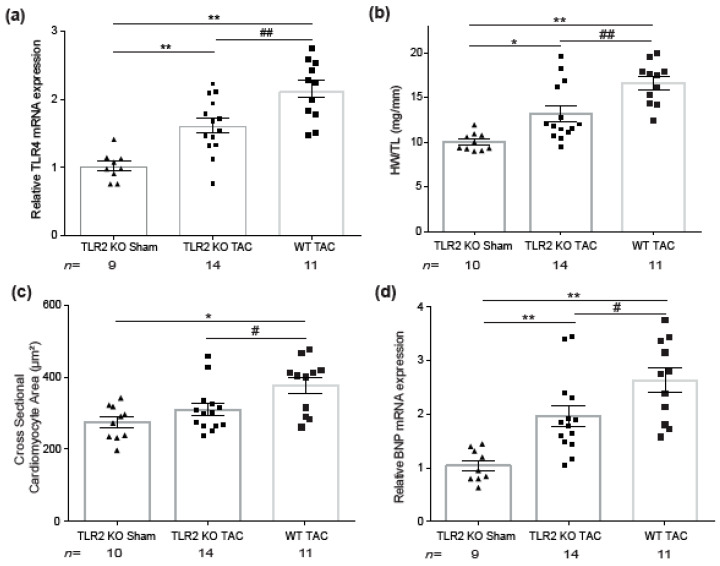
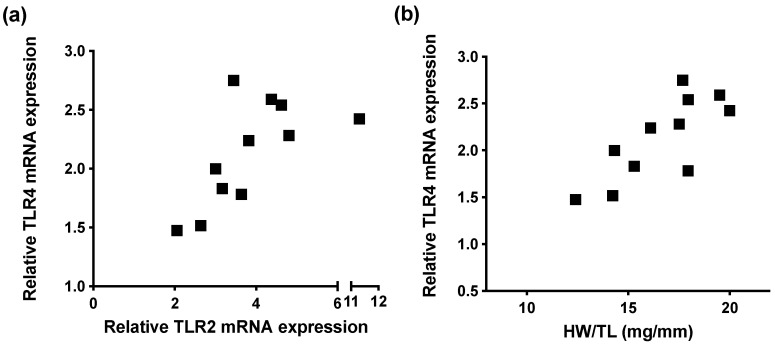
Involvement of the Toll-like receptor 4 (TLR4) in maladaptive cardiac remodeling and heart failure (HF) upon pressure overload has been studied extensively, but less is known about the role of TLR2. Interplay and redundancy of TLR4 with TLR2 have been reported in other organs but were not investigated during cardiac dysfunction. We explored whether TLR2 deficiency leads to less adverse cardiac remodeling upon chronic pressure overload and whether TLR2 and TLR4 additively contribute to this. We subjected 35 male C57BL/6J mice (wildtype (WT) or TLR2 knockout (KO)) to sham or transverse aortic constriction (TAC) surgery. After 12 weeks, echocardiography and electrocardiography were performed, and hearts were extracted for molecular and histological analysis. TLR2 deficiency ( = 14) was confirmed in all KO mice by PCR and resulted in less hypertrophy (heart weight to tibia length ratio (HW/TL), smaller cross-sectional cardiomyocyte area and decreased brain natriuretic peptide (BNP) mRNA expression, < 0.05), increased contractility (QRS and QTc, < 0.05), and less inflammation (e.g., interleukins 6 and 1β, < 0.05) after TAC compared to WT animals ( = 11). Even though TLR2 KO TAC animals presented with lower levels of ventricular TLR4 mRNA than WT TAC animals (13.2 ± 0.8 vs. 16.6 ± 0.7 mg/mm, < 0.01), TLR4 mRNA expression was increased in animals with the largest ventricular mass, highest hypertrophy, and lowest ejection fraction, leading to two distinct groups of TLR2 KO TAC animals with variations in cardiac remodeling. This variation, however, was not seen in WT TAC animals even though heart weight/tibia length correlated with expression of TLR4 in these animals (r = 0.078, = 0.005). Our data suggest that TLR2 deficiency ameliorates adverse cardiac remodeling and that ventricular TLR2 and TLR4 additively contribute to adverse cardiac remodeling during chronic pressure overload. Therefore, both TLRs may be therapeutic targets to prevent or interfere in the underlying molecular processes.
Toll 样受体 4(TLR4)在压力超负荷引起的适应性心脏重构和心力衰竭(HF)中的作用已经得到了广泛研究,但 TLR2 的作用知之甚少。TLR4 与 TLR2 之间的相互作用和冗余性已在其他器官中得到报道,但在心脏功能障碍期间并未进行研究。我们探讨了 TLR2 缺乏是否会导致慢性压力超负荷时心脏重构不良,以及 TLR2 和 TLR4 是否会共同导致这种情况。我们将 35 只雄性 C57BL/6J 小鼠(野生型(WT)或 TLR2 敲除(KO))分为假手术(Sham)或横主动脉缩窄(TAC)手术组。12 周后,进行超声心动图和心电图检查,并提取心脏进行分子和组织学分析。所有 KO 小鼠的 TLR2 缺乏( = 14)均通过 PCR 得到确认,导致心脏肥大程度降低(心脏重量与胫骨长度的比值(HW/TL)、心肌细胞截面积减小和脑钠肽(BNP)mRNA 表达降低, < 0.05)、收缩力增强(QRS 和 QTc, < 0.05)和炎症减少(例如白细胞介素 6 和 1β, < 0.05),与 WT 动物( = 11)相比。尽管 TLR2 KO TAC 动物的心室 TLR4 mRNA 水平低于 WT TAC 动物(13.2 ± 0.8 比 16.6 ± 0.7 mg/mm, < 0.01),但在心室质量最大、肥大程度最高和射血分数最低的动物中,TLR4 mRNA 表达增加,导致 TLR2 KO TAC 动物出现两种不同的心脏重构亚群。然而,在 WT TAC 动物中并未观察到这种变化,尽管这些动物的心脏重量/胫骨长度与 TLR4 的表达相关(r = 0.078, = 0.005)。我们的数据表明,TLR2 缺乏可改善心脏重构不良,而 TLR2 和 TLR4 在慢性压力超负荷时共同导致心脏重构不良。因此,两种 TLR 都可能是预防或干预潜在分子过程的治疗靶点。