Otto-Loewi Research Center for Vascular Biology, Immunology and Inflammation, Division of Pharmacology, Medical University of Graz, 8010 Graz, Austria.
National Research Centre, Cairo 12622, Egypt.
Int J Mol Sci. 2021 Nov 7;22(21):12048. doi: 10.3390/ijms222112048.
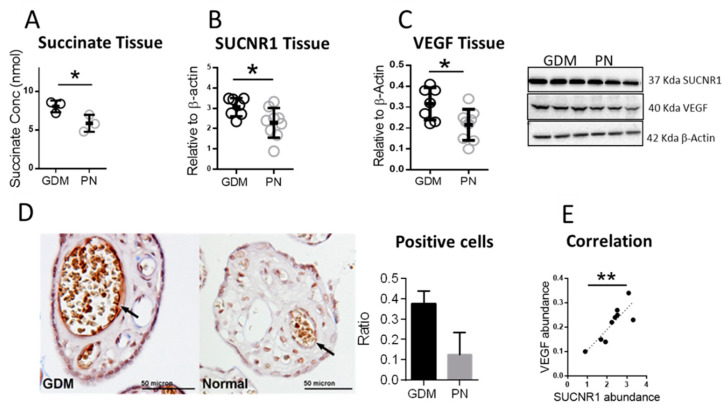
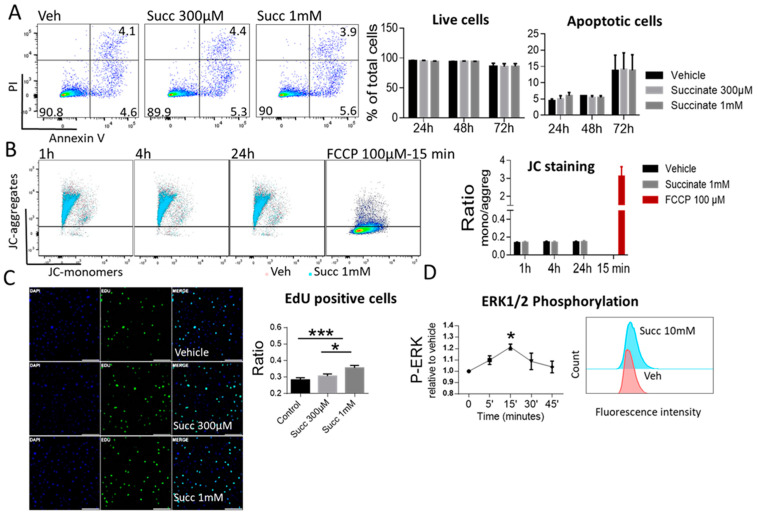
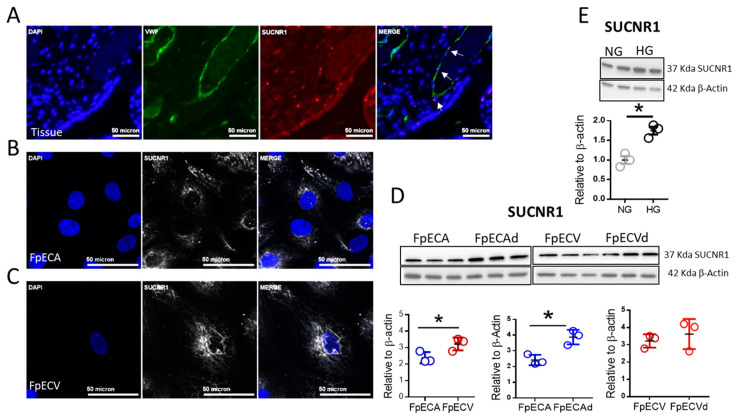
Placental hypervascularization has been reported in pregnancy-related pathologies such as gestational diabetes mellitus (GDM). Nevertheless, the underlying causes behind this abnormality are not well understood. In this study, we addressed the expression of SUCNR1 (cognate succinate receptor) in human placental endothelial cells and hypothesized that the succinate-SUCNR1 axis might play a role in the placental hypervascularization reported in GDM. We measured significantly higher succinate levels in placental tissue lysates from women with GDM relative to matched controls. In parallel, SUCNR1 protein expression was upregulated in GDM tissue lysates as well as in isolated diabetic fetoplacental arterial endothelial cells (FpECAds). A positive correlation of SUCNR1 and vascular endothelial growth factor (VEGF) protein levels in tissue lysates indicated a potential link between the succinate-SUCNR1 axis and placental angiogenesis. In our in vitro experiments, succinate prompted hallmarks of angiogenesis in human umbilical vein endothelial cells (HUVECs) such as proliferation, migration and spheroid sprouting. These results were further validated in fetoplacental arterial endothelial cells (FpECAs), where succinate induced endothelial tube formation. VEGF gene expression was increased in response to succinate in both HUVECs and FpECAs. Yet, knockdown of SUCNR1 in HUVECs led to suppression of VEGF gene expression and abrogated the migratory ability and wound healing in response to succinate. In conclusion, our data underline SUCNR1 as a promising metabolic target in human placenta and as a potential driver of enhanced placental angiogenesis in GDM.
胎盘的血管过度增生已在妊娠相关疾病如妊娠期糖尿病(GDM)中报道。然而,这种异常背后的潜在原因尚不清楚。在这项研究中,我们研究了 SUCNR1(同源琥珀酸受体)在人胎盘内皮细胞中的表达,并假设琥珀酸-SUCNR1 轴可能在 GDM 中报道的胎盘血管过度增生中发挥作用。我们测量了来自 GDM 女性的胎盘组织裂解物中琥珀酸水平显著升高,而对照组匹配。同时,GDM 组织裂解物以及分离的糖尿病胎儿胎盘动脉内皮细胞(FpECAds)中 SUCNR1 蛋白表达上调。组织裂解物中 SUCNR1 和血管内皮生长因子(VEGF)蛋白水平的正相关表明琥珀酸-SUCNR1 轴与胎盘血管生成之间存在潜在联系。在我们的体外实验中,琥珀酸促使人脐静脉内皮细胞(HUVECs)中血管生成的特征,如增殖、迁移和球体发芽。这些结果在胎儿胎盘动脉内皮细胞(FpECAs)中得到进一步验证,其中琥珀酸诱导内皮管形成。HUVECs 和 FpECAs 中 VEGF 基因表达均因琥珀酸而增加。然而,HUVECs 中 SUCNR1 的敲低导致 VEGF 基因表达的抑制,并消除了对琥珀酸的迁移能力和伤口愈合。总之,我们的数据强调了 SUCNR1 作为人胎盘有前途的代谢靶标,并作为 GDM 中增强胎盘血管生成的潜在驱动因素。