Higher Institute of Sport and Physical Education of Ksar-Said, University of La Manouba, Tunis 2010, Tunisia.
Research Unit (UR17JS01) Sports Performance, Health & Society, Higher Institute of Sport and Physical Education of Ksar-Said, Universite de la Manouba, Tunis 2010, Tunisia.
Int J Environ Res Public Health. 2021 Oct 29;18(21):11395. doi: 10.3390/ijerph182111395.
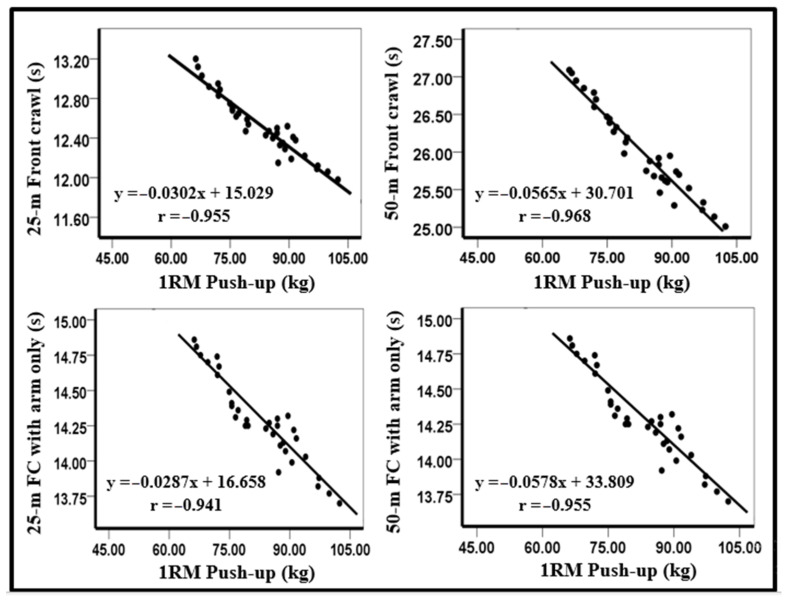
One repetition maximum (1RM) push-ups, based upon the load-velocity relationship, are able to predict the maximum upper body strength. The aim of the present study was to examine the relationship between the predicted 1RM push-up based upon the load-velocity relationship and swimming performance and kinematical variables in competitive swimmers. Thirty-three competitive male swimmers (age = 16.46 ± 0.59 years, body mass = 72.82 ± 8.41 kg, body height = 180.56 ± 5.69 cm) performed push-up exercises without a weight vest and with a 10, 20 and 30 kg weight vests. A load-velocity relationship was established as a product of the load and velocity of the push-up per participant, and the equation was used to establish a predicted 1RM. Our findings showed a predicted 1RM push-up of 82.98 ± 9.95 kg. Pearson correlations revealed a nearly perfect relationship between the 1RM push-up and the 25 or 50 m front crawl (r = -0.968, r = -0.955), and between 1RM push-up and the 25 or 50 m front crawl with arms (r = -0.955, r = x0.941). Similarly, our results revealed significant near-perfect correlations between 1RM push-up and kinematical variables (r = 0.93-0.96) except the stroke index, which had a large relationship (r = 0.56). This study suggests that swimming performance and kinematical variables are correlated with the predicted 1RM push-up. The 1RM push-up based upon the load-velocity relationship is a low cost and time-effective alternative for swimmers and coaches to predict maximum upper body strength to optimize swimming performance in short races.
一次重复最大(1RM)俯卧撑,基于负载-速度关系,能够预测最大的上身力量。本研究的目的是检查基于负载-速度关系的预测 1RM 俯卧撑与竞技游泳运动员的游泳表现和运动学变量之间的关系。33 名竞技男性游泳运动员(年龄=16.46±0.59 岁,体重=72.82±8.41 千克,身高=180.56±5.69 厘米)不戴负重背心和戴 10、20 和 30 千克负重背心进行俯卧撑练习。建立了一个负载-速度关系,作为每个参与者俯卧撑的负载和速度的乘积,并使用该方程建立了预测的 1RM。我们的研究结果显示,预测的 1RM 俯卧撑为 82.98±9.95 千克。皮尔逊相关分析显示,1RM 俯卧撑与 25 或 50 米自由泳(r=-0.968,r=-0.955)以及 25 或 50 米自由泳与手臂(r=-0.955,r=-0.941)之间存在近乎完美的关系。同样,我们的结果还显示,1RM 俯卧撑与运动学变量之间存在显著的近乎完美的相关性(r=0.93-0.96),除了stroke index(r=0.56)之外,两者之间的关系较大。本研究表明,游泳表现和运动学变量与预测的 1RM 俯卧撑相关。基于负载-速度关系的 1RM 俯卧撑是一种低成本、省时的替代方法,可供游泳运动员和教练使用,以预测最大上身力量,从而优化短距离比赛中的游泳表现。