van den Tillaar Roland, Ball Nick
Department of Sport Sciences and Physical Education, Nord University, Levanger, Norway.
Faculty of Health, Research Institute for Sport and Exercise Science, University of Canberra, Canberra, Australia.
J Hum Kinet. 2020 Jul 21;73:7-18. doi: 10.2478/hukin-2019-0133. eCollection 2020 Jul.
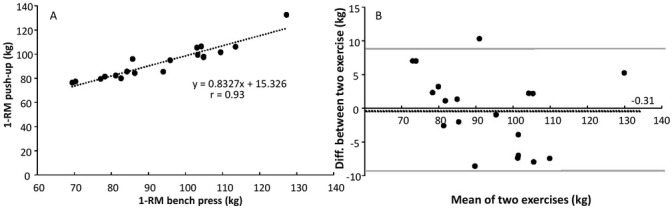
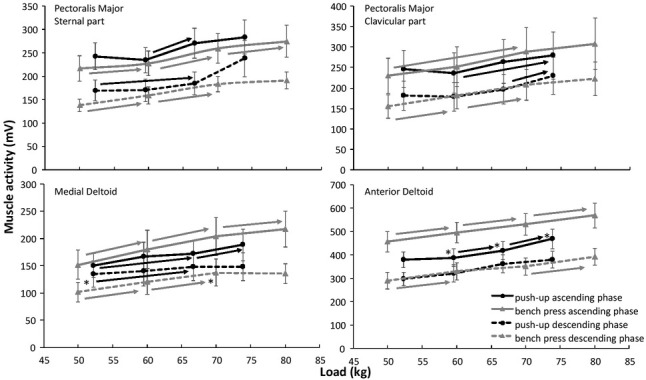
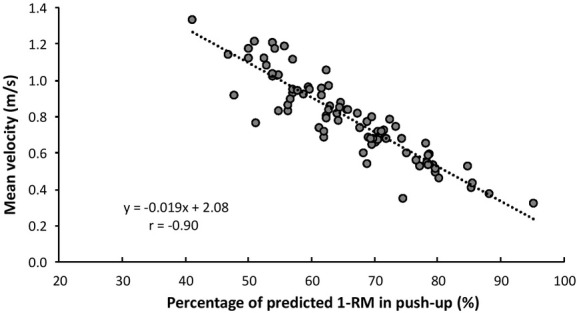
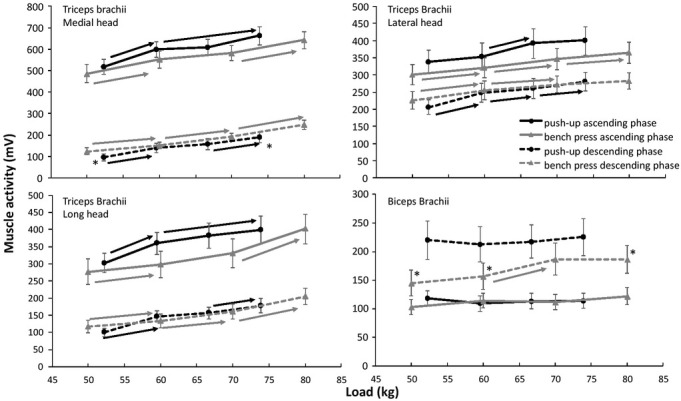
The aims of this study were firstly to compare the similarity in upper-body muscle activation between the bench press and push-up at similar loads, and secondly to establish a 1-RM prediction equation between the two exercises based upon the load-velocity relationship. Twenty resistance-trained male athletes (age 22.5 ± 5.24 years, body mass 83.7 ± 10.7 kg, body height 1.80 ± 0.06 m) performed push-ups and bench presses with four different loads. Push-ups were performed without a weight vest and with a 10-20-30 kg weight vest. Bench presses were performed at 50-80% of athletes' assumed 1 repetition max (1-RM) in 10 kg steps, while a linear encoder measured performance during the exercises. A load-velocity relationship was established as a product of the load and velocity for the push-up and bench press per participant and the equation was used to establish a predicted 1-RM. Mean muscle activation of eight upper body muscles was recorded for each exercise and each load. The main findings of this study demonstrate an extremely large association between the predicted 1-RM loads performed with the push-up and bench press (r = 0.93) in experienced resistance trained men. Furthermore, most muscles showed similar activations between the two exercises with the different loads except the deltoid and biceps brachii muscles. It may be concluded that it is possible to predict a cross-over 1-RM between the two exercises based upon the load-velocity relationship in each exercise, and that training push-ups largely targets the same muscles as the bench press except the deltoid and biceps muscles. For coaches and athletes, the use of this method is a low cost and time-effective alternative for standard 1-RM bench press testing to predict maximal upper body strength.
本研究的目的,一是比较在相似负荷下卧推和俯卧撑上身肌肉激活的相似性,二是基于负荷 - 速度关系建立这两种练习之间的1次重复最大值(1-RM)预测方程。20名经过抗阻训练的男性运动员(年龄22.5±5.24岁,体重83.7±10.7千克,身高1.80±0.06米)进行了四种不同负荷的俯卧撑和卧推。俯卧撑在不穿负重背心和穿着10 - 20 - 30千克负重背心的情况下进行。卧推以运动员假定的1次重复最大值(1-RM)的50 - 80%进行,以10千克为步长递增,同时使用线性编码器测量练习过程中的表现。为每位参与者建立了俯卧撑和卧推的负荷与速度乘积的负荷 - 速度关系,并使用该方程建立预测的1-RM。记录每种练习和每种负荷下八块上身肌肉的平均肌肉激活情况。本研究的主要结果表明,在有经验的抗阻训练男性中,俯卧撑和卧推预测的1-RM负荷之间存在极强的相关性(r = 0.93)。此外,除三角肌和肱二头肌外,大多数肌肉在两种不同负荷练习之间表现出相似的激活情况。可以得出结论,基于每种练习的负荷 - 速度关系,有可能预测两种练习之间的交叉1-RM,并且除三角肌和肱二头肌外,俯卧撑训练的主要目标肌肉与卧推基本相同。对于教练和运动员而言相比标准的1-RM卧推测试,使用这种方法预测上身最大力量是一种低成本且省时的替代方案。