School of Resources and Safety Engineering, Central South University, Changsha 410083, China.
Sensors (Basel). 2021 Oct 20;21(21):6967. doi: 10.3390/s21216967.
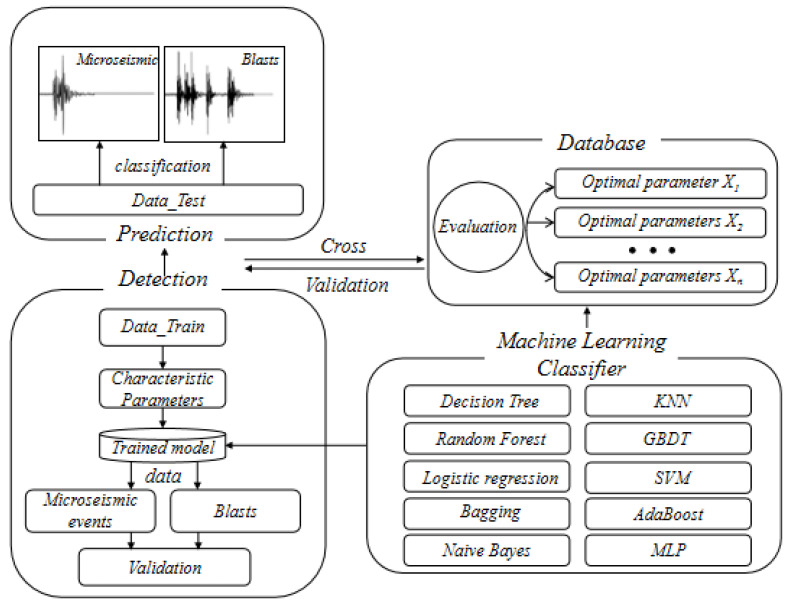
Microseismic monitoring system is one of the effective means to monitor ground stress in deep mines. The accuracy and speed of microseismic signal identification directly affect the stability analysis in rock engineering. At present, manual identification, which heavily relies on manual experience, is widely used to classify microseismic events and blasts in the mines. To realize intelligent and accurate identification of microseismic events and blasts, a microseismic signal identification system based on machine learning was established in this work. The discrimination of microseismic events and blasts was established based on the machine learning framework. The microseismic monitoring data was used to optimize the parameters and validate the classification methods. Subsequently, ten machine learning algorithms were used as the preliminary algorithms of the learning layer, including the Decision Tree, Random Forest, Logistic Regression, SVM, KNN, GBDT, Naive Bayes, Bagging, AdaBoost, and MLP. Then, training set and test set, accounting for 50% of each data set, were prospectively examined, and the ACC, PPV, SEN, NPV, SPE, FAR and ROC curves were used as evaluation indexes. Finally, the performances of these machine learning algorithms in microseismic signal identification were evaluated with cross-validation methods. The results showed that the Logistic Regression classifier had the best performance in parameter identification, and the accuracy of cross-validation can reach more than 0.95. Random Forest, Decision Tree, and Naive Bayes also performed well in this data set. There were some differences in the accuracy of different classifiers in the training set, test set, and all data sets. To improve the accuracy of signal identification, the database of microseismic events and blasts should be expanded, to avoid the inaccurate data distribution caused by the small training set. Artificial intelligence identification methods, including Random Forest, Logistic Regression, Decision Tree, Naive Bayes, and AdaBoost algorithms, were applied to signal identification of the microseismic monitoring system in mines, and the identification results were consistent with the actual situation. In this way, the confusion caused by manual classification between microseismic events and blasts based on the characteristics of waveform signals is solved, and the required source parameters are easily obtained, which can ensure the accuracy and timeliness of microseismic events and blasts identification.
微震监测系统是监测深部矿山地应力的有效手段之一。微震信号识别的准确性和速度直接影响到岩石工程的稳定性分析。目前,广泛采用人工识别方法来对矿山中的微震事件和爆破进行分类,这种方法严重依赖于人工经验。为了实现微震事件和爆破的智能准确识别,本工作建立了基于机器学习的微震信号识别系统。基于机器学习框架建立了微震事件和爆破的判别方法,利用微震监测数据对参数进行优化,并对分类方法进行验证。随后,采用 10 种机器学习算法作为学习层的初步算法,包括决策树、随机森林、逻辑回归、支持向量机、KNN、梯度提升决策树、朴素贝叶斯、Bagging、AdaBoost 和 MLP。然后,对训练集和测试集(各占数据集的 50%)进行前瞻性检查,使用 ACC、PPV、SEN、NPV、SPE、FAR 和 ROC 曲线作为评价指标。最后,采用交叉验证方法评估这些机器学习算法在微震信号识别中的性能。结果表明,Logistic Regression 分类器在参数识别中具有最佳性能,交叉验证的准确率可达到 0.95 以上。随机森林、决策树和朴素贝叶斯在该数据集中也表现良好。在训练集、测试集和所有数据集上,不同分类器的准确性存在一定差异。为了提高信号识别的准确性,应该扩大微震事件和爆破的数据库,避免由于训练集较小而导致数据分布不准确。将随机森林、Logistic Regression、决策树、朴素贝叶斯和 AdaBoost 等人工智能识别方法应用于矿山微震监测系统的信号识别中,识别结果与实际情况一致。这样,解决了基于波形信号特征的微震事件和爆破人工分类引起的混淆问题,并且容易得到所需的震源参数,从而可以保证微震事件和爆破识别的准确性和及时性。