• 文献检索
  • 文档翻译
  • 深度研究
  • 学术资讯
  • Suppr Zotero 插件Zotero 插件
  • 邀请有礼
  • 套餐&价格
  • 历史记录
应用&插件
Suppr Zotero 插件Zotero 插件浏览器插件Mac 客户端Windows 客户端微信小程序
定价
高级版会员购买积分包购买API积分包
服务
文献检索文档翻译深度研究API 文档MCP 服务
关于我们
关于 Suppr公司介绍联系我们用户协议隐私条款
关注我们

Suppr 超能文献

核心技术专利:CN118964589B侵权必究
粤ICP备2023148730 号-1Suppr @ 2026

文献检索

告别复杂PubMed语法,用中文像聊天一样搜索,搜遍4000万医学文献。AI智能推荐,让科研检索更轻松。

立即免费搜索

文件翻译

保留排版,准确专业,支持PDF/Word/PPT等文件格式,支持 12+语言互译。

免费翻译文档

深度研究

AI帮你快速写综述,25分钟生成高质量综述,智能提取关键信息,辅助科研写作。

立即免费体验

基于关节约束的惯性测量单元-运动捕捉下肢惯性测量单元位置动态标定

Joint Constraints Based Dynamic Calibration of IMU Position on Lower Limbs in IMU-MoCap.

机构信息

School of Information Engineering, East China Jiao Tong University, Shuanggang Dong Dajie 808, Nanchang 330013, China.

出版信息

Sensors (Basel). 2021 Oct 28;21(21):7161. doi: 10.3390/s21217161.

DOI:10.3390/s21217161
PMID:34770468
原文链接:https://pmc.ncbi.nlm.nih.gov/articles/PMC8588210/
Abstract

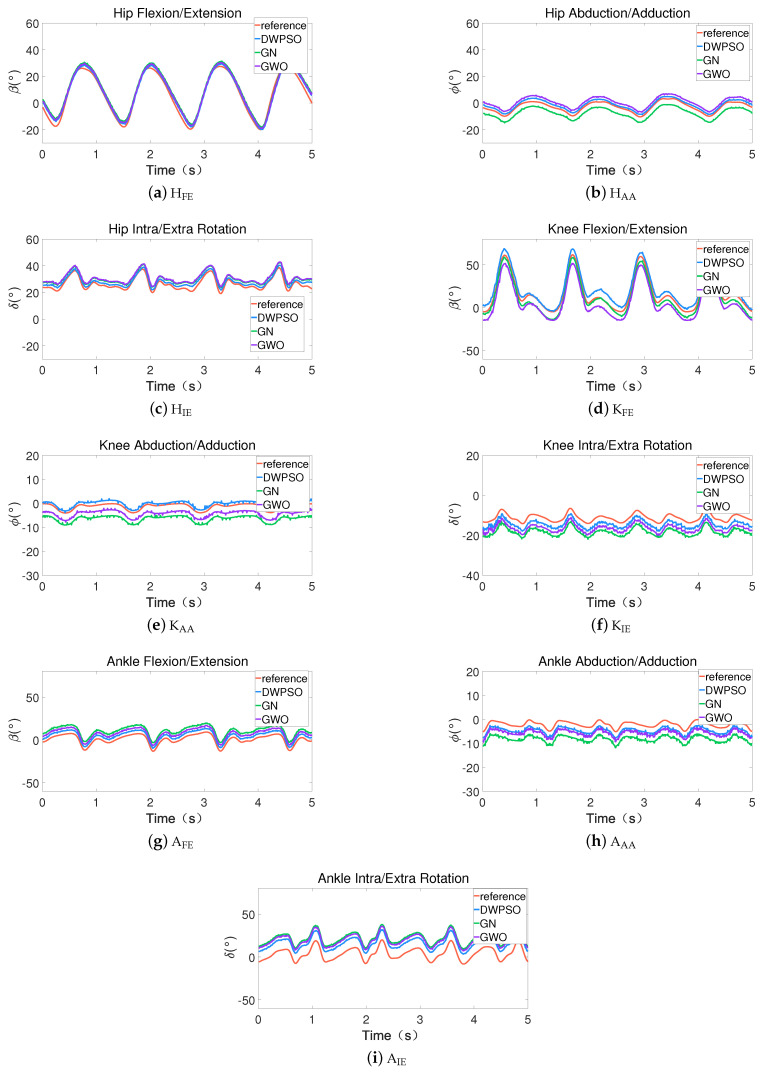
The position calibration of inertial measurement units (IMUs) is an important part of human motion capture, especially in wearable systems. In realistic applications, static calibration is quickly invalid during the motions for IMUs loosely mounted on the body. In this paper, we propose a dynamic position calibration algorithm for IMUs mounted on the waist, upper leg, lower leg, and foot based on joint constraints. To solve the problem of IMUs' position displacement, we introduce the Gauss-Newton (GN) method based on the Jacobian matrix, the dynamic weight particle swarm optimization (DWPSO), and the grey wolf optimizer (GWO) to realize IMUs' position calibration. Furthermore, we establish the coordinate system of human lower limbs to estimate each joint angle and use the fusion algorithm in the field of quaternions to improve the attitude calibration performance of a single IMU. The performances of these three algorithms are analyzed and evaluated by gait tests on the human body and comparisons with a high-precision IMU-Mocap reference device. The simulation results show that the three algorithms can effectively calibrate the IMU's position for human lower limbs. Additionally, when the degree of freedom (DOF) of a certain dimension is limited, the performances of the DWPSO and GWO may be better than GN, when the joint changes sufficiently, the performances of the three are close. The results confirm that the dynamic calibration algorithm based on joint constraints can effectively reduce the position offset errors of IMUs on upper or lower limbs in practical applications.

摘要

惯性测量单元 (IMU) 的位置校准是人体运动捕捉的重要组成部分,特别是在可穿戴系统中。在实际应用中,当 IMU 松安装在人体上时,其在运动过程中的静态校准会迅速失效。在本文中,我们提出了一种基于关节约束的腰部、大腿、小腿和脚部 IMU 的动态位置校准算法。为了解决 IMU 位置位移的问题,我们引入了基于雅可比矩阵的高斯-牛顿 (GN) 方法、动态权重粒子群优化 (DWPSO) 和灰狼优化 (GWO) 来实现 IMU 的位置校准。此外,我们建立了人体下肢的坐标系来估计每个关节角度,并使用四元数领域的融合算法来提高单个 IMU 的姿态校准性能。通过人体步态测试和与高精度 IMU-Mocap 参考设备的比较,对这三种算法的性能进行了分析和评估。仿真结果表明,这三种算法可以有效地校准人体下肢的 IMU 位置。此外,当某个维度的自由度 (DOF) 受到限制时,DWPSO 和 GWO 的性能可能优于 GN,当关节变化充分时,这三种算法的性能接近。结果证实了基于关节约束的动态校准算法可以有效地减少实际应用中上下肢 IMU 的位置偏移误差。

https://cdn.ncbi.nlm.nih.gov/pmc/blobs/b7aa/8588210/5bb4589f9b65/sensors-21-07161-g013.jpg
https://cdn.ncbi.nlm.nih.gov/pmc/blobs/b7aa/8588210/d59df6d52138/sensors-21-07161-g001.jpg
https://cdn.ncbi.nlm.nih.gov/pmc/blobs/b7aa/8588210/75de88d30f4b/sensors-21-07161-g002.jpg
https://cdn.ncbi.nlm.nih.gov/pmc/blobs/b7aa/8588210/59dcddeab02c/sensors-21-07161-g003.jpg
https://cdn.ncbi.nlm.nih.gov/pmc/blobs/b7aa/8588210/d271877af6b2/sensors-21-07161-g004.jpg
https://cdn.ncbi.nlm.nih.gov/pmc/blobs/b7aa/8588210/445e96b5f3a1/sensors-21-07161-g005.jpg
https://cdn.ncbi.nlm.nih.gov/pmc/blobs/b7aa/8588210/7db8a080d824/sensors-21-07161-g006.jpg
https://cdn.ncbi.nlm.nih.gov/pmc/blobs/b7aa/8588210/198cb4f4a1c9/sensors-21-07161-g007.jpg
https://cdn.ncbi.nlm.nih.gov/pmc/blobs/b7aa/8588210/736aa1302510/sensors-21-07161-g008.jpg
https://cdn.ncbi.nlm.nih.gov/pmc/blobs/b7aa/8588210/ebd8353e68ae/sensors-21-07161-g009.jpg
https://cdn.ncbi.nlm.nih.gov/pmc/blobs/b7aa/8588210/329a5c50573d/sensors-21-07161-g010.jpg
https://cdn.ncbi.nlm.nih.gov/pmc/blobs/b7aa/8588210/379492462c61/sensors-21-07161-g011.jpg
https://cdn.ncbi.nlm.nih.gov/pmc/blobs/b7aa/8588210/8d2ec3149814/sensors-21-07161-g012.jpg
https://cdn.ncbi.nlm.nih.gov/pmc/blobs/b7aa/8588210/5bb4589f9b65/sensors-21-07161-g013.jpg
https://cdn.ncbi.nlm.nih.gov/pmc/blobs/b7aa/8588210/d59df6d52138/sensors-21-07161-g001.jpg
https://cdn.ncbi.nlm.nih.gov/pmc/blobs/b7aa/8588210/75de88d30f4b/sensors-21-07161-g002.jpg
https://cdn.ncbi.nlm.nih.gov/pmc/blobs/b7aa/8588210/59dcddeab02c/sensors-21-07161-g003.jpg
https://cdn.ncbi.nlm.nih.gov/pmc/blobs/b7aa/8588210/d271877af6b2/sensors-21-07161-g004.jpg
https://cdn.ncbi.nlm.nih.gov/pmc/blobs/b7aa/8588210/445e96b5f3a1/sensors-21-07161-g005.jpg
https://cdn.ncbi.nlm.nih.gov/pmc/blobs/b7aa/8588210/7db8a080d824/sensors-21-07161-g006.jpg
https://cdn.ncbi.nlm.nih.gov/pmc/blobs/b7aa/8588210/198cb4f4a1c9/sensors-21-07161-g007.jpg
https://cdn.ncbi.nlm.nih.gov/pmc/blobs/b7aa/8588210/736aa1302510/sensors-21-07161-g008.jpg
https://cdn.ncbi.nlm.nih.gov/pmc/blobs/b7aa/8588210/ebd8353e68ae/sensors-21-07161-g009.jpg
https://cdn.ncbi.nlm.nih.gov/pmc/blobs/b7aa/8588210/329a5c50573d/sensors-21-07161-g010.jpg
https://cdn.ncbi.nlm.nih.gov/pmc/blobs/b7aa/8588210/379492462c61/sensors-21-07161-g011.jpg
https://cdn.ncbi.nlm.nih.gov/pmc/blobs/b7aa/8588210/8d2ec3149814/sensors-21-07161-g012.jpg
https://cdn.ncbi.nlm.nih.gov/pmc/blobs/b7aa/8588210/5bb4589f9b65/sensors-21-07161-g013.jpg

相似文献

1
Joint Constraints Based Dynamic Calibration of IMU Position on Lower Limbs in IMU-MoCap.基于关节约束的惯性测量单元-运动捕捉下肢惯性测量单元位置动态标定
Sensors (Basel). 2021 Oct 28;21(21):7161. doi: 10.3390/s21217161.
2
Validity Evaluation of an Inertial Measurement Unit (IMU) in Gait Analysis Using Statistical Parametric Mapping (SPM).基于统计参数图(SPM)的惯性测量单元(IMU)在步态分析中的有效性评估。
Sensors (Basel). 2021 May 25;21(11):3667. doi: 10.3390/s21113667.
3
Optimization of IMU Sensor Placement for the Measurement of Lower Limb Joint Kinematics.优化 IMU 传感器放置位置以测量下肢关节运动学。
Sensors (Basel). 2020 Oct 22;20(21):5993. doi: 10.3390/s20215993.
4
Measuring markers of aging and knee osteoarthritis gait using inertial measurement units.使用惯性测量单元测量衰老和膝骨关节炎步态的标志物。
J Biomech. 2020 Jan 23;99:109567. doi: 10.1016/j.jbiomech.2019.109567. Epub 2019 Dec 27.
5
Variations in Concurrent Validity of Two Independent Inertial Measurement Units Compared to Gold Standard for Upper Body Posture during Computerised Device Use.两种独立惯性测量单元与计算机设备使用期间上半身姿势金标准的同时效度比较的变异性。
Sensors (Basel). 2023 Jul 28;23(15):6761. doi: 10.3390/s23156761.
6
Lower Extremity Inverse Kinematics Results Differ Between Inertial Measurement Unit- and Marker-Derived Gait Data.下肢运动学反演结果在惯性测量单元和标记点运动学数据之间存在差异。
J Appl Biomech. 2023 Apr 6;39(3):133-142. doi: 10.1123/jab.2022-0194. Print 2023 Jun 1.
7
Concurrent validity and within-session reliability of gait kinematics measured using an inertial motion capture system with repeated calibration.使用经过多次校准的惯性运动捕捉系统测量步态运动学的同时效度和会话内可靠性。
J Bodyw Mov Ther. 2020 Oct;24(4):251-260. doi: 10.1016/j.jbmt.2020.06.008. Epub 2020 Aug 4.
8
An IMU-to-Body Alignment Method Applied to Human Gait Analysis.一种应用于人体步态分析的惯性测量单元与身体对齐方法。
Sensors (Basel). 2016 Dec 10;16(12):2090. doi: 10.3390/s16122090.
9
Effects of Dynamic IMU-to-Segment Misalignment Error on 3-DOF Knee Angle Estimation in Walking and Running.动态 IMU 与肢体对位误差对行走和跑步时三维膝关节角度估计的影响。
Sensors (Basel). 2022 Nov 21;22(22):9009. doi: 10.3390/s22229009.
10
On Inertial Body Tracking in the Presence of Model Calibration Errors.存在模型校准误差时的惯性人体跟踪
Sensors (Basel). 2016 Jul 22;16(7):1132. doi: 10.3390/s16071132.

引用本文的文献

1
Effects of Dynamic IMU-to-Segment Misalignment Error on 3-DOF Knee Angle Estimation in Walking and Running.动态 IMU 与肢体对位误差对行走和跑步时三维膝关节角度估计的影响。
Sensors (Basel). 2022 Nov 21;22(22):9009. doi: 10.3390/s22229009.

本文引用的文献

1
Trends Supporting the In-Field Use of Wearable Inertial Sensors for Sport Performance Evaluation: A Systematic Review.支持在运动表现评估中现场使用可穿戴惯性传感器的趋势:一项系统综述。
Sensors (Basel). 2018 Mar 15;18(3):873. doi: 10.3390/s18030873.
2
An Automatic Gait Feature Extraction Method for Identifying Gait Asymmetry Using Wearable Sensors.一种使用可穿戴传感器识别步态不对称的自动步态特征提取方法。
Sensors (Basel). 2018 Feb 24;18(2):676. doi: 10.3390/s18020676.
3
An IMU-to-Body Alignment Method Applied to Human Gait Analysis.一种应用于人体步态分析的惯性测量单元与身体对齐方法。
Sensors (Basel). 2016 Dec 10;16(12):2090. doi: 10.3390/s16122090.
4
Validation of inertial measurement units with an optoelectronic system for whole-body motion analysis.使用光电系统对惯性测量单元进行全身运动分析的验证。
Med Biol Eng Comput. 2017 Apr;55(4):609-619. doi: 10.1007/s11517-016-1537-2. Epub 2016 Jul 5.
5
IMU-based joint angle measurement for gait analysis.用于步态分析的基于惯性测量单元的关节角度测量
Sensors (Basel). 2014 Apr 16;14(4):6891-909. doi: 10.3390/s140406891.
6
Gait analysis methods: an overview of wearable and non-wearable systems, highlighting clinical applications.步态分析方法:可穿戴和不可穿戴系统概述,重点介绍临床应用。
Sensors (Basel). 2014 Feb 19;14(2):3362-94. doi: 10.3390/s140203362.
7
Gait analysis using wearable sensors.使用可穿戴传感器进行步态分析。
Sensors (Basel). 2012;12(2):2255-83. doi: 10.3390/s120202255. Epub 2012 Feb 16.
8
'Outwalk': a protocol for clinical gait analysis based on inertial and magnetic sensors.《Outwalk》:基于惯性和磁场传感器的临床步态分析方案。
Med Biol Eng Comput. 2010 Jan;48(1):17-25. doi: 10.1007/s11517-009-0545-x. Epub 2009 Nov 13.
9
Functional calibration procedure for 3D knee joint angle description using inertial sensors.使用惯性传感器进行 3D 膝关节角度描述的功能校准程序。
J Biomech. 2009 Oct 16;42(14):2330-5. doi: 10.1016/j.jbiomech.2009.06.025. Epub 2009 Aug 8.
10
An inertial and magnetic sensor based technique for joint angle measurement.一种基于惯性和磁传感器的关节角度测量技术。
J Biomech. 2007;40(12):2604-11. doi: 10.1016/j.jbiomech.2006.12.010. Epub 2007 Mar 7.