Office of Science and Engineering Laboratories, Center for Devices and Radiological Health, U.S. Food and Drug Administration, Silver Spring, MD 20993, USA.
Division of Clinical Evidence and Analysis 2, Office of Clinical Evidence and Analysis, Office of Product Evaluation and Quality, Center for Devices and Radiological Health, U.S. Food and Drug Administration, Silver Spring, MD 20993, USA.
Sensors (Basel). 2020 Oct 22;20(21):5993. doi: 10.3390/s20215993.
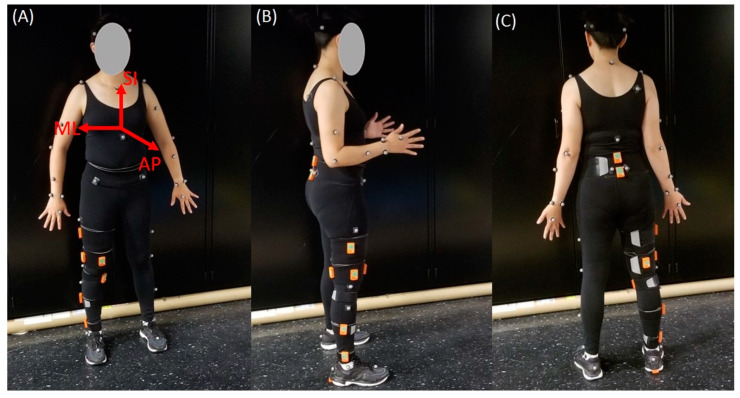
There is an increased interest in using wearable inertial measurement units (IMUs) in clinical contexts for the diagnosis and rehabilitation of gait pathologies. Despite this interest, there is a lack of research regarding optimal sensor placement when measuring joint kinematics and few studies which examine functionally relevant motions other than straight level walking. The goal of this clinical measurement research study was to investigate how the location of IMU sensors on the lower body impact the accuracy of IMU-based hip, knee, and ankle angular kinematics. IMUs were placed on 11 different locations on the body to measure lower limb joint angles in seven participants performing the timed-up-and-go (TUG) test. Angles were determined using different combinations of IMUs and the TUG was segmented into different functional movements. Mean bias and root mean square error values were computed using generalized estimating equations comparing IMU-derived angles to a reference optical motion capture system. Bias and RMSE values vary with the sensor position. This effect is partially dependent on the functional movement analyzed and the joint angle measured. However, certain combinations of sensors produce lower bias and RMSE more often than others. The data presented here can inform clinicians and researchers of placement of IMUs on the body that will produce lower error when measuring joint kinematics for multiple functionally relevant motions. Optimization of IMU-based kinematic measurements is important because of increased interest in the use of IMUs to inform diagnose and rehabilitation in clinical settings and at home.
人们越来越感兴趣地将可穿戴惯性测量单元 (IMU) 用于临床环境,以诊断和康复步态病理。尽管对此感兴趣,但在测量关节运动学方面,关于最佳传感器放置位置的研究还很少,并且很少有研究检查除直线路径行走以外的其他功能相关运动。本临床测量研究的目的是研究在人体下半身放置 IMU 传感器的位置如何影响基于 IMU 的髋部、膝部和踝部角度运动学的准确性。在 7 名参与者进行计时起立行走 (TUG) 测试时,将 IMU 放置在身体的 11 个不同位置,以测量下肢关节角度。使用不同的 IMU 组合和 TUG 分段为不同的功能运动来确定角度。使用广义估计方程比较 IMU 衍生角度和参考光学运动捕捉系统,计算平均偏差和均方根误差值。偏差和 RMSE 值随传感器位置而变化。这种影响部分取决于分析的功能运动和测量的关节角度。然而,某些传感器组合比其他组合更经常产生较低的偏差和 RMSE。这里呈现的数据可以为临床医生和研究人员提供有关在身体上放置 IMU 的信息,以便在测量多个功能相关运动的关节运动学时产生较低的误差。优化基于 IMU 的运动学测量非常重要,因为人们越来越感兴趣地将 IMU 用于临床环境和家庭中的诊断和康复。