School of Health Sciences, College of Health, Medicine and Wellbeing, The University of Newcastle, Callaghan, NSW 2308, Australia.
Active Living Research Program, Hunter Medical Research Institute, New Lambton Heights, NSW 2305, Australia.
Sensors (Basel). 2023 Jul 28;23(15):6761. doi: 10.3390/s23156761.
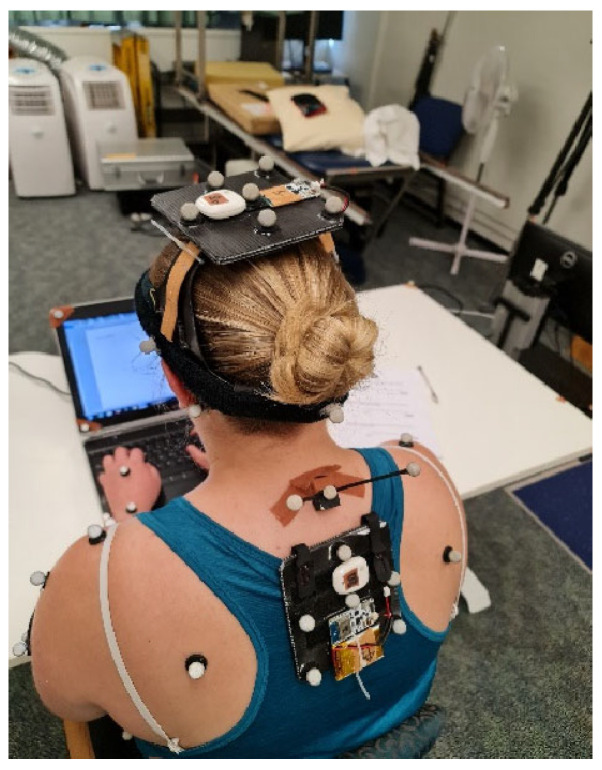
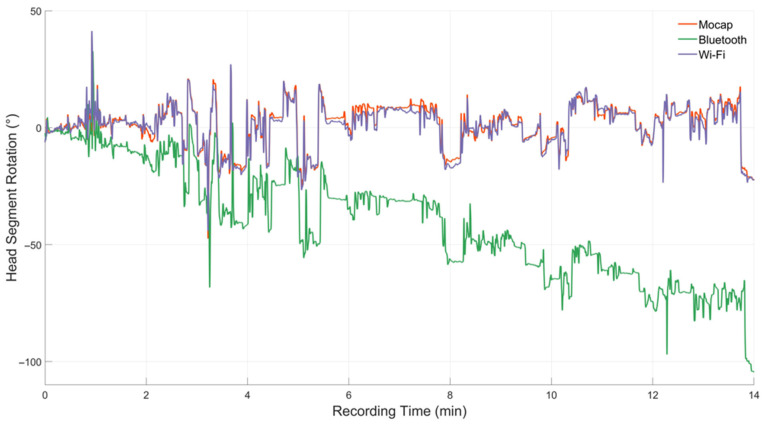
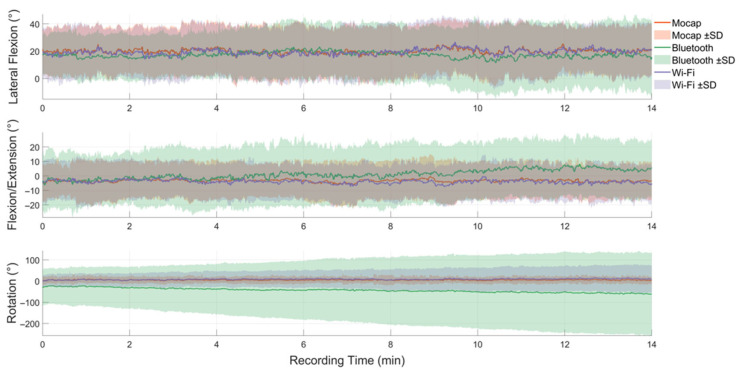
Inertial measurement units (IMUs) may provide an objective method for measuring posture during computer use, but research is needed to validate IMUs' accuracy. We examine the concurrent validity of two different IMU systems in measuring three-dimensional (3D) upper body posture relative to a motion capture system (Mocap) as a potential device to assess postures outside a laboratory environment. We used 3D Mocap and two IMU systems (Wi-Fi and Bluetooth) to capture the upper body posture of twenty-six individuals during three physical computer working conditions (monitor correct, monitor raised, and laptop). Coefficient of determination (R) and root-mean-square error (RMSE) compared IMUs to Mocap. Head/neck segment [HN], upper trunk segment [UTS], and joint angle [HN-UTS] were the primary variables. Wi-Fi IMUs demonstrated high validity for HN and UTS (sagittal plane) and HN-UTS (frontal plane) for all conditions, and for HN rotation movements (both for the monitor correct and monitor raised conditions), others moderate to poor. Bluetooth IMUs for HN, and UTS (sagittal plane) for the monitor correct, laptop, and monitor raised conditions were moderate. Frontal plane movements except UTS (monitor correct and laptop) and all rotation had poor validity. Both IMU systems were affected by gyroscopic drift with sporadic data loss in Bluetooth IMUs. Wi-Fi IMUs had more acceptable accuracy when measuring upper body posture during computer use compared to Mocap, except for trunk rotations. Variation in IMU systems' performance suggests validation in the task-specific movement(s) is essential.
惯性测量单元 (IMU) 可以为测量计算机使用过程中的姿势提供一种客观的方法,但需要研究来验证 IMU 的准确性。我们检验了两种不同的 IMU 系统在测量相对于运动捕捉系统 (Mocap) 的三维 (3D) 上半身姿势方面的同时效度,作为一种在实验室环境之外评估姿势的潜在设备。我们使用 3D Mocap 和两个 IMU 系统 (Wi-Fi 和蓝牙) 来捕获二十六个人在三种物理计算机工作条件 (显示器正确、显示器升高和笔记本电脑) 下的上半身姿势。决定系数 (R) 和均方根误差 (RMSE) 将 IMU 与 Mocap 进行比较。头部/颈部节段 [HN]、上躯干节段 [UTS] 和关节角度 [HN-UTS] 是主要变量。Wi-Fi IMU 对所有条件下的 HN 和 UTS(矢状面)和 HN-UTS(额状面)以及 HN 旋转运动(显示器正确和显示器升高条件)都具有较高的有效性,而其他的则是中等至较差。蓝牙 IMU 对 HN 和 UTS(矢状面)在显示器正确、笔记本电脑和显示器升高的条件下具有中等的有效性。除了显示器正确和笔记本电脑的 UTS(额状面)以及所有旋转运动外,额状面运动的有效性都较差。两个 IMU 系统都受到陀螺仪漂移的影响,蓝牙 IMU 偶尔会出现数据丢失。Wi-Fi IMU 在测量计算机使用过程中的上半身姿势时比 Mocap 具有更高的准确性,除了躯干旋转运动外。IMU 系统性能的变化表明,在特定任务的运动中进行验证是必不可少的。