Faculty of Physical Culture, Palacký University Olomouc, 771 11 Olomouc, Czech Republic.
School of Sport and Recreation, Auckland University of Technology, Auckland 1010, New Zealand.
Sensors (Basel). 2021 Oct 30;21(21):7232. doi: 10.3390/s21217232.
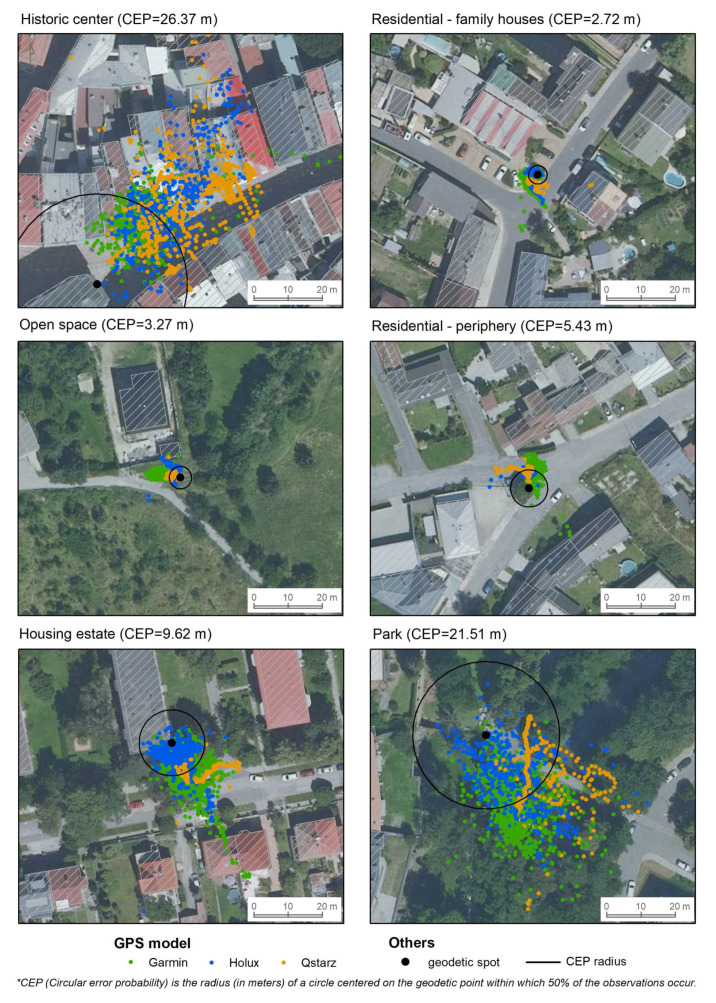
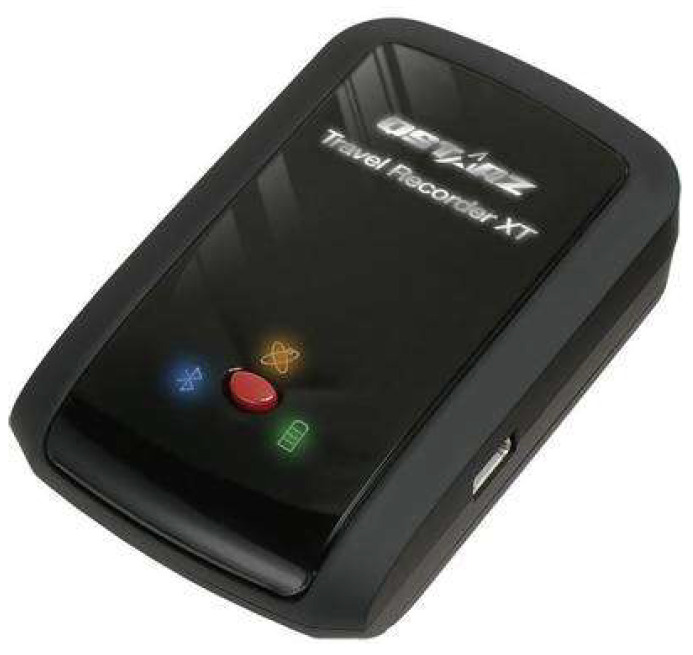
In order to study the relationship between human physical activity and the design of the built environment, it is important to measure the location of human movement accurately. In this study, we compared an inexpensive GPS receiver (Holux RCV-3000) and a frequently used Garmin Forerunner 35 smart watch, with a device that has been validated and recommended for physical activity research (Qstarz BT-Q1000XT). These instruments were placed on six geodetic points, which represented a range of different environments (e.g., residential, open space, park). The coordinates recorded by each device were compared with the known coordinates of the geodetic points. There were no differences in accuracy among the three devices when averaged across the six sites. However, the Garmin was more accurate in the city center and the Holux was more accurate in the park and housing estate areas compared to the other devices. We consider the location accuracy of the Holux and the Garmin to be comparable to that of the Qstarz. Therefore, we consider these devices to be suitable instruments for locating physical activity. Researchers must also consider other differences among these devices (such as battery life) when determining if they are suitable for their research studies.
为了研究人类身体活动与建筑环境设计之间的关系,准确测量人类运动的位置非常重要。在本研究中,我们比较了一种廉价的 GPS 接收器(Holux RCV-3000)和一款常用的 Garmin Forerunner 35 智能手表,以及一种已被验证并推荐用于身体活动研究的设备(Qstarz BT-Q1000XT)。这三种仪器被放置在六个大地测量点上,这些点代表了不同的环境(如住宅、开放空间、公园)。每个设备记录的坐标与大地测量点的已知坐标进行了比较。在六个地点的平均值上,三种设备之间的精度没有差异。然而,与其他设备相比,Garmin 在市中心更准确,而 Holux 在公园和住宅区更准确。我们认为 Holux 和 Garmin 的位置精度与 Qstarz 相当。因此,我们认为这些设备是适合定位身体活动的仪器。研究人员在确定这些设备是否适合他们的研究时,还必须考虑这些设备之间的其他差异(如电池寿命)。