Swiss Federal Institute of Sport Magglingen, Magglingen/Macolin, Switzerland.
JMIR Mhealth Uhealth. 2020 Jun 24;8(6):e17118. doi: 10.2196/17118.
Elite athletes and recreational runners rely on the accuracy of global navigation satellite system (GNSS)-enabled sport watches to monitor and regulate training activities. However, there is a lack of scientific evidence regarding the accuracy of such sport watches.
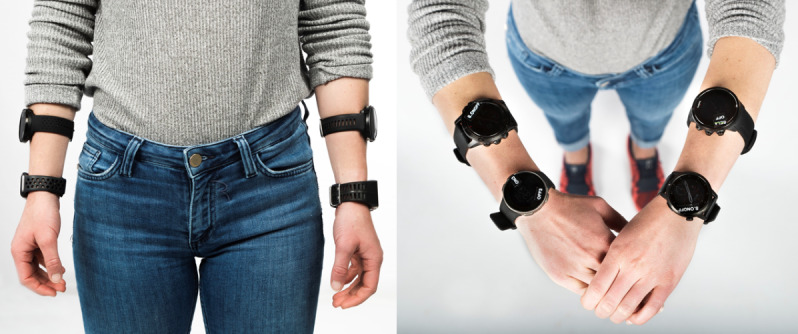
The aim was to investigate the accuracy of the recorded distances obtained by eight commercially available sport watches by Apple, Coros, Garmin, Polar, and Suunto when assessed in different areas and at different speeds. Furthermore, potential parameters that affect the measurement quality were evaluated.
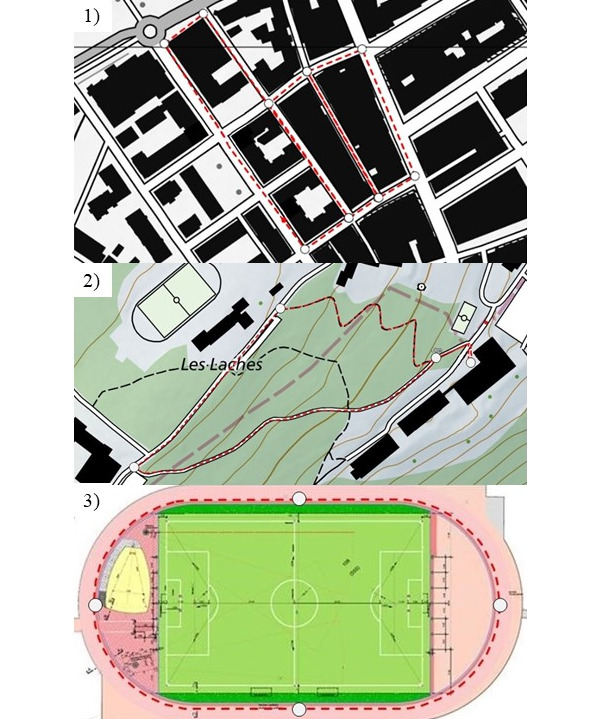
Altogether, 3 × 12 measurements in urban, forest, and track and field areas were obtained while walking, running, and cycling under various outdoor conditions.
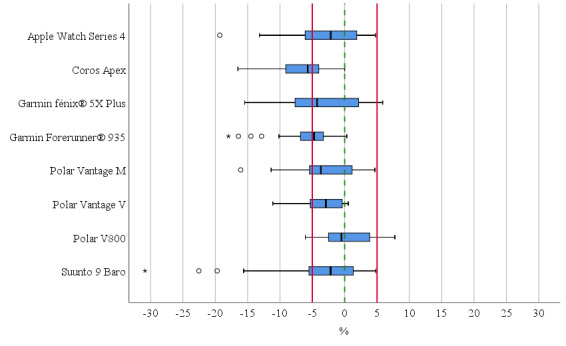
The selected reference distances ranged from 404.0 m to 4296.9 m. For all the measurement areas combined, the recorded systematic errors (±limits of agreements) ranged between 3.7 (±195.6) m and -101.0 (±231.3) m, and the mean absolute percentage errors ranged from 3.2% to 6.1%. Only the GNSS receivers from Polar showed overall errors <5%. Generally, the recorded distances were significantly underestimated (all P values <.04) and less accurate in the urban and forest areas, whereas they were overestimated but with good accuracy in 75% (6/8) of the sport watches in the track and field area. Furthermore, the data assessed during running showed significantly higher error rates in most devices compared with the walking and cycling activities.
The recorded distances might be underestimated by up to 9%. However, the use of all investigated sport watches can be recommended, especially for distance recordings in open areas.
精英运动员和休闲跑者依赖全球导航卫星系统(GNSS)启用的运动手表来监测和调节训练活动。然而,关于此类运动手表的准确性缺乏科学证据。
旨在研究苹果、高驰、佳明、 Polar 和颂拓等 8 款市售运动手表在不同区域和不同速度下记录的距离的准确性。此外,评估了可能影响测量质量的潜在参数。
总共在城市、森林和田径场地区进行了 3 次×12 次测量,在各种户外条件下步行、跑步和骑自行车。
选择的参考距离范围为 404.0 米至 4296.9 米。对于所有测量区域的组合,记录的系统误差(±一致性界限)范围为 3.7(±195.6)米至-101.0(±231.3)米,平均绝对百分比误差范围为 3.2%至 6.1%。只有 Polar 的 GNSS 接收器总体误差<5%。通常,记录的距离明显低估(所有 P 值<.04),且在城市和森林区域的准确性较低,而在田径场区域的 8 款运动手表中有 75%(6/8)的记录距离被高估,但准确性较高。此外,与步行和骑行活动相比,跑步时评估的数据在大多数设备中显示出明显更高的误差率。
记录的距离可能低估了 9%。然而,可以推荐使用所有调查的运动手表,特别是在开阔区域记录距离时。