AltaML Inc., Edmonton, AB T5J 3N9, Canada.
PROTXX Inc., Menlo Park, CA 94025, USA.
Sensors (Basel). 2021 Nov 8;21(21):7417. doi: 10.3390/s21217417.
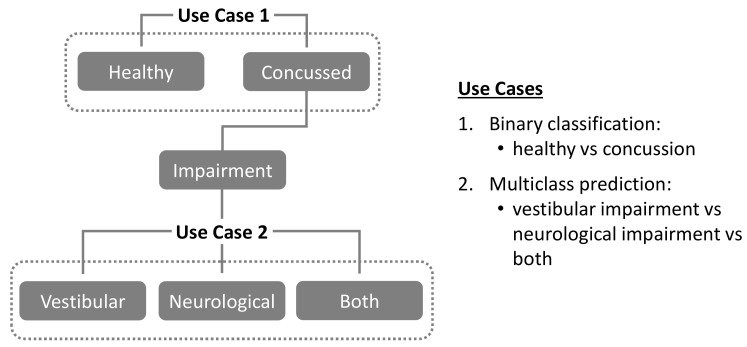
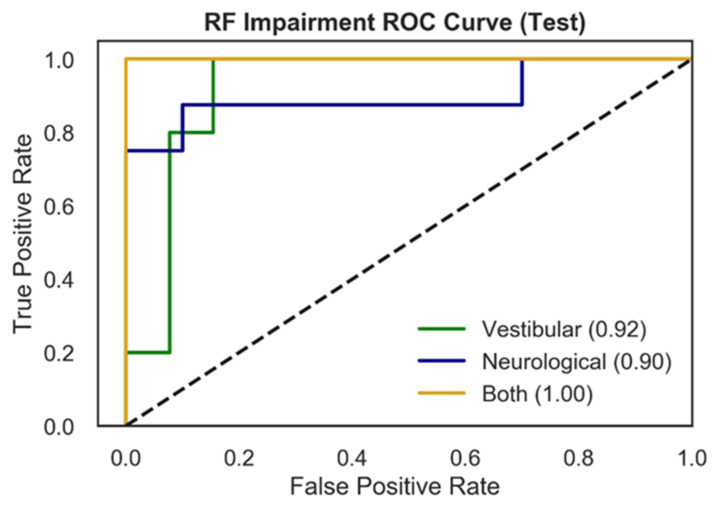
Concussion injuries remain a significant public health challenge. A significant unmet clinical need remains for tools that allow related physiological impairments and longer-term health risks to be identified earlier, better quantified, and more easily monitored over time. We address this challenge by combining a head-mounted wearable inertial motion unit (IMU)-based physiological vibration acceleration ("phybrata") sensor and several candidate machine learning (ML) models. The performance of this solution is assessed for both binary classification of concussion patients and multiclass predictions of specific concussion-related neurophysiological impairments. Results are compared with previously reported approaches to ML-based concussion diagnostics. Using phybrata data from a previously reported concussion study population, four different machine learning models (Support Vector Machine, Random Forest Classifier, Extreme Gradient Boost, and Convolutional Neural Network) are first investigated for binary classification of the test population as healthy vs. concussion (Use Case 1). Results are compared for two different data preprocessing pipelines, Time-Series Averaging (TSA) and Non-Time-Series Feature Extraction (NTS). Next, the three best-performing NTS models are compared in terms of their multiclass prediction performance for specific concussion-related impairments: vestibular, neurological, both (Use Case 2). For Use Case 1, the NTS model approach outperformed the TSA approach, with the two best algorithms achieving an F1 score of 0.94. For Use Case 2, the NTS Random Forest model achieved the best performance in the testing set, with an F1 score of 0.90, and identified a wider range of relevant phybrata signal features that contributed to impairment classification compared with manual feature inspection and statistical data analysis. The overall classification performance achieved in the present work exceeds previously reported approaches to ML-based concussion diagnostics using other data sources and ML models. This study also demonstrates the first combination of a wearable IMU-based sensor and ML model that enables both binary classification of concussion patients and multiclass predictions of specific concussion-related neurophysiological impairments.
脑震荡损伤仍然是一个重大的公共卫生挑战。目前仍然存在着一个巨大的临床需求,需要开发工具,以便更早地识别相关的生理损伤和长期健康风险,更准确地量化这些风险,并更方便地进行长期监测。为了解决这一挑战,我们结合了一个头戴式可穿戴惯性运动单元(IMU)的生理振动加速度(phybrata)传感器和几个候选机器学习(ML)模型。我们评估了这种解决方案在脑震荡患者的二进制分类和特定脑震荡相关神经生理损伤的多类预测方面的性能。结果与以前报道的基于 ML 的脑震荡诊断方法进行了比较。使用以前报道的脑震荡研究人群中的 phybrata 数据,我们首先研究了四种不同的机器学习模型(支持向量机、随机森林分类器、极端梯度提升和卷积神经网络),用于测试人群的健康与脑震荡的二进制分类(用例 1)。我们比较了两种不同的数据预处理管道,时间序列平均(TSA)和非时间序列特征提取(NTS)的结果。接下来,我们比较了三种性能最好的 NTS 模型在特定脑震荡相关损伤的多类预测性能方面的表现:前庭、神经、两者都有(用例 2)。对于用例 1,NTS 模型方法优于 TSA 方法,两种最佳算法的 F1 分数达到 0.94。对于用例 2,NTS 随机森林模型在测试集中取得了最好的性能,F1 分数为 0.90,并且确定了更广泛的与损伤分类相关的 phybrata 信号特征,与手动特征检查和统计数据分析相比,这些特征对损伤分类有贡献。本工作中实现的整体分类性能优于以前使用其他数据源和 ML 模型进行的基于 ML 的脑震荡诊断方法。本研究还首次结合了基于可穿戴 IMU 的传感器和 ML 模型,实现了脑震荡患者的二进制分类和特定脑震荡相关神经生理损伤的多类预测。