Center for Child and Adolescent Medicine and Center for Rare Diseases, University Hospital Heidelberg, 69120, Heidelberg, Germany.
Department of Pediatrics, Dr Von Hauner Children's Hospital, University Hospital and Munich Centre for Rare Diseases, LMU Munich, 80337, Munich, Germany.
Orphanet J Rare Dis. 2021 Nov 12;16(1):474. doi: 10.1186/s13023-021-02092-w.
Diagnosis, treatment, and care of patients with rare diseases require multidisciplinary cooperation between medical and paramedical specialities and with patients and families. Innovative genetic diagnostics, whole exome and whole genome sequencing (WES, WGS) has enlarged the diagnostic toolkit but also increased the complexity of the endeavour. Structured multidisciplinary clinical pathways (CPW) can guide diagnosis, treatment, and care of patients with rare diseases, link scientific evidence to clinical practice and optimise clinical outcomes whilst maximising clinical efficiency.
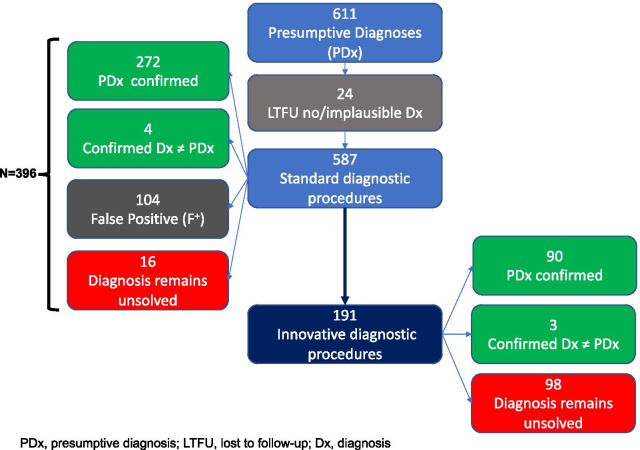
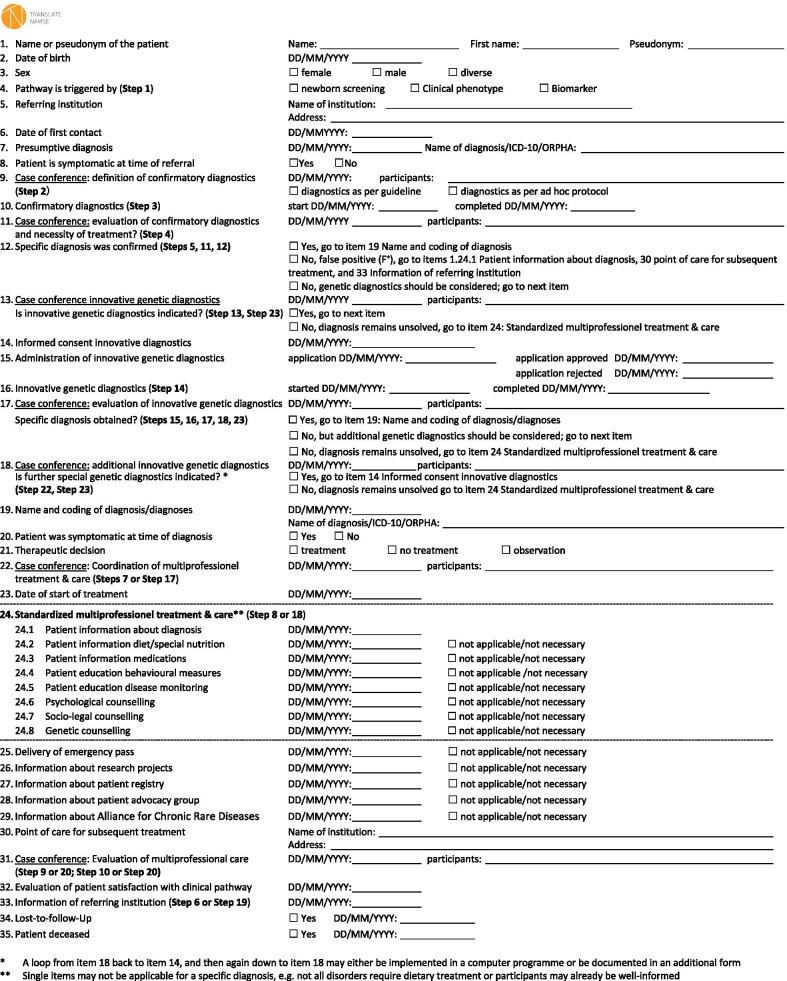
In contrast to the common approach of appending disease-specific CPWs to disease-specific guidelines, we suggest a generic CPW manoeuvring the patient along the way of finding the correct diagnosis by applying the best diagnostic strategy into an appropriate system of treatment and care. Available guidelines can be integrated into the generic CPW in the course of its application. The approach also applies to situations where a diagnosis remains unsolved. The backbone of the generic CPW is a set of multidisciplinary structured case conferences projecting and evaluating diagnostic and/or therapeutic steps, enforcing to integrate best scientific evidence with clinical experience. The generic CPW is stated as a flowchart and a checklist which can be used to record and document parsimoniously the structure, process and results of a patient's pathway, but also as a data model for research. It was applied in a multicentre setting with 587 cases each with a presumptive diagnosis of a rare disease. In 369 cases (62.8%) a diagnosis could be confirmed, and multidisciplinary treatment and/or care was initiated. The median process time from first contact until confirmation of diagnosis by WES was 109 days and much shorter than diagnostic delays reported in the literature. Application of the CPW is illustrated by two case reports.
Our model is a tool to change the diagnostic odyssey into an organised and trackable route. It can also be used to inform patients and families about the stages of their individual route, to update health care providers only partially involved or attending specialised treatment and care, like the patient's or family's primary physician, and finally to train novices in the field.
诊断、治疗和护理罕见病患者需要医学和辅助医学专业之间的多学科合作,以及患者及其家属的参与。创新的基因诊断技术,外显子组和全基因组测序(WES、WGS)扩大了诊断工具包,但也增加了工作的复杂性。结构化的多学科临床路径(CPW)可以指导罕见病患者的诊断、治疗和护理,将科学证据与临床实践联系起来,优化临床结果,同时最大限度地提高临床效率。
与将特定疾病的 CPW 附加到特定疾病指南的常见方法相反,我们建议使用通用 CPW,通过应用最佳诊断策略到适当的治疗和护理系统,引导患者找到正确的诊断。在应用过程中,可以将可用的指南整合到通用 CPW 中。该方法也适用于诊断仍未解决的情况。通用 CPW 的骨干是一组多学科结构化病例会议,预测和评估诊断和/或治疗步骤,强制将最佳科学证据与临床经验相结合。通用 CPW 以流程图和检查表的形式呈现,可以用于精简地记录和记录患者路径的结构、过程和结果,也可以作为研究的数据模型。它在一个多中心环境中应用于 587 例疑似罕见病患者,其中 369 例(62.8%)可以确诊,并启动多学科治疗和/或护理。从首次接触到通过 WES 确认诊断的中位时间为 109 天,明显短于文献报道的诊断延迟。CPW 的应用通过两个病例报告进行说明。
我们的模型是将诊断的曲折之旅转变为有条理和可追踪的路径的工具。它还可以用于告知患者及其家属其个人路径的各个阶段,仅向部分参与或仅参与特定治疗和护理的医疗保健提供者(如患者或家庭的初级保健医生)提供信息,并最终培训该领域的新手。