Department of Obstetrics and Gynecology, Shengjing Hospital of China Medical University, Shenyang, Liaoning, China.
Cancer Med. 2021 Dec;10(23):8558-8569. doi: 10.1002/cam4.4368. Epub 2021 Nov 12.
There is currently no recognized first-line treatment strategy for ovarian neuroendocrine tumors (NETs). Furthermore, because of the low incidence of ovarian NETs, no studies have reported prognostic statistics derived from large samples. This retrospective study aimed to investigate the clinical behavior of ovarian NETs.
The Surveillance, Epidemiology, and End Results database was used to identify women diagnosed with ovarian NETs from 2004 to 2015. Overall survival (OS), cancer-specific survival (CSS), and independent prognostic factors for ovarian NETs were evaluated. The effects of different treatments on prognosis were also compared, as were OS and CSS rates for histological subtypes.
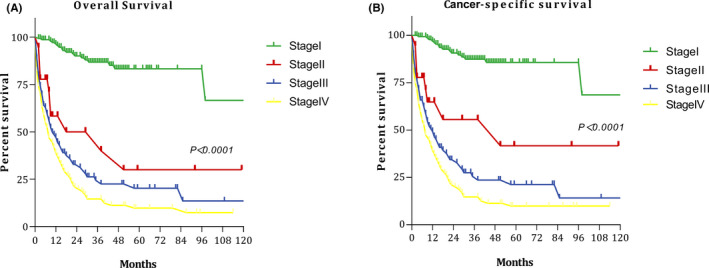
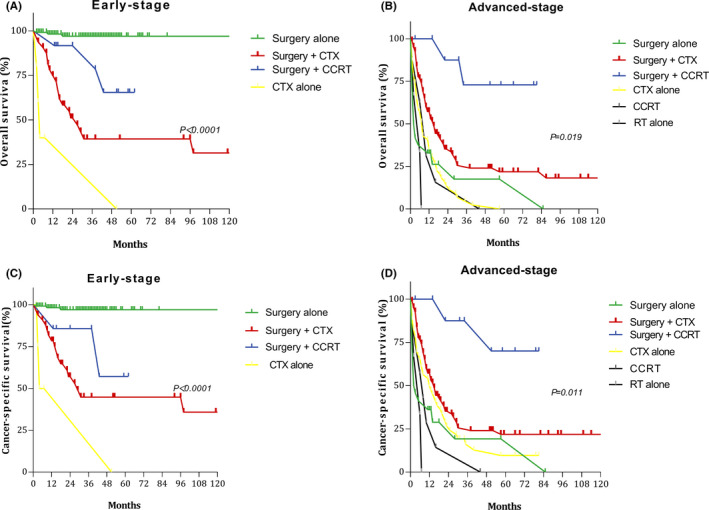
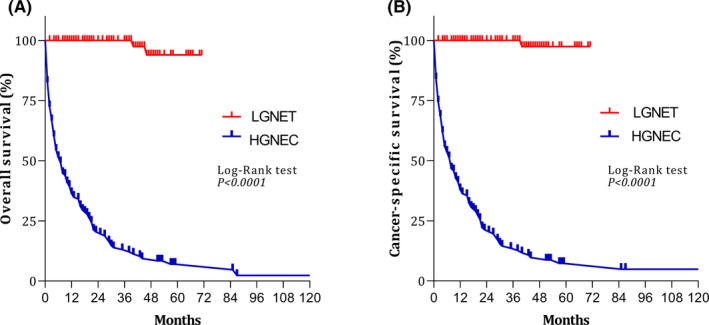
The 5-year OS rates were 83.3%, 30.0%, 20.3%, and 9.8% for patients in stages I (n = 159), II (n = 23), III (n = 101), and IV (n = 148), respectively. The 5-year CSS rates were 85.6%, 41.7%, 21.2%, and 9.8% for patients in stages I-IV, respectively. Age, American Joint Committee on Cancer (AJCC) stage, lymph node metastasis, treatment, and histological type were related to poor OS and CSS. In the early stage, the 5-year OS and CSS rates were 97.03% and 96.90%, respectively. For patients in the advanced stage receiving comprehensive treatment (surgery + chemotherapy + radiotherapy), the 5-year OS and CSS rates were 72.9% and 70.00%, respectively. When comparing low- and high-grade neuroendocrine carcinoma, 5-year OS rates were 93.96% and 7.01%, 5-year CSS rates were 97.44% and 7.31%, 10-year OS rates were 93.56% and 2.34%, and 10-year CSS rates were 97.44% and 4.88%, respectively.
Age, AJCC stage, treatment, and histological type are independent prognostic factors of ovarian NETs. OS and CSS are relatively good for early-stage cases treated with surgery alone, whereas more comprehensive treatment is required to improve OS and CSS in the advanced stage.
目前,卵巢神经内分泌肿瘤(NETs)尚无公认的一线治疗策略。此外,由于卵巢 NETs 的发病率较低,因此没有研究报告大样本得出的预后统计数据。本回顾性研究旨在探讨卵巢 NETs 的临床行为。
利用监测、流行病学和最终结果数据库,从 2004 年至 2015 年期间,确定诊断为卵巢 NETs 的女性。评估总生存率(OS)、癌症特异性生存率(CSS)和卵巢 NETs 的独立预后因素。还比较了不同治疗方法对预后的影响,以及组织学亚型的 OS 和 CSS 率。
Ⅰ期(n=159)、Ⅱ期(n=23)、Ⅲ期(n=101)和Ⅳ期(n=148)患者的 5 年 OS 率分别为 83.3%、30.0%、20.3%和 9.8%。Ⅰ-Ⅳ 期患者的 5 年 CSS 率分别为 85.6%、41.7%、21.2%和 9.8%。年龄、美国癌症联合委员会(AJCC)分期、淋巴结转移、治疗和组织学类型与不良 OS 和 CSS 相关。在早期阶段,5 年 OS 和 CSS 率分别为 97.03%和 96.90%。对于接受综合治疗(手术+化疗+放疗)的晚期患者,5 年 OS 和 CSS 率分别为 72.9%和 70.00%。比较低级别和高级别神经内分泌癌时,5 年 OS 率分别为 93.96%和 7.01%,5 年 CSS 率分别为 97.44%和 7.31%,10 年 OS 率分别为 93.56%和 2.34%,10 年 CSS 率分别为 97.44%和 4.88%。
年龄、AJCC 分期、治疗和组织学类型是卵巢 NETs 的独立预后因素。对于单独手术治疗的早期病例,OS 和 CSS 相对较好,而晚期则需要更全面的治疗以提高 OS 和 CSS。