University of Manitoba, Max Rady College of Medicine, Department of Medical Microbiology and Infectious Diseases, Winnipeg, Canada.
IHMA, Schaumburg, IL, USA.
Braz J Infect Dis. 2021 Nov-Dec;25(6):101647. doi: 10.1016/j.bjid.2021.101647. Epub 2021 Nov 10.
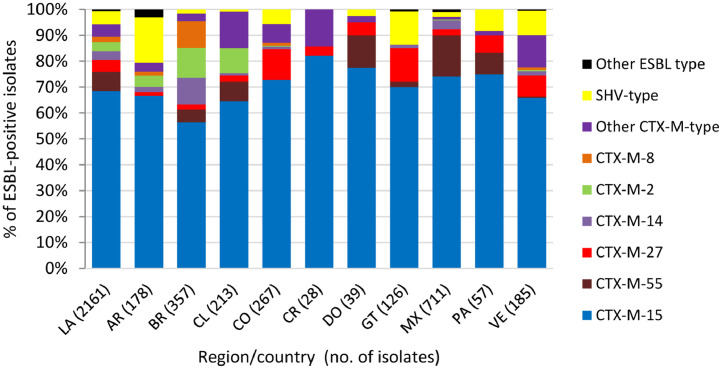
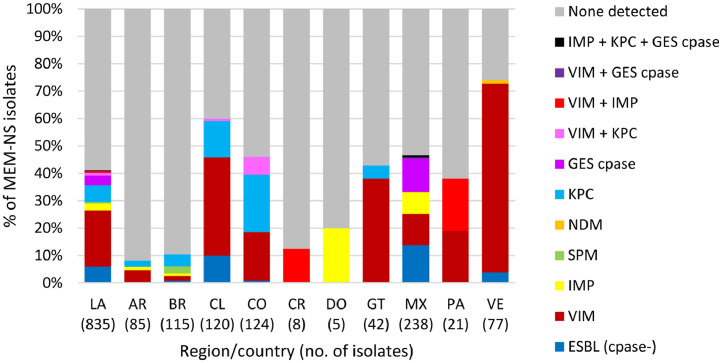
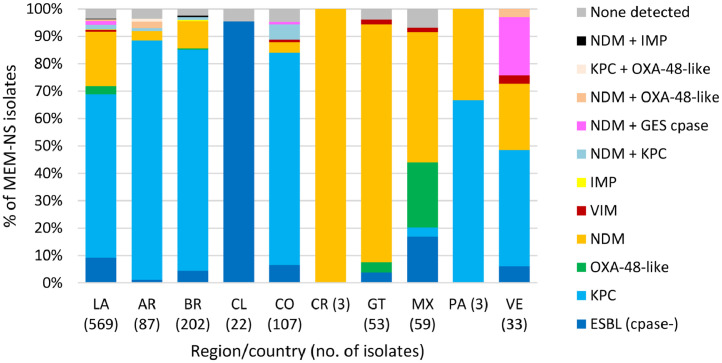
The Antimicrobial Testing Leadership and Surveillance (ATLAS) global surveillance program collected clinical isolates of Enterobacterales (n = 8416) and Pseudomonas aeruginosa (n = 2521) from 41 medical centers in 10 Latin American countries from 2017 to 2019. In vitro activities of ceftazidime-avibactam and comparators were determined using the Clinical and Laboratory Standards Institute (CLSI) broth microdilution method. Overall, 98.1% of Enterobacterales and 86.9% of P. aeruginosa isolates were susceptible to ceftazidime-avibactam. When isolates were analyzed by country of origin, susceptibility to ceftazidime-avibactam for Enterobacterales ranged from 97.8% to 100% for nine of 10 countries (except Guatemala, 86.3% susceptible) and from 75.9% to 98.4% for P. aeruginosa in all 10 countries. For Enterobacterales, 100% of AmpC-positive, ESBL- and AmpC-positive, GES-type carbapenemase-positive, and OXA-48-like-positive isolates were ceftazidime-avibactam-susceptible as were 99.8%, 91.8%, and 74.7% of ESBL-positive, multidrug-resistant (MDR), and meropenem-nonsusceptible isolates. Among meropenem-nonsusceptible isolates of Enterobacterales, 24.4% (139/570) carried a metallo-β-lactamase (MBL); 83.3% of the remaining meropenem-nonsusceptible isolates carried another class of carbapenemase and 99.4% of those isolates were ceftazidime-avibactam-susceptible. Among meropenem-non-susceptible isolates of P. aeruginosa (n = 835), 25.6% carried MBLs; no acquired β-lactamase was identified in the majority of isolates (64.8%; 87.2% of those isolates were ceftazidime-avibactam-susceptible). Overall, clinical isolates of Enterobacterales collected in Latin America from 2017 to 2019 were highly susceptible to ceftazidime-avibactam, including isolates carrying ESBLs, AmpCs, and KPCs. Country-specific variation in susceptibility to ceftazidime-avibactam was more common among isolates of P. aeruginosa than Enterobacterales. The frequency of MBL-producers among Enterobacterales from Latin America was low (1.7% of all isolates; 146/8,416), but higher than reported in previous surveillance studies.
抗微生物药物测试领导和监测(ATLAS)全球监测计划于 2017 年至 2019 年期间,从拉丁美洲 10 个国家的 41 个医疗中心收集了 8416 株肠杆菌科(Enterobacterales)和 2521 株铜绿假单胞菌(P. aeruginosa)的临床分离株。使用临床和实验室标准协会(CLSI)肉汤微量稀释法测定头孢他啶-阿维巴坦和对照药物的体外活性。总体而言,98.1%的肠杆菌科和 86.9%的铜绿假单胞菌分离株对头孢他啶-阿维巴坦敏感。按原产国分析分离株时,10 个国家中有 9 个国家(除危地马拉外,敏感率为 86.3%)的肠杆菌科对头孢他啶-阿维巴坦的敏感性为 97.8%至 100%,10 个国家的铜绿假单胞菌的敏感性为 75.9%至 98.4%。对于肠杆菌科,100%的 AmpC 阳性、ESBL 和 AmpC 阳性、GES 型碳青霉烯酶阳性、OXA-48 样阳性分离株对头孢他啶-阿维巴坦敏感,99.8%、91.8%和 74.7%的 ESBL 阳性、多重耐药(MDR)和美罗培南不敏感分离株对头孢他啶-阿维巴坦敏感。在肠杆菌科的美罗培南不敏感分离株中,24.4%(139/570)携带金属β-内酰胺酶(MBL);其余美罗培南不敏感分离株中,83.3%携带另一种碳青霉烯酶,这些分离株中 99.4%对头孢他啶-阿维巴坦敏感。在铜绿假单胞菌的美罗培南不敏感分离株(n=835)中,25.6%携带 MBL;大多数分离株未鉴定出获得性β-内酰胺酶(64.8%;这些分离株中 87.2%对头孢他啶-阿维巴坦敏感)。总体而言,2017 年至 2019 年拉丁美洲收集的肠杆菌科临床分离株对头孢他啶-阿维巴坦高度敏感,包括携带 ESBL、AmpC 和 KPC 的分离株。与肠杆菌科相比,铜绿假单胞菌对头孢他啶-阿维巴坦的敏感性在不同国家之间存在更大的差异。拉丁美洲肠杆菌科 MBL 生产者的频率较低(所有分离株的 1.7%;8416 株中的 146 株),但高于以前的监测研究报告的频率。