Huang Huang, Ye Guozhu, Lai Song-Qing, Zou Hua-Xi, Yuan Bin, Wu Qi-Cai, Wan Li, Wang Qun, Zhou Xue-Liang, Wang Wen-Jun, Cao Yuan-Ping, Huang Jian-Feng, Chen Shi-Li, Yang Bi-Cheng, Liu Ji-Chun
Department of Cardiac Surgery, The First Affiliated Hospital of Nanchang University, Nanchang, China.
Center for Excellence in Regional Atmospheric Environment and Key Laboratory of Urban Environment and Health, Institute of Urban Environment, Chinese Academy of Sciences, Xiamen, China.
Front Cardiovasc Med. 2021 Oct 28;8:757022. doi: 10.3389/fcvm.2021.757022. eCollection 2021.
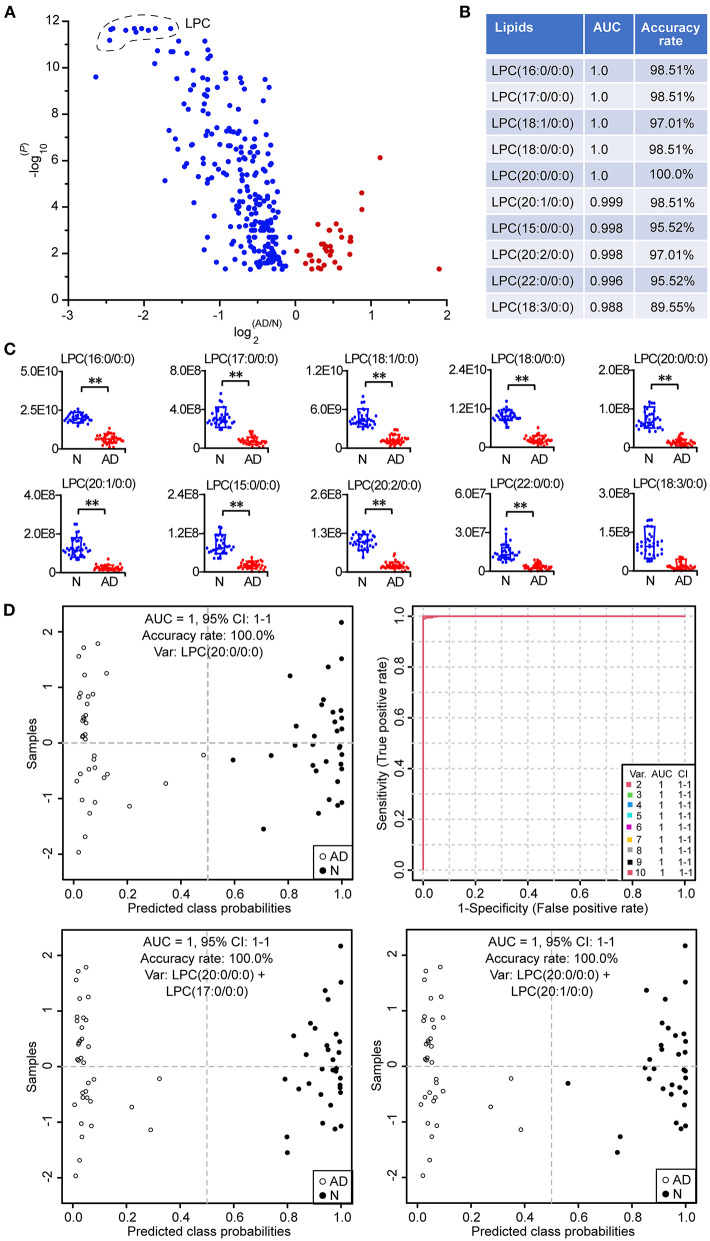
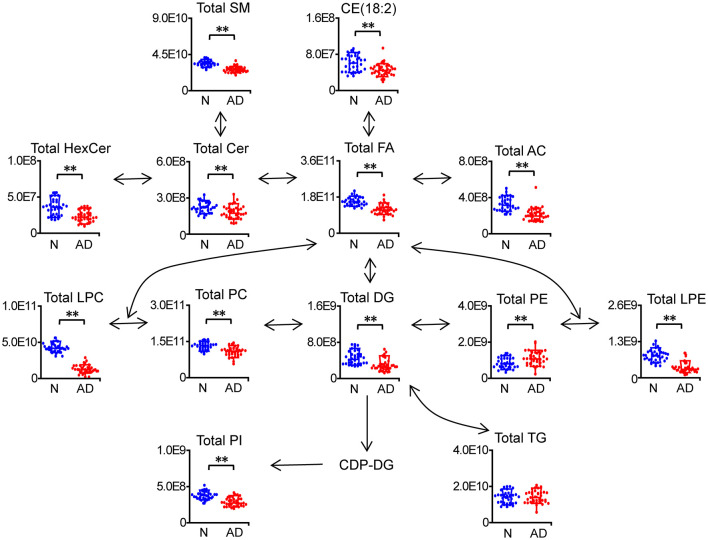
Aortic dissection (AD) is a catastrophic cardiovascular emergency with a poor prognosis, and little preceding symptoms. Abnormal lipid metabolism is closely related to the pathogenesis of AD. However, comprehensive lipid alterations related to AD pathogenesis remain unclear. Moreover, there is an urgent need for new or better biomarkers for improved risk assessment and surveillance of AD. Therefore, an untargeted lipidomic approach based on ultra-high-performance liquid chromatograph-mass spectrometry was employed to unveil plasma lipidomic alterations and potential biomarkers for AD patients in this study. We found that 278 of 439 identified lipid species were significantly altered in AD patients ( = 35) compared to normal controls ( = 32). Notably, most lipid species, including fatty acids, acylcarnitines, cholesteryl ester, ceramides, hexosylceramides, sphingomyelins, lysophosphatidylcholines, lysophosphatidylethanolamines, phosphatidylcholines, phosphatidylinositols, diacylglycerols, and triacylglycerols with total acyl chain carbon number ≥54 and/or total double bond number ≥4 were decreased, whereas phosphatidylethanolamines and triacylglycerols with total double bond number <4 accumulated in AD patients. Besides, the length and unsaturation of acyl chains in triacylglycerols and unsaturation of 1-acyl chain in phosphatidylethanolamines were decreased in AD patients. Moreover, lysophosphatidylcholines were the lipids with the largest alterations, at the center of correlation networks of lipid alterations, and had excellent performances in identifying AD patients. The area under the curve of 1.0 and accuracy rate of 100% could be easily obtained by lysophosphatidylcholine (20:0/0:0) or its combination with lysophosphatidylcholine (17:0/0:0) or lysophosphatidylcholine (20:1/0:0). This study provides novel and comprehensive plasma lipidomic signatures of AD patients, identifies lysophosphatidylcholines as excellent potential biomarkers, and would be beneficial to the pathogenetic study, risk assessment and timely diagnosis and treatment of AD.
主动脉夹层(AD)是一种预后不良的灾难性心血管急症,且前期症状较少。脂质代谢异常与AD的发病机制密切相关。然而,与AD发病机制相关的全面脂质变化仍不清楚。此外,迫切需要新的或更好的生物标志物来改善AD的风险评估和监测。因此,本研究采用基于超高效液相色谱 - 质谱联用的非靶向脂质组学方法,以揭示AD患者的血浆脂质组变化和潜在生物标志物。我们发现,与正常对照组(n = 32)相比,在AD患者(n = 35)中,439种已鉴定的脂质中有278种发生了显著变化。值得注意的是,大多数脂质,包括脂肪酸、酰基肉碱、胆固醇酯、神经酰胺、己糖神经酰胺、鞘磷脂、溶血磷脂酰胆碱、溶血磷脂酰乙醇胺、磷脂酰胆碱、磷脂酰肌醇、二酰基甘油和总酰基链碳原子数≥54和/或总双键数≥4的三酰基甘油减少,而总双键数<4的磷脂酰乙醇胺和三酰基甘油在AD患者中积累。此外,AD患者中三酰基甘油的酰基链长度和不饱和度以及磷脂酰乙醇胺中1 - 酰基链的不饱和度降低。此外,溶血磷脂酰胆碱是变化最大的脂质,处于脂质变化相关网络的中心,在识别AD患者方面具有出色表现。通过溶血磷脂酰胆碱(20:0/0:0)或其与溶血磷脂酰胆碱(17:0/0:0)或溶血磷脂酰胆碱(20:1/0:0)的组合,可轻松获得曲线下面积为1.0且准确率为100%的结果。本研究提供了AD患者新的、全面的血浆脂质组特征,将溶血磷脂酰胆碱鉴定为优秀的潜在生物标志物,这将有助于AD的发病机制研究、风险评估以及及时的诊断和治疗。