Nkomo Larian M, Daniel Ben K, Butson Russell J
Higher Education Development Centre, University of Otago, Dunedin, 9016 New Zealand.
Int J Educ Technol High Educ. 2021;18(1):34. doi: 10.1186/s41239-021-00270-1. Epub 2021 Jun 30.
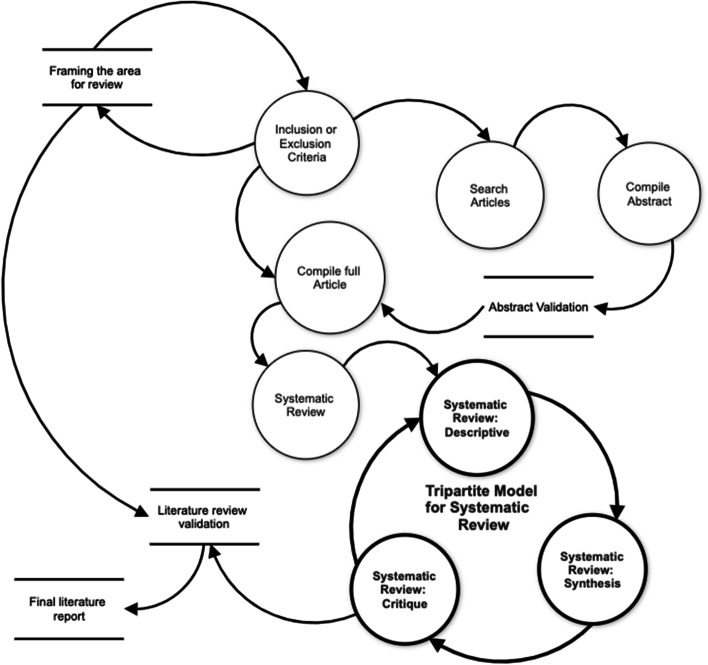
Restrictions on physical gathering due to COVID-19 has compelled higher education institutions to rapidly embrace digital technologies to support teaching and learning. While logistically, the use of digital technologies offers an obvious solution, attention must be given to these methods' pedagogical appropriateness, mainly how students engage and learn in the spaces supported by these technologies. In this context, we explored the degree to which digital technologies have contributed to teaching and learning practices over the past decade. The study employed a systematic review using a newly developed tripartite model for conducting and presenting literature review reports. The model approaches the literature review process systematically and employs three phases for the critical examination of literature: description, synthesis, and critique. The current review focused on student engagement across technologies that encompass social media, video, and collaborative learning technologies. Relevant articles were obtained from the Scopus and Web of Science databases. Three core themes were identified: there was no shared understanding of what constitutes student engagement with learning technologies, there was a lack of explanation concerning the contextual variation and modalities of student engagement across the digital technologies, and self-reporting was the primary method of measuring student engagement, rendering results as perceptual rather than behavioural. We argue that using multiple datasets and different methodological approaches can provide further insights into student engagement with digital technologies. This approach to measuring engagement can substantiate findings and most likely provide additional insights into students' engagement with digital technologies.
由于新冠疫情对线下聚集的限制,高等教育机构不得不迅速采用数字技术来支持教学。从后勤角度来看,数字技术的使用提供了一个显而易见的解决方案,但必须关注这些方法在教学上的适用性,尤其是学生在这些技术所支持的空间中的参与方式和学习情况。在此背景下,我们探讨了在过去十年中数字技术对教学实践的贡献程度。该研究采用了一种新开发的三方模型进行系统综述,以撰写和展示文献综述报告。该模型系统地处理文献综述过程,并采用三个阶段对文献进行批判性审视:描述、综合和批判。当前的综述聚焦于涵盖社交媒体、视频和协作学习技术在内的各类技术中的学生参与情况。相关文章从Scopus和科学网数据库中获取。确定了三个核心主题:对于什么构成学生对学习技术的参与,没有达成共识;对于数字技术中学生参与的情境差异和方式,缺乏解释;自我报告是衡量学生参与的主要方法,导致结果是基于感知而非行为的。我们认为,使用多个数据集和不同的方法可以进一步深入了解学生对数字技术的参与情况。这种衡量参与度的方法可以证实研究结果,并很可能为学生对数字技术的参与提供更多见解。