Department of Cardiology, Cardiology I, University Medical Center Mainz (Johannes Gutenberg-University Mainz), Mainz, Germany.
German Center for Cardiovascular Research (DZHK), Partner Site Rhine Main, Mainz, Germany.
J Diabetes Investig. 2022 Apr;13(4):725-737. doi: 10.1111/jdi.13710. Epub 2021 Dec 1.
AIMS/INTRODUCTION: In patients with pulmonary embolism (PE), the impact of diabetes mellitus on patient profile and outcome is not well investigated.
The German nationwide inpatient sample of the years 2005-2018 was analyzed. Hospitalized PE patients were stratified for diabetes, and the impact of diabetes on in-hospital events was investigated.
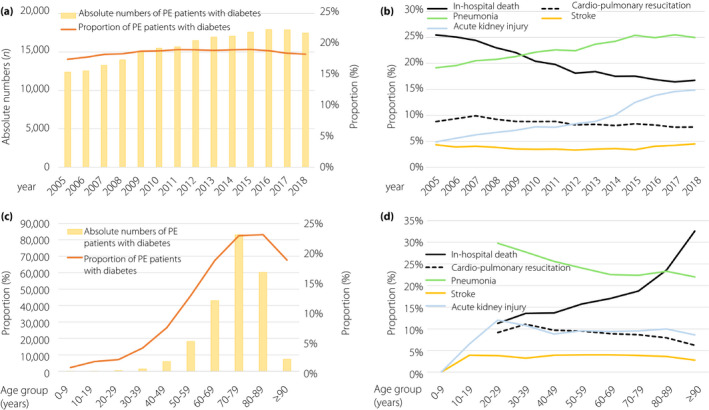
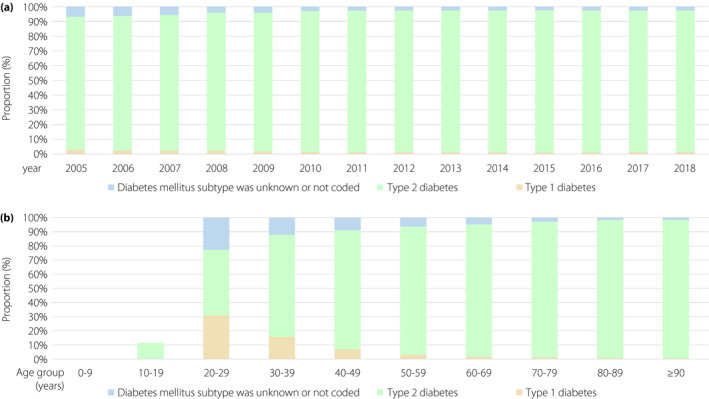
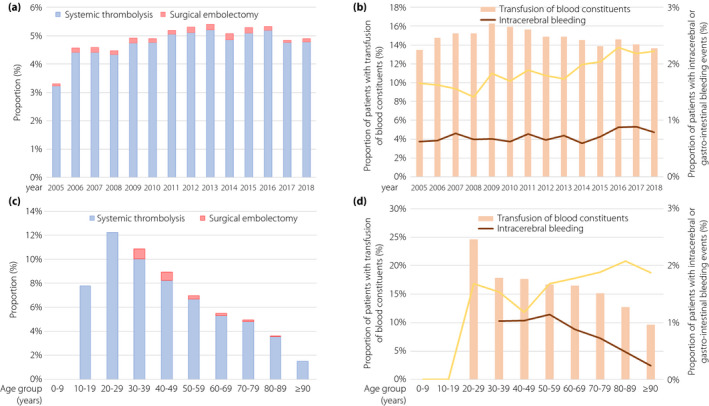
Overall, 1,174,196 PE patients (53.8% aged ≥70 years, 53.5% women) and, among these, 219,550 (18.7%) diabetes patients were included. In-hospital mortality rate amounted to 15.8%, and was higher in diabetes patients than in non-diabetes patients (19.8% vs 14.8%, P < 0.001). PE patients with diabetes had a higher prevalence of cardiovascular risk factors, comorbidities, right ventricular dysfunction (31.8% vs 27.7%, P < 0.001), prolonged in-hospital stay (11.0 vs 9.0 days, P < 0.001) and higher rates of adverse in-hospital events. Remarkably, diabetes was independently associated with increased in-hospital mortality (odds ratio [OR] 1.21, 95% confidence interval [CI] 1.20-1.23, P < 0.001) when adjusted for age, sex and comorbidities. Within the observation period of 2005-2018, a relevant decrease of in-hospital mortality in PE patients with diabetes was observed (25.5% to 16.8%). Systemic thrombolysis was more often administered to diabetes patients (OR 1.18, 95% CI 1.01-3.49, P < 0.001), and diabetes was associated with intracerebral (OR 1.19, 95% CI 1.12-1.26, P < 0.001), as well as gastrointestinal bleeding (OR 1.11, 95% CI 1.07-1.15, P < 0.001). Type 1 diabetes mellitus was shown to be a strong risk factor in PE patients for shock, right ventricular dysfunction, cardiopulmonary resuscitation and in-hospital death (OR 1.75, 95% CI 1.61-1.90, P < 0.001).
Despite the progress in diabetes treatments, diabetes is still associated with an unfavorable clinical patient profile and higher risk for adverse events, including substantially increased in-hospital mortality in acute PE.
目的/引言:在肺栓塞(PE)患者中,糖尿病对患者特征和结局的影响尚未得到充分研究。
分析了 2005 年至 2018 年德国全国住院患者样本。将住院的 PE 患者按糖尿病分层,并研究糖尿病对住院期间事件的影响。
总体而言,纳入了 1174196 例 PE 患者(≥70 岁者占 53.8%,女性占 53.5%),其中 219550 例(18.7%)为糖尿病患者。住院期间死亡率为 15.8%,糖尿病患者高于非糖尿病患者(19.8%比 14.8%,P<0.001)。患有糖尿病的 PE 患者心血管危险因素、合并症和右心室功能障碍的发生率更高(31.8%比 27.7%,P<0.001),住院时间延长(11.0 天比 9.0 天,P<0.001),不良住院期间事件发生率更高。值得注意的是,在调整年龄、性别和合并症后,糖尿病与住院期间死亡率增加独立相关(比值比[OR] 1.21,95%置信区间[CI] 1.20-1.23,P<0.001)。在 2005-2018 年的观察期间,糖尿病 PE 患者的住院期间死亡率显著下降(从 25.5%降至 16.8%)。糖尿病患者更常接受全身溶栓治疗(OR 1.18,95%CI 1.01-3.49,P<0.001),糖尿病与颅内出血(OR 1.19,95%CI 1.12-1.26,P<0.001)和胃肠道出血(OR 1.11,95%CI 1.07-1.15,P<0.001)相关。1 型糖尿病被证明是 PE 患者休克、右心室功能障碍、心肺复苏和住院死亡的强烈危险因素(OR 1.75,95%CI 1.61-1.90,P<0.001)。
尽管糖尿病治疗取得了进展,但糖尿病仍与不良临床患者特征和不良事件风险增加相关,包括急性 PE 患者的住院死亡率显著增加。