Department of Medicine, University of Mississippi School of Medicine, Jackson (J.B., T.J.S.).
National and Kapodistrian University of Athens School of Medicine, Athens University Hospital Attikon, Greece (G.F.).
Circulation. 2022 Jan 18;145(3):184-193. doi: 10.1161/CIRCULATIONAHA.121.057812. Epub 2021 Nov 15.
Patients with heart failure with preserved ejection fraction have significant impairment in health-related quality of life. In the EMPEROR-Preserved trial (Empagliflozin Outcome Trial in Patients With Chronic Heart Failure With Preserved Ejection Fraction), we evaluated the efficacy of empagliflozin on health-related quality of life in patients with heart failure with preserved ejection fraction and whether the clinical benefit observed with empagliflozin varies according to baseline health status.
Health-related quality of life was measured with the Kansas City Cardiomyopathy Questionnaire (KCCQ) at baseline and 12, 32, and 52 weeks. Patients were divided by baseline KCCQ Clinical Summary Score (CSS) tertiles, and the effect of empagliflozin on outcomes was examined. The effect of empagliflozin on KCCQ-CSS, Total Symptom Score, and Overall Summary Score was evaluated. Responder analyses were performed to compare the odds of improvement and deterioration in KCCQ related to treatment with empagliflozin.
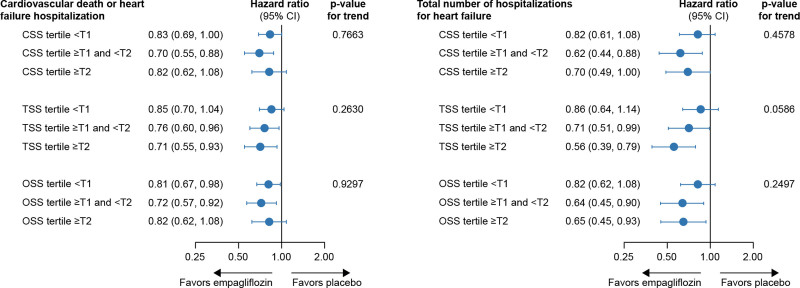
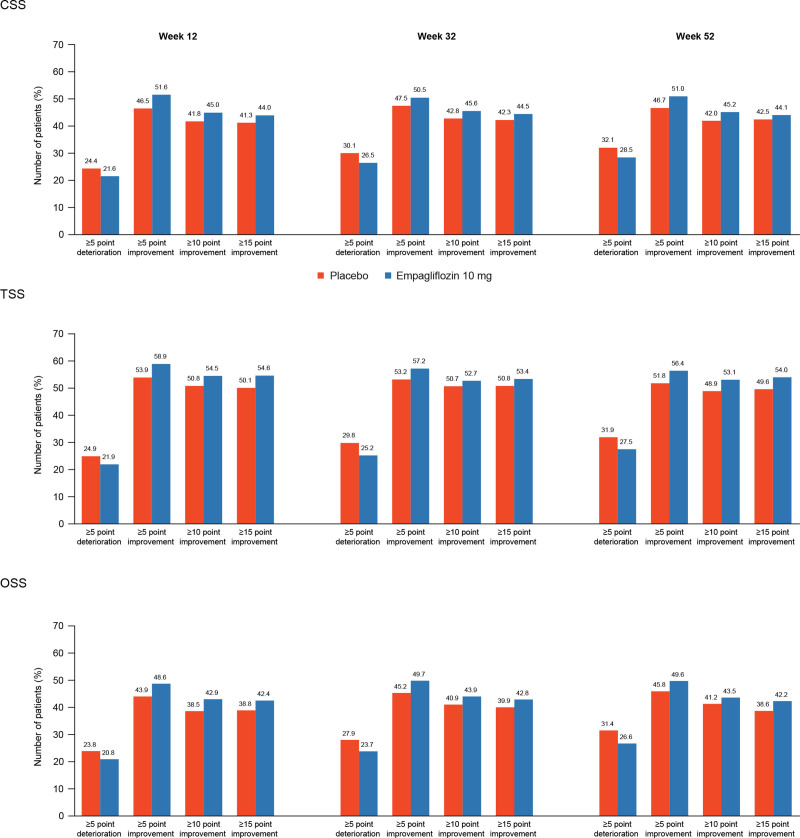
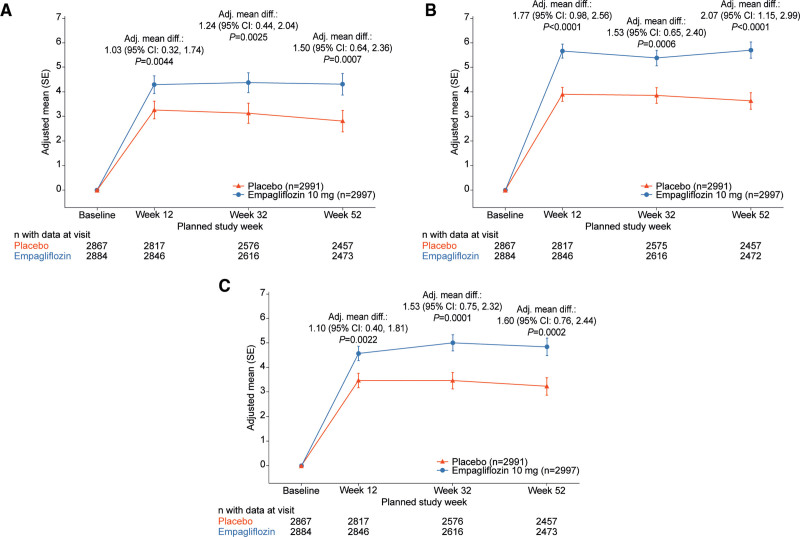
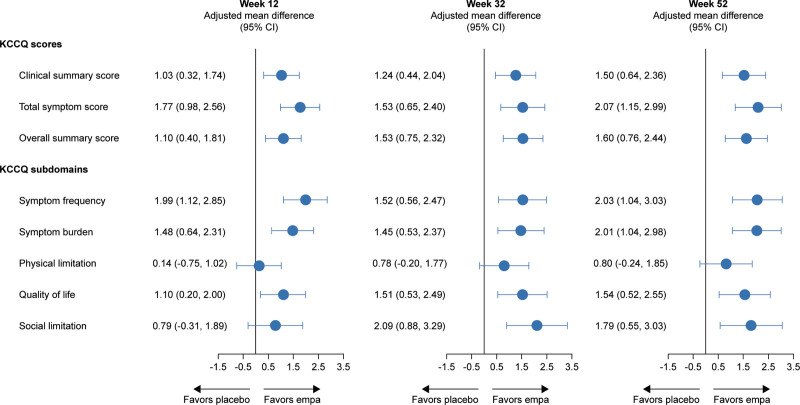
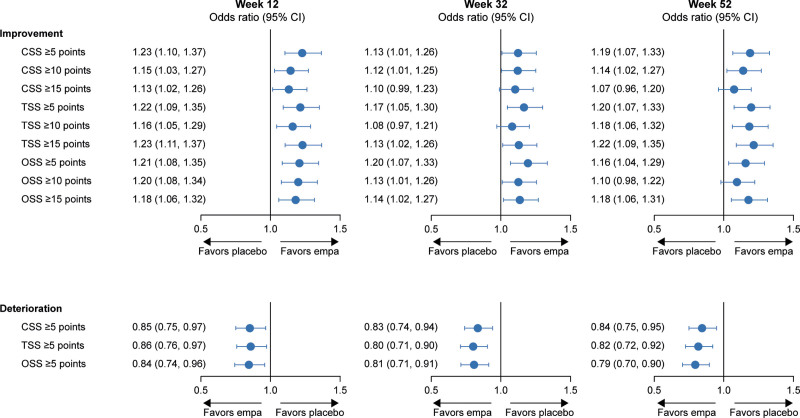
The effect of empagliflozin on reducing the risk of time to cardiovascular death or heart failure hospitalization was consistent across baseline KCCQ-CSS tertiles (hazard ratio, 0.83 [95% CI, 0.69-1.00], 0.70 [95% CI, 0.55-0.88], and 0.82 [95% CI, 0.62-1.08] for scores <62.5, 62.5-83.3, and ≥83.3, respectively; trend=0.77). Similar results were seen for total heart failure hospitalizations. Patients treated with empagliflozin had significant improvement in KCCQ-CSS versus placebo (+1.03, +1.24, and +1.50 at 12, 32, and 52 weeks, respectively; <0.01); similar results were seen for Total Symptom Score and Overall Summary Score. At 12 weeks, patients on empagliflozin had higher odds of improvement ≥5 points (odds ratio, 1.23 [95% CI, 1.10-1.37]), ≥10 points (odds ratio, 1.15 [95% CI, 1.03-1.27]), and ≥15 points (odds ratio, 1.13 [95% CI, 1.02-1.26]) and lower odds of deterioration ≥5 points in KCCQ-CSS (odds ratio, 0.85 [95% CI, 0.75-0.97]). A similar pattern was seen at 32 and 52 weeks, and results were consistent for Total Symptom Score and Overall Summary Score.
In patients with heart failure with preserved ejection fraction, empagliflozin reduced the risk for major heart failure outcomes across the range of baseline KCCQ scores. Empagliflozin improved health-related quality of life, an effect that appeared early and was sustained for at least 1 year. Registration: URL: https://www.clinicaltrials.gov; Unique identifier: NCT03057951.
射血分数保留的心力衰竭患者的健康相关生活质量有显著的损害。在 EMPEROR-Preserved 试验(依帕列净在射血分数保留的慢性心力衰竭患者中的疗效试验)中,我们评估了依帕列净对射血分数保留的心力衰竭患者健康相关生活质量的疗效,以及依帕列净观察到的临床获益是否因基线健康状况而异。
健康相关生活质量采用堪萨斯城心肌病问卷(KCCQ)在基线和 12、32 和 52 周进行测量。根据基线 KCCQ 临床综合评分(CSS)三分位数对患者进行分组,并检查依帕列净对结局的影响。评估依帕列净对 KCCQ-CSS、总症状评分和总体综合评分的影响。进行应答分析,比较依帕列净治疗与 KCCQ 相关的改善和恶化的几率。
依帕列净降低心血管死亡或心力衰竭住院风险的效果在基线 KCCQ-CSS 三分位数之间是一致的(风险比,0.83 [95%CI,0.69-1.00]、0.70 [95%CI,0.55-0.88]和 0.82 [95%CI,0.62-1.08],评分分别为 <62.5、62.5-83.3 和 ≥83.3;趋势=0.77)。总心力衰竭住院的结果类似。与安慰剂相比,依帕列净治疗的患者 KCCQ-CSS 显著改善(12、32 和 52 周时分别为+1.03、+1.24 和+1.50;<0.01);总症状评分和总体综合评分也有类似的结果。在 12 周时,依帕列净治疗的患者改善≥5 分(优势比,1.23 [95%CI,1.10-1.37])、≥10 分(优势比,1.15 [95%CI,1.03-1.27])和≥15 分(优势比,1.13 [95%CI,1.02-1.26])的几率更高,而 KCCQ-CSS 恶化≥5 分的几率更低(优势比,0.85 [95%CI,0.75-0.97])。在 32 和 52 周时也有类似的模式,总症状评分和总体综合评分的结果一致。
在射血分数保留的心力衰竭患者中,依帕列净降低了主要心力衰竭结局的风险,跨越了基线 KCCQ 评分的范围。依帕列净改善了健康相关的生活质量,这种效果在早期出现,并持续至少 1 年。注册:网址:https://www.clinicaltrials.gov;唯一标识符:NCT03057951。